










CrowdStrike's business chief: "We're long on Israel and we're not going anywhere"
The cybersecurity giant has continued acquiring Israeli startups through the war with Iran and now employs more than 500 people in the country. Chief Business Officer Daniel Bernard says partnerships, rather than acquisitions, are the main opportunity for local startups, while warning that AI is making strong products easier to replicate.
CrowdStrike's Chief Business Officer Daniel Bernard says the cyber giant kept buying in Israel through the war with Iran, sees partnering as "the rule" and acquisitions as "the exception," and warns that in the AI era go-to-market matters more than product.
CrowdStrike now employs more than 500 people in Israel, and the executive who oversees its partnerships says the war with Iran never made the company think twice about investing here.
"When the right companies come around, we still acquire those companies because we're long on the country and we're not worried about the geopolitical," Daniel Bernard, CrowdStrike's Chief Business Officer, told CTech during Tel Aviv University's Cyber & AI Week. "Obviously we're citizens of the world and we're aware of the geopolitical risks. At the same time, the talent, the opportunity, and the resolve of the local community, we're all in and we're not going anywhere."
1 View gallery
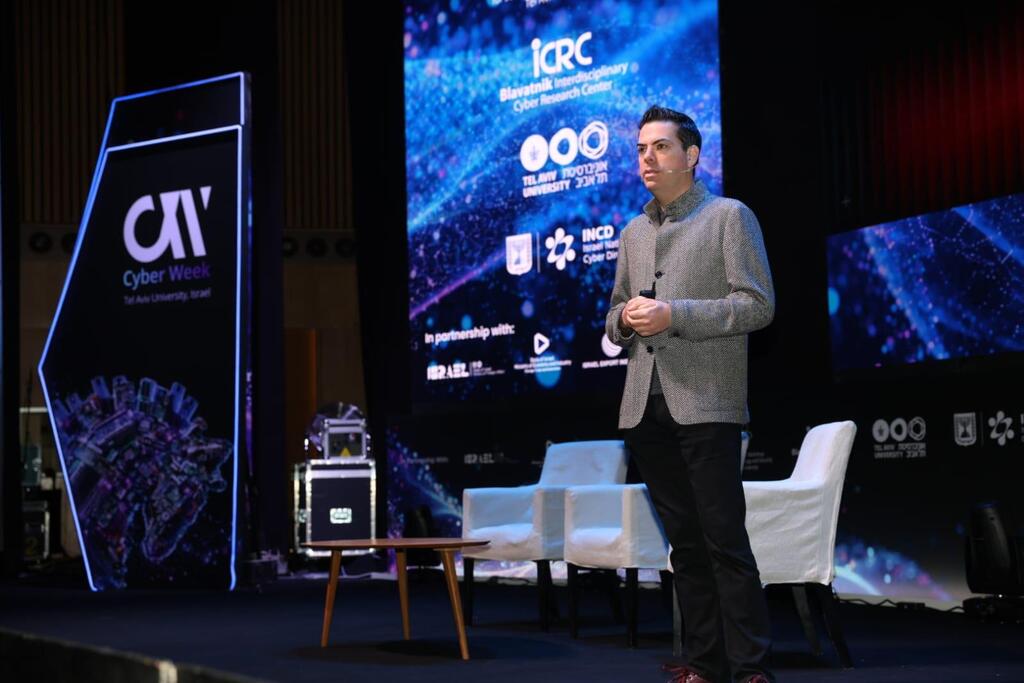
CrowdStrike CBO Daniel Bernard presenting during Cyber Week 2026.
(Photo: Chen Galili)
Bernard, who joined CrowdStrike in early 2023 after four years as CMO of rival SentinelOne, runs the company's channel, alliances and partnerships. CrowdStrike has bought six Israeli companies since 2020: Preempt Security, Reposify, Bionic, Flow Security, Adaptive Shield and, in January, browser security startup Seraphic Security, in a deal estimated at about $400 million. That puts its Israeli acquisitions and venture investments at over $1 billion.
"We have hundreds of employees over here, north of 500 employees," Bernard said. "We're one of the largest non-Israeli cybersecurity employers here." He described the local team as "a very resilient bunch," adding: "We're really proud of our Israel team and it grows every week."
Most of CrowdStrike's Israeli purchases were young companies with small teams. Bernard said that is by design. "We really look at team and tech really in that order," he said. "These are mostly technology and team buys versus holistic businesses, because a lot of them are pretty early. But we have a really good track record and a playbook of how we integrate these companies and build them into $100 million plus ARR businesses very rapidly." He named Preempt, CrowdStrike's first Israeli acquisition, as the template, with Adaptive Shield as the most recent example.
In October, CTech reported that CrowdStrike was in advanced talks to acquire Israeli data security startup Orion Security for about $500 million. Asked about it, Bernard said: "We didn't buy Orion."
On whether competition from Palo Alto Networks, Google and others is inflating Israeli valuations, Bernard pointed instead at venture capital. "I think the larger driver of upward mobility and valuations is probably the VC market," he said. His pitch to founders is that CrowdStrike is "cybersecurity's largest startup" and a pure-play security company. "Do you want to join a conglomerate where you're part of a security business that's a part of a search business?" he asked, in an apparent reference to Google, which agreed last year to buy Israeli-founded Wiz.
Acquired teams become modules on Falcon, CrowdStrike's platform, which Bernard said now runs "35 plus" of them. "We want each one to have the latitude to innovate, to have their own roadmap," he said. "You get the velocity and the agility of a startup with the investment and the scale and the impact of a much larger company."
For most Israeli startups, Bernard said, the realistic relationship with CrowdStrike is not an exit. "We partner with thousands and thousands and thousands of them. So partnering is more of the rule. Acquisition is the exception," he said. He described CrowdStrike as "the operating system of cybersecurity," with its own modules at the core and third-party tools built around it, much like apps on Windows or macOS.
"I don't look at the success metric of how many acquisitions have we done in Israel, although that's wonderful," he said. The goal is to get companies integrated with Falcon so they can sell to CrowdStrike's customers.
Bernard spent four years marketing an Israeli-founded company, and he has a blunt read on where Israeli founders have struggled. "Israeli companies generally have been very product focused and technology focused," he said, speaking generally rather than about SentinelOne. "I think that is something historically that Israeli companies have gotten wrong. They haven't understood how to take the magic of here and go build very successful businesses across the US, Europe, and Asia."
AI raises the stakes, he argued, because features are now easy to copy. "Your best feature can be replicated by other people very, very quickly with AI," he said. What can't be copied is customer trust: being the vendor a company calls after a breach, or the one its insurer brings in. "An agent doesn't build trust, an agent can build code, an agent can make you a reservation at a restaurant," he said. "I have not seen agents yet build trust with a customer that results in a sale."
His advice is a budgeting one. "When you raise a round, don't just hire all the people in R&D," he said. Founders should set aside money to hire "A-plus talent in other markets," let decisions be made outside headquarters, and "invest appropriately in marketing and building a brand." He said Israeli startups have improved on this over the past four to five years. "These are all concepts that were pretty taboo and foreign in the past."
Bernard also said that a "vast majority" of the companies in CrowdStrike's startup accelerator come from Israel, and that the company's venture arm, Falcon Fund, invests in many Israeli startups. "We continue to hire here. We continue to acquire here. We continue to partner here," he said.



