










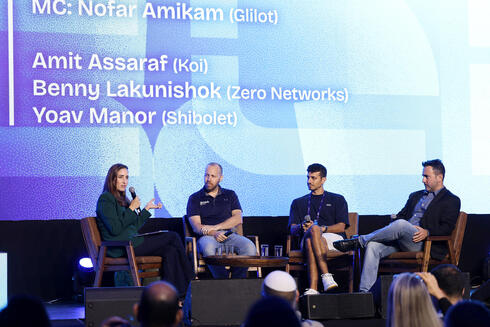
“Defenders are years behind attackers, and the toughest challenges are still ahead”
Amit Assaraf, CEO of Koi, acquired by Palo Alto Networks, warns that AI is widening the cybersecurity challenge, while industry leaders debate whether defenders can catch up and how the technology will reshape startups and acquisition deals.
Artificial intelligence is changing the cybersecurity landscape, giving attackers more powerful tools and enabling them to move faster, while creating new opportunities for companies developing defensive technologies. Will defenders manage to close the gap, or will attackers retain the advantage?
At the Tech1 conference, hosted by Calcalist and Live Nation, Nofar Amikam, a partner at Glilot Capital Partners; Amit Assaraf, co-founder and CEO of Koi, which was acquired by Palo Alto Networks; Benny Lakunishok, founder and CEO of Zero Networks; and Yoav Manor, a partner at law firm Shibolet, discussed the emerging AI arms race, its implications for the cybersecurity industry, and how the technology is reshaping the mergers and acquisitions market.
1 View gallery
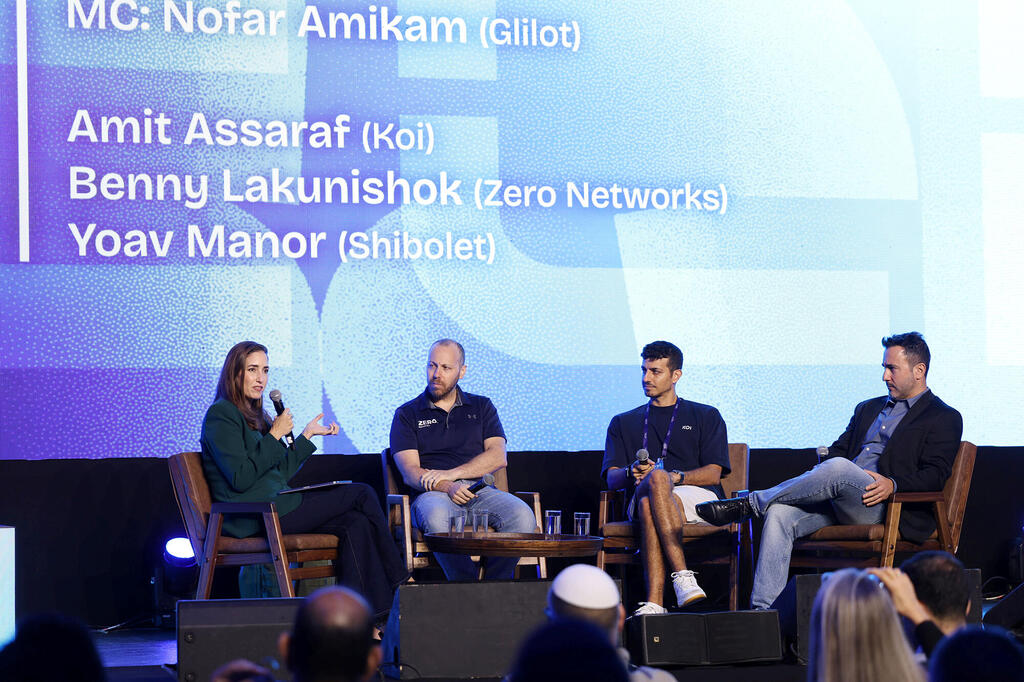
TECH1 2026 Conference panel. From right: Yoav Manor (Shibolet), Amit Assaraf (Koi), Benny Lakunishok (Zero Networks), and Nofar Amikam (Glilot).
(Photo: Orel Cohen)
Nofar Amikam: The cybersecurity landscape has long been defined by an arms race between attackers and defenders. With the advent of artificial intelligence, the pace is changing. Who will move faster in the coming years, the attackers or the defenders?
Benny Lakunishok: "I believe the defenders will win in the long run, but in the short term, the attackers have the advantage. They have extremely powerful tools. On the other hand, chief information security officers, or CISOs, are much better prepared today than they were in the past. I expect a few difficult years, but within a few years, the defenders will manage to gain the upper hand."
Amit Assaraf: "I believe the situation is far more dangerous than we realize. In large organizations, protecting every system is extremely difficult. We are playing a new and highly problematic game. In terms of capabilities, defenders are years behind attackers, and the toughest challenges are still ahead. The encouraging side is that there is now greater awareness of the risk, which makes me optimistic about the future."
Nofar Amikam: Early on, there were significant concerns about the capabilities of AI models, particularly the possibility that they could be used to launch sophisticated cyberattacks. It later became clear that the technology could also create opportunities. Were those initial concerns exaggerated?
Benny Lakunishok: "I believe AI represents an opportunity and that the apocalyptic predictions were overblown. The technology can be used to build many powerful things, but there is a huge difference between developing a tool and building an entire company around it. Just because something can be developed relatively easily with AI does not mean it can become the basis of a successful business.
"The idea that AI tools could bring down any system is inaccurate. Cybersecurity technologies are highly complex, and AI will not replace them overnight."
Nofar Amikam: Amit, what do these changes mean for cybersecurity companies? Are they a threat to the industry or an opportunity to build new businesses?
Amit Assaraf: "It is a very interesting time to start a cybersecurity company. Strategies that worked in the past are not necessarily relevant today. The biggest challenge for entrepreneurs is to adapt quickly to the new reality and keep up with the pace of change.
"Every organization has vulnerabilities and needs agents and tools that can identify them and stop attacks. I agree with Benny that there were significant concerns initially about the impact of artificial intelligence, but I see a major opportunity for the cybersecurity industry. In my view, the sector is set to grow substantially in the coming years."
Nofar Amikam: Yoav, are you seeing more transactions in this area? How are technological changes affecting the M&A market?
Yoav Manor: "There are many opportunities, but buyers are more selective today. Not every buyer is looking for a huge company. Sometimes they are interested in a specific team or technology that can be integrated into their existing operations.
"On the one hand, we are seeing huge deals. On the other, the question is what happens to companies in the middle: those that are not big enough to attract the largest buyers but do not necessarily have unique technology that would make them acquisition targets. This is a significant challenge for many companies."
Nofar Amikam: Cybersecurity managers face a dilemma. Organizations want to introduce AI agents to accelerate work and automate processes, but every new connection can create security vulnerabilities. How should they manage this tension?
Amit Assaraf: "This was a problem even before the age of artificial intelligence. Organizations have always had to decide how much access to grant to their systems to allow the business to operate while maintaining security.
"The key is to have good visibility into what is happening across the organization. No organization is 100% protected, so security must also be considered from the operator's point of view."
Nofar Amikam: Yoav, if organizations try to resolve the security issues arising from AI agents too quickly, they risk disrupting business operations. If they fail to address those issues, they expose themselves to new risks. How can they strike the right balance?
Yoav Manor: "It is a matter of checks and balances. You need to ensure that a product performs as intended and that customers understand the permissions they are granting it and the capabilities it has. You also need to determine where human oversight is necessary, who is responsible for the system, and which actions require human involvement.
"I expect senior management to become increasingly involved in decisions about integrating AI systems. These decisions will no longer be the sole responsibility of technology or information security teams. They will become broader organizational decisions."
Benny Lakunishok: "I will admit that I approach this topic with a tendency to take risks, and I believe there is a valid case for doing so. There will always be vulnerabilities and risks, but in my view, the opportunity justifies the risk."
Amit Assaraf: "CISOs must recognize that a security breach is a genuine possibility and prepare accordingly. Alongside investments in prevention, they need to invest much more heavily in their ability to recover from cyber incidents."
Nofar Amikam: Over the past year, we have seen major cybersecurity deals, including the acquisitions of Armis and Wiz. At the same time, many transactions have taken place at much lower valuations, in the hundreds of millions of dollars. Are we likely to see more exits of this scale, or will mega-deals dominate the market?
Yoav Manor: "First of all, an exit should not be the goal in itself. Founders should focus on building strong companies, and opportunities to sell may arise along the way. It is also worth remembering that an average figure, say around $200 million, can be misleading. We will see a mix of smaller deals and very large exits.
"I believe we will see plenty of transactions, but they will vary significantly in size. Some companies will be sold for relatively modest sums, others will be involved in major deals, and some will continue to grow independently."
Nofar Amikam: Amit, what advice would you give an entrepreneur starting a cybersecurity company today who wants to succeed and perhaps eventually sell the business?
Amit Assaraf: "We founded Koi before artificial intelligence became the phenomenon it is today, and we wrote the code ourselves. Entrepreneurs starting out now need to think differently. They cannot rely on the traditional approach to building a cybersecurity company because the reality has changed.
"They need to think about how to move faster and establish a competitive advantage in a short period of time. I expect to see many smaller funding rounds alongside rapid acquisitions. At the same time, some companies will succeed in scaling up into large, significant businesses. The key is speed, adaptability and an understanding of how the market is changing."
Benny Lakunishok: "I agree with Amit, but it depends on the type of company you want to build. Artificial intelligence may change the world, but there will still be a strong need for human knowledge and expertise. Not everything that can be developed using AI can be turned into a product that supports a successful business."
Yoav Manor: "An entrepreneur may start out in one place and end up somewhere entirely different. It is therefore important to be prepared for change, recognize when the market is shifting, and adapt the company to the new reality."
Nofar Amikam: To wrap up, if we meet here again in five years, who will have the advantage: the Red Team, representing attackers, or the Blue Team, representing defenders?
Benny Lakunishok: "The Blue Team."
Amit Assaraf: "The Red Team."
Yoav Manor: "The Red Team. Attackers need to find only one vulnerability in a system, while defenders have to protect the entire thing."



