










Why a $60 million order mattered more than a $35 billion deal
Inside the valuation gap between NextVision and NewMed.
Just earlier this week, they were valued identically. One earned $72 million this year; the other earned 4.5 times more, with revenues 5.3 times higher. The first is NextVision, a manufacturer of cameras for drones and UAVs. The second is NewMed Energy, the gas partnership controlled by the Delek Group, owned by Yitzhak Tshuva, which holds, among other assets, a 40% stake in the Leviathan natural gas field, Israel’s largest.
At the start of the week, the two companies were trading at the same market value of roughly NIS 22.5 billion. On Monday, however, NextVision’s share price jumped 7.7%, lifting its market value to NIS 24.3 billion, while NewMed’s shares fell 3.1%, reducing its value to NIS 21.9 billion. The surge in NextVision followed the announcement of a $60 million order, its second-largest since the company’s founding.

On the surface, this appears modest compared with NewMed’s announcement last Friday that what may become the largest export deal in Israeli history is underway: the sale of natural gas from the Leviathan field to Egypt for an estimated $35 billion. Yet the capital market is currently assigning a higher valuation to NextVision, despite the stark differences in scale between the two companies.
In the January-September 2025 period, NextVision reported revenues of $121 million, reaching $168 million for the full year. NewMed, by contrast, posted revenues of $649 million over the same nine-month period. Despite this gap, NewMed is trading at a multiple of around 16, while NextVision is valued at a multiple of approximately 80, five times higher. This disparity reflects the market’s belief that NextVision’s growth potential is significantly greater than that of the mature energy company.
The contrast is even sharper in absolute terms. NewMed’s profits in January-September 2025 totaled $326 million, 4.5 times NextVision’s profit, while its revenues were more than five times higher. Since NextVision’s IPO in June 2021, when it was valued at NIS 407 million, its share price has soared by 4,784%. Over the same period, NewMed’s shares rose 428%, compared with a 130% increase in the Tel Aviv-35 index, which includes both companies.
The key difference lies in the pace of growth. NextVision benefits from the “law of small numbers” and has demonstrated sharp, sustained acceleration. Revenues grew from $15 million in 2021 to $26 million in 2022, doubled to $52 million in 2023, surged to $115 million in 2024, and reached $168 million in 2025. After exceeding its targets for two consecutive years, the company set a sales target of $275 million for 2026, 63% higher than its 2025 revenues.

Profit growth has followed a similar trajectory. Net income rose from $5.7 million in 2021 to $11.1 million in 2022, jumped to $27.6 million in 2023, climbed to $66.4 million in 2024, and reached $72 million in the January-September 2025 period alone.
At NewMed, revenues and profits are far larger but more volatile. Revenues increased from $754 million in 2021 to $972 million in 2022, declined in 2023, rebounded to $973 million in 2024, and then fell 13% year-on-year to $649 million in January-September 2025. Net income followed a similar pattern: rising from $405 million in 2021 to $470 million in 2022, falling in 2023, jumping to $525 million in 2024, and then declining 20% year-on-year to $326 million in the first nine months of 2025.
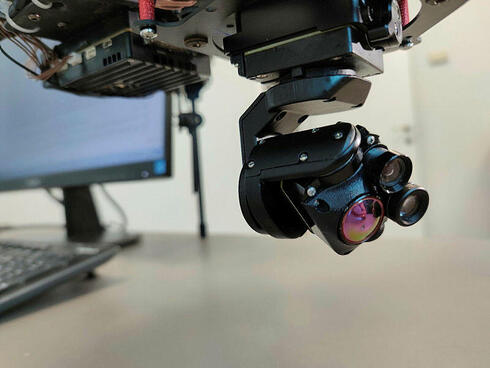
NextVision’s acceleration has been particularly pronounced since the Russia-Ukraine war and intensified further after October 7, 2023. The company develops lightweight imaging systems, including cooled cameras for long-range observation, designed for drones and small platforms that have become central to modern warfare. Its customers include Elbit Systems, UVision, Israel Aerospace Industries, and Aeronautics, which supply the IDF and security forces worldwide.
Ilya Feiner, an analyst at Leader Capital Markets, told Calcalist that investors view NextVision’s ambitious 2026 target with confidence, given its track record of meeting, and exceeding, previous forecasts. “The latest order is particularly significant from an investor perspective because it provides revenue visibility for the coming years,” he said.
Addressing the company’s high valuation multiple, Feiner noted that while it is elevated by historical standards, the market believes strong performance will continue. “Comparable companies abroad trade at even higher multiples,” he added.
Feiner also said that even if the war in Ukraine ends, any impact on sentiment would likely be short-term. “European countries and the U.S. have realized their defense inventories are low and have already begun increasing procurement budgets,” he said. “NextVision’s growth is coming both from Europe and from the U.S., where the market believes the potential is even greater,” partly due to the emphasis placed on defense procurement by the Trump administration.
He added that the market expects NextVision to complete an acquisition in the coming months in a complementary area, enabling it to offer greater value to customers, and potentially accelerate revenue growth further.



