











Elbit’s $32 billion backlog is funding its next bet on warfare: airborne lasers
The Israeli defense giant reported a 16% increase in second-quarter revenue to $2.3 billion and a 39% jump in operating profit as it expands production and develops a high-power laser system for helicopters and fighter aircraft.
Elbit Systems is entering the second half of 2026 with a record $32 billion order backlog, as the wars in the Middle East and Ukraine and a broader European military buildup continue to translate into growing demand for Israeli-made weapons, electronic warfare systems and other defense technologies.
The Israeli defense contractor reported second-quarter revenue of $2.29 billion on Tuesday, up 16% from $1.97 billion a year earlier. GAAP net income rose to $173.6 million, while non-GAAP net income reached $199.1 million. Operating profitability also improved, with GAAP operating income rising 39% to $218.8 million and the operating margin increasing to 9.6% from 8% a year earlier.
The backlog, however, may be the most important number in the results. It has now reached $32 billion, up from $30.2 billion at the end of the first quarter and $23 billion a year earlier.
The figure gives Elbit an unusually large amount of work already contracted for future years, but it also illustrates the scale of the transformation underway in the defense industry. Governments are not simply replacing weapons consumed in recent conflicts. They are investing in new capabilities, expanding ammunition stocks and upgrading military systems designed for increasingly complex battlefields.
That demand is being reflected across Elbit's business.
Land systems revenue jumped 32% in the second quarter, driven primarily by ammunition and munitions sales in Israel. Revenue from intelligence, surveillance, target acquisition and reconnaissance and electronic warfare rose 22%, helped by increased sales of airborne and land high-power laser systems, electronic warfare and maritime systems in the Asia-Pacific region.
C4I and cyber revenue increased 11%, mainly because of higher sales of radio and command-and-control systems in Europe.
Elbit's American operations grew 17%, although the company said the increase was partly due to a one-time favorable project mix. Aerospace was the exception, with revenue falling 8%, primarily because of an unfavorable project mix and weaker sales of training and simulation systems in Europe, partly offset by increased UAV sales in Israel.
The results come as European governments continue to increase military spending following Russia's invasion of Ukraine and amid a broader reassessment of defense capabilities across the continent.
Elbit has increasingly positioned itself to benefit from that spending, with subsidiaries and production capabilities across Europe. In the first quarter, European sales exceeded $500 million, accounting for 23.4% of total revenue.
In May, Elbit announced a five-year defense modernization contract worth approximately $1.4 billion with an unnamed European country. The agreement covers a combination of unmanned systems, electronic warfare, software-defined radios, electro-optical systems and precision-guided munitions.
That contract was part of a series of major European deals. In April, Elbit signed a $750 million agreement to supply Greece with its PULS precision rocket systems, while previous contracts included a more than $1.6 billion agreement to modernize Serbia's military.
The significance of the European market extends beyond any individual contract. European governments are seeking to build up domestic production and military capacity after decades of relatively low defense spending, creating demand not only for individual weapons but for integrated battlefield systems.
Elbit has sought to take advantage of that shift by establishing a deeper industrial presence in European countries rather than relying solely on exports from Israel.
The company's Israeli business remains a major source of growth, particularly in land systems and ammunition.
Land revenue grew by nearly one-third in the quarter, primarily because of ammunition and munition sales to Israel. Elbit has been expanding production capacity to respond to the increased demand, including at its Ramat Beka industrial complex in the Negev.
The company has also been increasing production of artillery shells, precision mortar bombs and other munitions for the IDF. In January, the Defense Ministry placed an order worth more than $183 million for air-to-ground bombs, including MK-84 general-purpose bombs weighing roughly 900 kilograms.
But Israel's growing demand has also created a financial complication for the defense industry: the government has struggled to keep pace with payments to its major suppliers.
As previously reported by CTech, Israel's Defense Ministry has accumulated billions of dollars in debts to Elbit, Rafael and Israel Aerospace Industries. In April, the ministry's total outstanding payments to the three companies were estimated at approximately NIS 13 billion ($4.3 billion), including roughly NIS 3 billion owed to Elbit.
The issue has been tied to a broader dispute between the Defense Ministry and the Finance Ministry over the size of Israel's defense budget. In June, officials warned that the budget impasse could begin affecting new orders for Elbit ammunition and other defense equipment.
For Elbit, the international side of the business has helped cushion the impact of delayed Israeli payments. The company has said that advances from foreign customers have helped it manage its cash flow while waiting for the Israeli government to settle its debts.
Beyond the immediate growth in ammunition and conventional defense systems, Elbit is also investing heavily in technologies that could define the next generation of warfare.
Among them are high-power lasers and directed-energy systems.
CEO Bezhalel “Butzi” Machlis said in May that the experience gained during the wars in the Middle East was influencing Elbit's product strategy and leading the company to expand its investment in energy weapons.
“We are investing significantly in energy weapons, including a powerful aerial laser,” Machlis told Calcalist at the time.
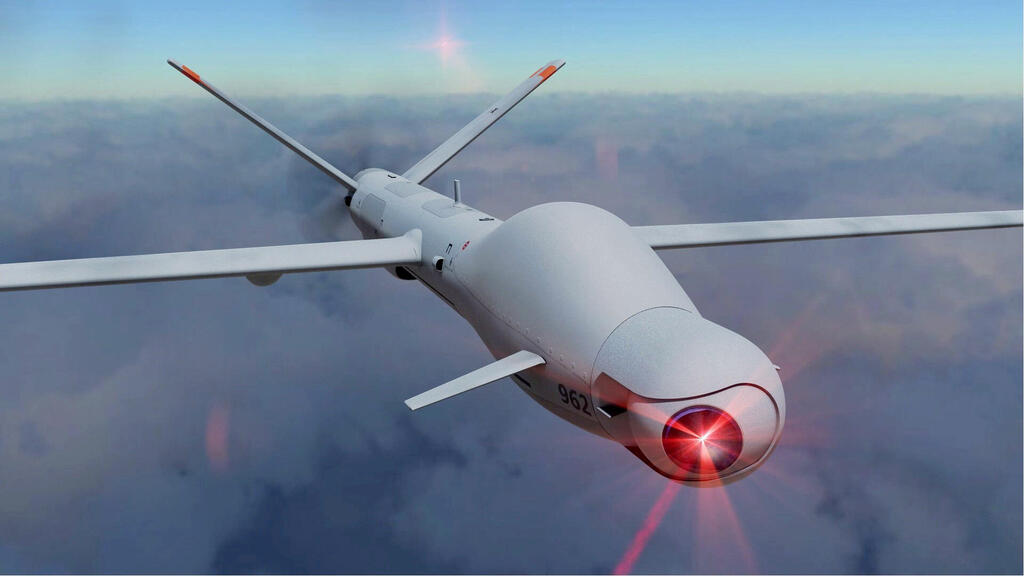
Elbit has now disclosed that it is developing a high-power airborne laser system for helicopters and fighter aircraft.
The company has been working on airborne laser technology for years. Its El-Op subsidiary has previously developed laser weapons for aircraft, while Elbit has also been involved in Israel's broader effort to develop high-power laser-based defense systems.
The move comes as directed-energy weapons are gaining increasing attention because of their potential to provide a different economics of interception and defense than conventional missiles.
Israel is already developing and deploying high-power laser interception capabilities. In June, the Defense Ministry and Rafael completed tests of an upgraded Iron Dome system designed to operate alongside the Iron Beam laser system, incorporating lessons from recent combat against rockets, cruise missiles and drones.
Elbit's airborne system represents a different application: rather than using a laser as a ground-based layer of missile defense, the company is working toward putting a high-power laser on aircraft.
The technology remains under development, and the company has not disclosed operational specifications or a timetable for deployment. But its inclusion in the earnings release indicates how Elbit is trying to translate battlefield experience and growing defense budgets into a pipeline of next-generation systems.
“Elbit Systems is leading the development of next-generation high power laser and directed energy capabilities,” Machlis said on Tuesday. “Most recently, we unveiled our airborne high-power laser system, currently under development for helicopters and fighter aircraft. This new capability builds on decades of technological and operational experience and will further expand Elbit Systems’ broad portfolio of systems, supporting customers and helping protect nations and critical assets around the world.”
The company is also increasing its investment in research and development. R&D spending rose to $159.1 million in the quarter, up from $129.7 million a year earlier.
The record backlog is an opportunity, but it also creates a manufacturing challenge.
Elbit has been expanding its production infrastructure as orders accumulate. Machlis said in May that the company had added approximately 2,000 employees over the previous year and planned to recruit another 2,000, including for the expansion of its Ramat Beka complex.
The company has previously said that some production lines increased output as much as tenfold as demand surged.
That expansion is necessary if Elbit is to turn its backlog into revenue without allowing production bottlenecks to erode profitability.
So far, the financial results suggest that the company is managing that transition. Gross margin increased to 25.3% from 24%, while the GAAP operating margin rose to 9.6% from 8%.
Non-GAAP operating income reached $237.5 million, up from $175.1 million a year earlier, with the margin rising to 10.4% from 8.9%.
At the same time, Elbit's tax burden increased sharply. The effective tax rate rose to 16.4% from 5.6% a year earlier, primarily because of the implementation of the OECD's Pillar II global minimum tax rules.
The company also reported lower financial expenses, partly because of a reduction in average debt.



