










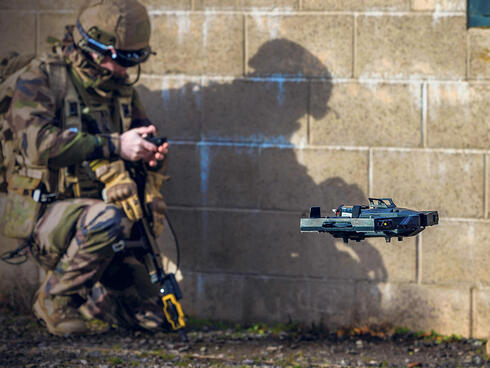
XTEND’s 25% surge in debut gives Israeli drone maker a strong start on Wall Street
Shares jumped in the company’s first day of trading following its $1.5 billion merger with JFB. The debut comes as XTEND attempts to bridge the gap between its current revenue and the hundreds of millions of dollars it has projected in coming years.
Israeli drone company XTEND entered the New York Stock Exchange with a burst of investor enthusiasm, with its shares surging 25% on their first day of trading. The strong debut gives the company an early boost as it begins its first full week as a publicly traded business on Tuesday, despite entering the market with relatively modest revenue, substantial losses and ambitious growth projections.
XTEND began trading on the NYSE on Friday following its merger with publicly traded real estate company JFB. The transaction valued XTEND at approximately $1.5 billion and changed JFB’s trading symbol to XTND.
The first-day performance marks a sharp contrast with the market reaction to JFB before the merger was completed. In the six months after the planned transaction with XTEND was announced, JFB shares had fallen 36%, suggesting limited enthusiasm for the deal among investors. XTEND’s first day as a standalone public-market story offered a markedly different signal.
The company did not raise capital directly from public-market investors as part of the transaction. Instead, it received funding through an investment agreement with private funds. The original plan called for $152 million, but the final investment was reduced to $100 million, with $42 million already transferred earlier this year through a SAFE. XTEND is expected to receive the remaining approximately $60 million.
American Ventures is now XTEND’s largest shareholder with a 15% stake. Other investors include Aliya Capital, U.S. drone company Unusual Machines, Israeli defense-tech fund Protego, Union Tech, Chartered Group, Claltech and TAU Ventures.
The strong debut comes as investor interest in defense technology and autonomous systems has grown, but XTEND still has to prove that the market’s enthusiasm can be translated into the financial performance expected of a $1.5 billion company.
In the first quarter of 2026, XTEND generated $5.8 million in revenue, a 234% increase from the same period a year earlier. Its net loss, however, more than doubled to $11.5 million from $5.7 million.
For all of 2025, the company generated $20 million in revenue, up 20% from 2024, with most of the increase and the majority of revenue coming from the United States. Its net loss widened to $27 million from $17 million.
Those figures are particularly relevant because XTEND entered the merger with unusually ambitious projections. Its prospectus initially projected revenue of $85.6 million in 2026, $150 million in 2027 and $381 million in 2028, with profitability expected in 2027.
The company has since acknowledged that the projections were based on its order backlog and leads approximately a year ago. It does not intend to update the forecasts.
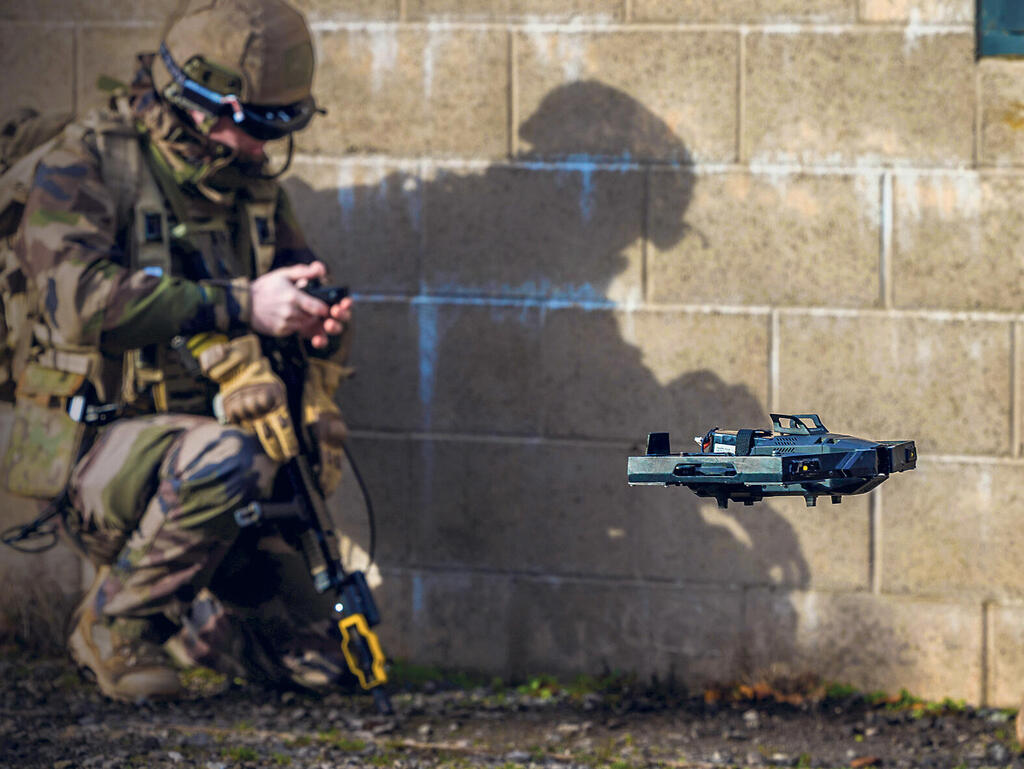
XTEND is betting that demand for autonomous systems will provide the growth needed to close the gap between its current financial performance and those projections. The company says it has deployed 12,500 systems in 30 countries and recently signed a $15 million multi-year framework agreement with the defense ministry of a NATO member country, as well as a $12 million agreement with the U.S. Department of Defense.
The company was founded in 2018 by Aviv Shapira, Matteo Shapira, Rubi Liani and Adir Tubi. It began as a gaming company focused on drone-operating-system technology before shifting toward defense applications. Today, XTEND describes its technology as an operating system for autonomous robots, combining drones, robotics and artificial intelligence.
It employs 267 people, about 60% of them in Israel, and has acquired two companies over the past two years, one in Latvia and another in Singapore.



