










Cluster warheads vs. hypersonics: A tale of two missile ages
Primitive Houthi tactics contrast with global pursuit of next-gen weapons.
The cluster munition warhead carried by the ballistic missile launched by the Houthis from Yemen over the weekend does not pose a new threat capable of fundamentally challenging the Air Force’s missile defense system, which has been on high alert since the beginning of the war. Missiles with such warheads were already launched at Israel during the 12-day war with Iran that ended about two months ago, when the Air Force struck the Islamic Republic’s nuclear facilities, missile factories, and other military infrastructure.
The Houthi missile launched on Friday evening carried a warhead containing dozens of small bombs, some of which reached central Israel, including one that landed in the courtyard of a house in Ginaton. These bomblets, each weighing a few kilograms, are capable of causing casualties and localized damage, but their destructive power is far lower than that of heavy warheads carrying hundreds of kilograms of explosives, which also create devastating shock waves.
1 View gallery
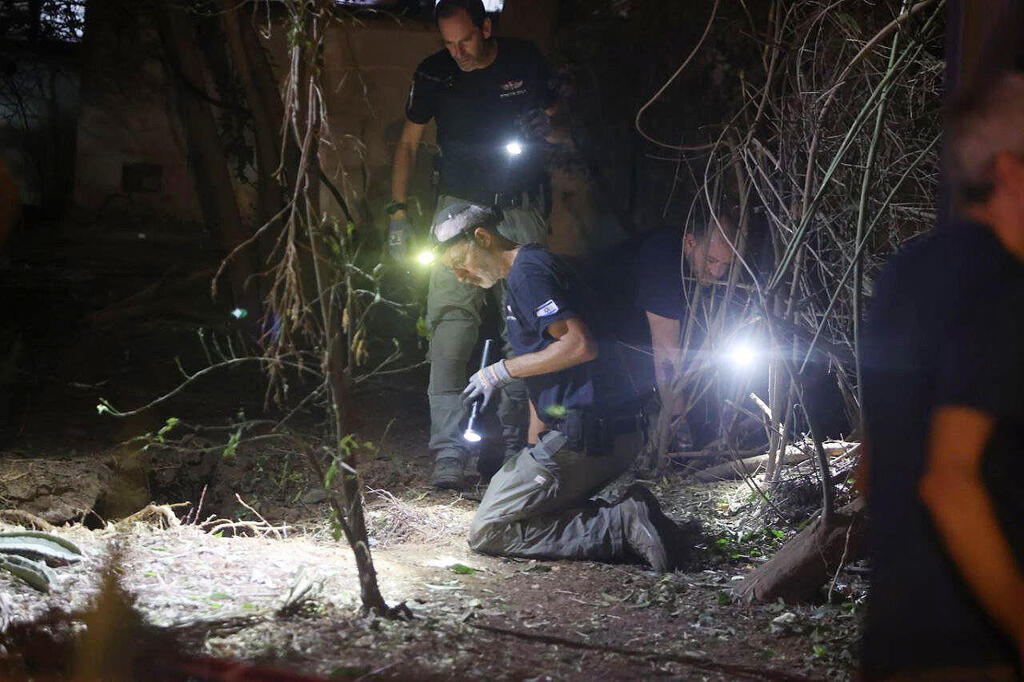
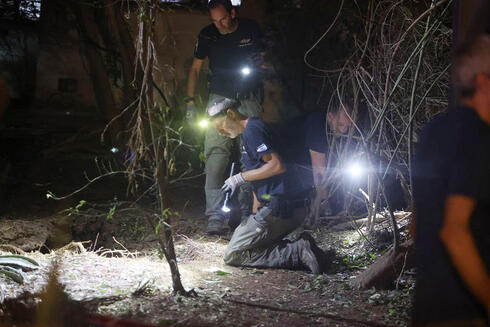
Bomb squad searches for remains of bomb that fell in Ginaton from a missile launch from Yemen.
(Motti Kimchi)
The destructive capabilities of heavier warheads were demonstrated during Iran’s missile barrages, when un-intercepted missiles destroyed residential buildings in central Israel, damaged laboratories at the Weizmann Institute in Rehovot and the Bazan’s complex in Haifa, and struck additional sites, killing around 30 people.
Interception – using Arrow 3
“The cluster munition is considered primitive, far less threatening, and much less effective than a heavy warhead. Its use reflects flawed logic by those who launch it,” a missile expert told Calcalist. “The defensive response is the same as against any other ballistic missile, detonating it at high altitude and far from Israeli territory using Arrow 3 interceptors.”
According to the Air Force’s initial investigation, this was the first time the Houthis launched a missile of this type at Israel. Missile experts, however, caution that there is no way to verify whether it was indeed the first, since most missiles are intercepted far from Israeli airspace. Unlike previous launches, Friday’s missile was not intercepted after both an Arrow 3 interceptor and a U.S. THAAD interceptor deployed in Israel missed their targets.
While the Air Force stresses that its defense systems are fully capable of intercepting cluster munition warheads, and have done so in the past, security officials suggest that the failure to intercept this missile stemmed from the broader interception policy, which balances a wide range of operational considerations.
Iranian fingerprints
The launch once again highlighted the Houthis’ close ties to Iran, which either supplies them with missiles directly or transfers knowledge enabling local production. It also underscored the Houthis’ efforts to disrupt commercial flights at Ben Gurion Airport, where more and more foreign airlines have recently resumed operations.
The Houthis may have hoped that at least some of the submunitions would strike near the airport, potentially triggering a chain reaction that could paralyze its activity. A missile expert described the use of cluster munitions as “a wasted opportunity, they chose a warhead type that significantly limited their ability to cause real damage.”
Media coverage of the launch, however, was rife with confusion. Some outlets incorrectly said the warhead broke up outside the atmosphere and released guided mini-warheads capable of navigating toward multiple targets. The defense response to such advanced threats involves high-altitude interceptions outside the atmosphere.
No hypersonic weapons yet
More concerning than the Houthis’ or Iranians’ use of cluster munitions is the pursuit of hypersonic missile technology by Russia and China. These weapons travel at least five times the speed of sound, making them extremely difficult to intercept with existing defense systems.
China has recently showcased progress in this area, but Israeli security sources estimate that Iran is still far from achieving true hypersonic capability, despite its ambitions. “There is a lot of talk about hypersonic weapons, but we have yet to see a proven system that fully meets the definition, even from global powers, let alone Iran,” a senior defense source told Calcalist.
Israel is preparing nonetheless. Rafael is developing the Sky Sonic interceptor to counter hypersonic threats but has remained silent on progress. Israel Aerospace Industries (IAI) is also accelerating development of the Arrow 4 system, designed to defend against both split-warhead and hypersonic missile threats.



