










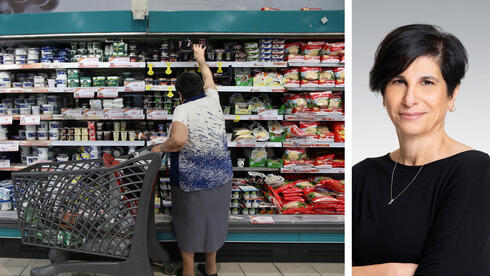
Israel’s food market is so concentrated that suppliers may be able to leverage power across categories
The Competition Authority found that the country’s largest food suppliers dominate multiple product categories, creating conditions that could allow them to use “must-have” products to strengthen their position elsewhere. The findings come as political candidates promise to dismantle monopolies and bring down food prices.
Just before the elections, and as candidates for prime minister declare their intention to dismantle monopolies in the food market in an effort to lower prices, the Competition Authority is painting a picture of a highly concentrated industry that may help explain why food and consumer products in Israel remain more expensive than in many other countries.
A mapping conducted by the Competition Authority’s Food and Consumer Products Department found that conditions exist among Israel’s largest food suppliers that could create incentives for what economists call a “basket effect”, the ability to leverage market power in one category into other categories in which a supplier operates, including through tying practices.
In practice, this could involve commercial arrangements between suppliers and retailers in which a large supplier conditions the sale of a sought-after product on the purchase of another, typically less sought-after, product.
1 View gallery
Michal Cohen (right) in charge of competition, dairy products
(Rami Zinger, Orel Cohen)
The mapping, based on StoreNext data for 2025, shows that each of the six largest companies in the industry is the leading supplier in numerous product categories. Tnuva, the country’s largest food company, and Strauss, the second-largest, are each the largest supplier in 12 of the 20 categories examined. Osem, the third-largest food company, and Unilever Israel are each the largest supplier in 13 of the 20 categories.
The Central Bottling Company, better known as Coca-Cola Israel, is the largest supplier in five categories, with the Coca-Cola and Fuze Tea brands accounting for more than 90% of sales in the relevant categories. Sano leads sales in eight categories in the cleaning and toiletries sector.
The Authority also examined the market power of other major companies. Neto Meat and Poultry, controlled by Adi Ezra and David Matsasa, leads five categories; importer Diplomat, controlled by the Wyman and Mandel families, leads nine; Tempo, owned by Jacques Bar and Heineken International, leads six; and paper products manufacturer Kimberly-Clark leads four categories.
Alongside its mapping of suppliers’ control over key categories, the Authority examined economic theories concerning the ability to leverage market power from one market into another through tying.
The review considered the “Chicago School” approach, which argues that the mere fact that a supplier operates in several markets and is dominant in some of them is not enough to conclude that it will seek to transfer that market power into another market where it is not dominant. Under this approach, such a strategy may not be profitable and therefore may not provide the supplier with an economic incentive to pursue it.
The Authority noted, however, that this argument relies on a number of assumptions that may not hold in practice. Over the years, economic theories have emerged that challenge the Chicago School’s predictions regarding the leveraging of market power and the creation of market power through tying. These theories argue that the conditions required for such leveraging not to be profitable are often too restrictive or unrealistic.
The Authority concluded that the combination of its market mapping and the economic literature indicates that conditions do exist among Israel’s largest food suppliers that could create incentives for a basket effect.
Price controls as an incentive to leverage market power
One example is price regulation. Price controls can make it harder for regulated companies, such as Tnuva, to extract the full profit potential from regulated products. This may create an incentive to seek additional profits by leveraging market power from regulated markets into other categories that are not subject to price controls.
The Authority also pointed to the role of so-called “must-have” products. When retailers need to stock a particular product in order to compete effectively, and consumers tend to purchase most of their grocery basket in a single store, suppliers of those products may have an opportunity to use them as leverage to strengthen their position in other markets where they are not dominant.
In this context, the Authority highlighted Tnuva’s dominance across numerous product categories, particularly dairy products, a significant portion of which is subject to price controls. These include fluid milk, yellow cheeses sold by weight, white cheeses, sweet cream, laban and sour cream.
Studies conducted in Israel on dairy price controls have found that the controls are effective in keeping prices lower than they would otherwise be, while profit margins on regulated dairy products are lower than those on similar products that are not subject to regulation.
Coca-Cola as a “must-have” product
The Authority also examined the potential use of must-have products as a lever to strengthen market power, citing the Central Bottling Company as an example.
The company is the exclusive marketer in Israel of the Coca-Cola brand, which the Authority considers a must-have product for retailers. Stocking Coca-Cola can be essential for retailers seeking to compete effectively and avoid losing customers to rival stores that carry the brand, particularly because consumers who buy a broad basket of products generally prefer to do so in a single location.
According to economic theory, a supplier of a must-have product can potentially use tying to induce retailers to accept higher prices for another product than they would pay to competing suppliers. By combining the two products, the supplier may increase its overall profit beyond what it could earn from the must-have product alone.
In other words, a supplier of a must-have product can potentially use that product as leverage over retailers to strengthen its position in other product markets where it does not have a dominant position.
The Central Bottling Company is also a significant player in some regulated dairy categories through its subsidiary Tara. Like Tnuva, Tara is affected by price regulation. The Authority therefore identified a potential incentive for the company to use its position in regulated markets through Tara to leverage market power into other categories.
Despite identifying a highly concentrated market and conditions that could create incentives for suppliers to exploit their market power, the Competition Authority stopped short of drawing a definitive conclusion that such practices are taking place.
Instead, it left the broader policy implications to the next government, presenting the potential positive and negative effects of the market structure and the economic mechanisms it had identified.



