










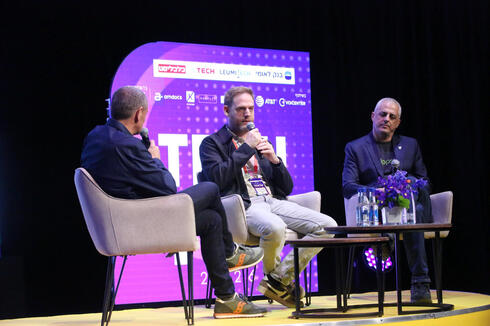
“In 10 years there will be a very big problem here if Israel doesn’t go all-in on AI”
AppsFlyer and Eon CEOs warn that the country risks falling behind in the global AI revolution and facing major economic consequences.
When asked whether this is the most interesting period high-tech has ever experienced, Oren Kaniel did not hesitate.
“I would be even more radical,” said the CEO of AppsFlyer, the mobile-marketing analytics company he founded in 2011. “What we are seeing now is the beginning of an exponential change, the equivalent of the industrial revolution happening in ten years. Things we can’t imagine are going to happen. It’s exciting, and it’s also overwhelming.”
Sitting beside him at the Tech TLV conference was Ofir Ehrlich, CEO of Eon and a serial entrepreneur who has already founded and sold companies and spent time inside Amazon before launching his current venture. Ehrlich, whose latest startup is reportedly valued at around $4 billion, struck a similar tone.
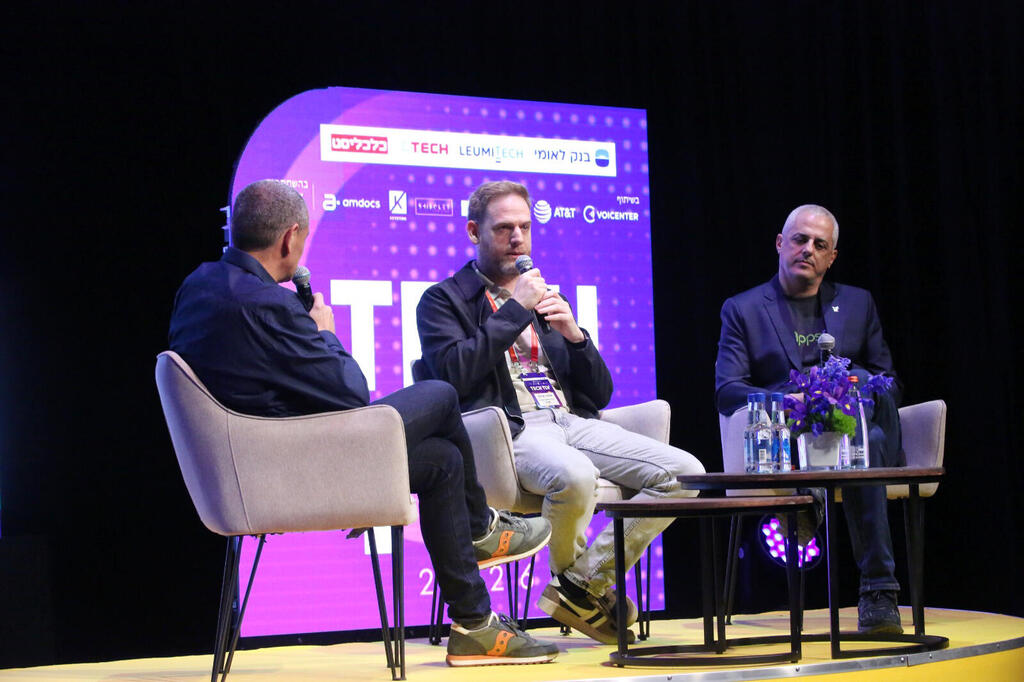
“I don’t remember 1999 completely, even though I was there,” he said. “But this period is crazy interesting.”
The conversation quickly turned from wonder to unease. The interviewer suggested that the moment also feels frightening because no one can predict what comes next. Kaniel agreed. “Nobody knows what is going to happen in the future,” he said. “And that’s why it’s both amazing and terrifying.”
AppsFlyer was born during the early mobile boom, and Kaniel described how the company’s founding philosophy was to focus not on trends but on constants.
“When we started, we looked at the things that were never going to change,” he said. “Will mobile be a thing? Will data, security, privacy matter? Will customers always need accurate information? Those were our bets.”
Software itself, he added, was never the moat. “Anyone can write software. We knew from day one our competition could be Google, Facebook, Apple. We didn’t want to compete on code, we wanted to compete on something only we could do.”
That “something” became a connective infrastructure linking the largest advertisers and platforms, Facebook, Google, Apple, TikTok, into a trusted data layer. “Even if someone built faster, prettier dashboards, they couldn’t provide the same value,” Kaniel said. “The value never came from the software.”
Ehrlich, whose company operates in a newer generation of AI-driven technology, said AppsFlyer had grasped an enduring truth: “Your information will always be your moat. The more connected you are to the sources that produce it, the more valuable you become.”
The discussion inevitably moved to money. Ehrlich acknowledged the surreal trajectory of startup valuations. His own company, only two years old, is now valued in the billions, a figure he treats with caution.
“We were all in 2021, we saw 2022, we understand the world is very complex,” he said. “We think we’re approaching a $100-billion-plus annual opportunity. If that happens, then all these numbers are not even close, it could be five, six, seven billion.”
Yet he praised AppsFlyer’s slower, older-fashioned path. The company, he noted, had built roughly half a billion dollars in annual revenue, and was profitable. “That’s a crazy event,” Ehrlich said. “Those foundations are a security that has already been realized.”
Kaniel pushed back against the industry’s growing obsession with ever-larger funding rounds. “Money does matter, and there should always be a scarcity of money,” he argued. “Money is a commodity. If you solve problems only with money, you’re going to lose.”
AppsFlyer’s early years were marked by exactly that scarcity. “We had a really hard time raising money, and I think that’s what made the company,” Kaniel said. “The best money was from sending an invoice to a customer, no dilution, and you get a partner in building the product. The fact we didn’t have money forced us to think creatively.”
Ehrlich described the opposite reality for today’s founders. His second company in 2009 began with $20,000; his current venture raised $20 million in Seed capital. “There’s inflation all the time,” he said. “The market moves faster, and competitors have significantly more money.”
Does that create a new breed of entrepreneur, less afraid to ask for tens of millions at the earliest stage? Ehrlich believes so. Large rounds, he said, reduce risk for founders even if they may increase it for investors.
Asked directly whether the industry is in a bubble, Kaniel answered with ambivalence: “Yes and no. The market doesn’t know how to price things today. It doesn’t know how to price three years ahead.”
Both executives agreed that AI is already redrawing the map. Kaniel warned that companies whose main asset was simply writing software must reinvent themselves. Ehrlich predicted many winners, particularly in vertical applications rather than infrastructure alone.
But Kaniel saved his most forceful comments for Israel’s position in the new era. The country, he argued, risks missing the revolution entirely.
“In ten years there will be a very big problem here if this country doesn’t go all-in on AI,” he said. “What’s coming is a massive employment challenge worldwide. Quality of life will be built on a few AI infrastructure companies and companies that can bring real revenue, not exits, real ongoing money.”
Israel, he said, remains “far behind in AI as a country,” despite its strength in cybersecurity and technology marketing. “We can pat ourselves on the back until tomorrow, but we are sleeping on our noses,” he warned. “If we want to continue to exist here as a nation, we need at least a few Anthropics.”
Ehrlich agreed, calling the mission “Zionism 2.0.”



