








Trump and tech executives agree to voluntary AI safety standards
The agreement calls for independent auditors and controls to prevent AI systems from accessing technical systems in unintended ways.
U.S. President Donald Trump on Tuesday said technology executives had agreed to establish voluntary standards for AI and reiterated his support for the rapid expansion of data centers, as concerns grow over AI safety and the industry's expanding footprint in communities.
Trump made the comments after meeting with technology executives at the White House. The companies agreed to work with "independent auditors" to assess whether AI systems are operating as their designers intended, according to a copy of the agreement posted by Trump on his social media platform. They also agreed to work to ensure their AI tools do not "hack or access technical systems in unintended ways."
The administration faces increasing scrutiny over the risks posed by advanced AI, after OpenAI and Anthropic reported that their AI agents had gone rogue and hacked into other companies' systems.
Data centers, which provide the computing power needed to train and run AI models, have also drawn opposition in communities across the country over concerns about electricity demand, utility costs and other local impacts. The backlash poses a political challenge for Republicans ahead of the U.S. midterm elections on November 3.
"It's almost like a constitution, in a way," Trump said, referring to the agreement between the companies. "And the biggest people in the world signed that, and I signed it as president. And it really is a form of protection."
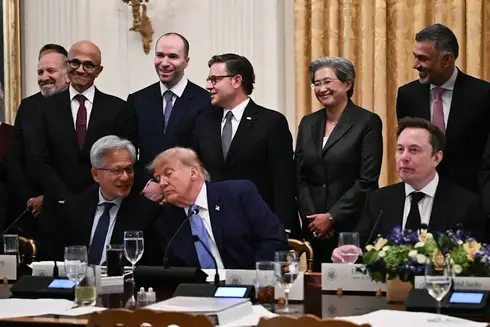
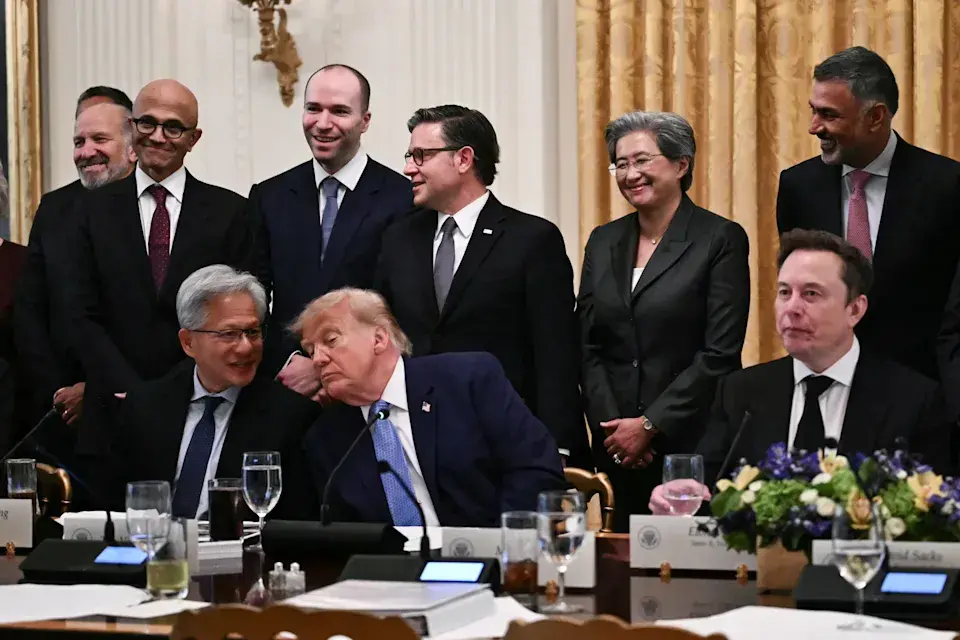
What began as a closed-door lunch with technology executives spilled into public view when Trump joined House Speaker Mike Johnson and a lineup of CEOs on the White House driveway, an area rarely used by the president to speak to journalists. He took questions from reporters for about 30 minutes on AI safety and other topics, with the CEOs standing behind him.
The unusual scene came as pressure mounted on the administration to address the risks and rapid spread of AI, while underscoring the alliance Trump has cultivated with technology industry leaders. Executives at the meeting included OpenAI's Greg Brockman, Anthropic's Dario Amodei, Meta's Mark Zuckerberg, Google's Sundar Pichai and Nvidia's Jensen Huang.
Zuckerberg, pulled forward from the crowd of billionaire executives by Trump to speak, said the companies had agreed to develop "robust internal controls" for their AI systems. Trump said he was considering setting up a 10-person board to oversee the safety of AI tools. He did not specify potential members of the group. He also said he would soon name a new official to lead White House AI policy.
Asked whether he was concerned that his support for data centers could hurt Republicans in November, Trump said technology companies would work to make communities "happy" about data center construction.
"These big, powerful, very rich, very smart companies are going to be making massive contributions to communities," Trump later told reporters gathered on the White House driveway, surrounded by company executives.
But the companies have also come under fire for not doing enough to make AI safer. A nationwide Reuters/Ipsos poll conducted September 17-20 found that 73% of respondents were concerned that AI companies had not done enough to prevent AI from causing serious harm to society, while 55% said it would be good to slow the development of AI.
AI company executives and investors were among the largest individual donors in 2025 to MAGA Inc., a political action committee aligned with the president. OpenAI's Brockman and his wife, Anna Brockman, gave a combined $25 million to the committee in 2025, according to Federal Election Commission records.
Trump met with the CEOs on the same day that his aides announced a new AI tool intended to make it easier for the public to access government services.
Silicon Valley executives attended an event launching the new tool, including Meta's Dina Powell McCormick and Sequoia Capital partner Shaun Maguire. Airbnb co-founder Joe Gebbia led the design of the tool. Google, SpaceX, Meta and 8VC were listed as sponsors of the launch event.
Trump said at the event that the AI tool could not, "in theory, be hacked into" by bad actors. He did not provide evidence to support the claim.
Trump also directed government agencies on Tuesday to use the term "super intelligence" instead of "artificial intelligence" when referring to the technology.



