










Analysis
Israel faces strategic choice as Zim sale nears decision point
Financial stability versus long-term control of maritime infrastructure.
At the end of the process, two factors will determine whether the sale of Zim to the German shipping giant Hapag-Lloyd and the FIMI Fund is approved: the security establishment, which can recommend that the Companies Authority oppose the deal on the grounds of protecting national and security interests, and the court, to which the buyers or Zim shareholders may turn if they wish to appeal such a decision.
Until then, political and vested interests are likely to attempt to influence both the decision and public opinion, raising alarmist scenarios such as hostile actors gaining control over Israel’s maritime supply routes, and emphasizing Zim’s strategic importance to the economy. While these claims merit discussion, until recently none of the bodies responsible for safeguarding national interests appeared particularly concerned.
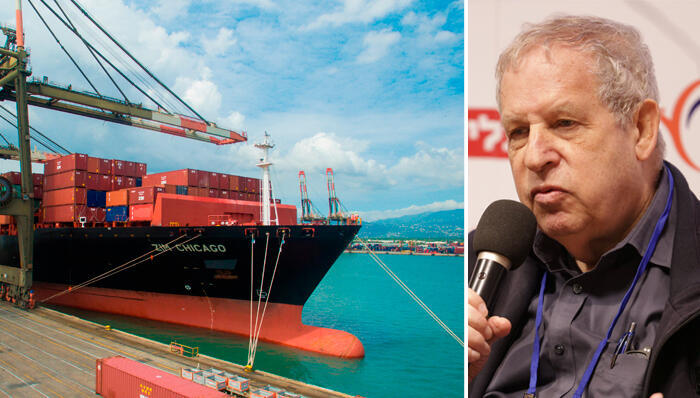
Last month, Zim’s board of directors, chaired by Yair Seroussi, signed an agreement to sell all of the company’s shares to Hapag-Lloyd for $4.2 billion. At the same time, the German group signed a deal with the FIMI Fund, led by Ishay Davidi, under which it will sell Zim’s Israeli operations to the fund.
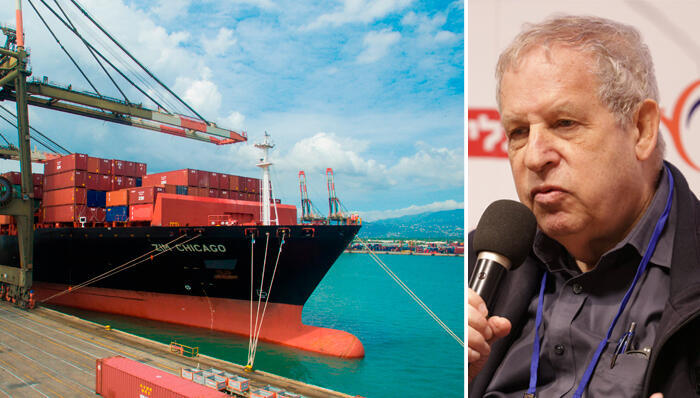
This is where Maj. Gen. (res.) Giora Eiland enters the picture. The Zim workers’ union, which opposes the deal, commissioned him to prepare an opinion explaining why it should not be approved. This is not the first time the committee has relied on Eiland; in 2014, he was similarly recruited in an attempt to influence the terms of the golden share. Although he was not a party to the legal proceedings, the committee sought to influence decision-makers through his opinion.
For more than a decade, nearly 70% of Zim’s shares have been held by the company’s creditors, including foreign entities that received them as part of a debt restructuring. On the eve of its Nasdaq IPO in late 2021, Deutsche Bank held nearly 16%, the Greek shipping company Danaos about 10%, and the European investment firm KSAC about 5%. The Ofer family, which held 32% at the time of the IPO and was the de facto controlling shareholder, completed the sale of its remaining shares at the end of 2024. From that point, Zim became a company without a controlling shareholder.
No government authority raised alarm over the possibility that Zim could fall into the hands of “hostile” parties, without the state having the ability to prevent it. Under the golden share provisions, any investor can acquire up to 24% of Zim without notifying the state, simply by purchasing shares on the stock exchange. Even when investor groups, including CEO Eli Glickman, explored acquiring control, the state did not act proactively.
In this sense, the current deal appears to have caught the relevant authorities off guard. It is a complex transaction in which Hapag-Lloyd will acquire all of Zim’s shares and, in a second stage, transfer the Israeli operations to FIMI. The “Israeli Zim” will inherit the golden share and be required to maintain an Israeli identity and a minimum fleet of 11 ships.
The idea of such a split is not new. It was first proposed in 2003 by Benjamin Netanyahu, then serving as finance minister, who suggested dividing Zim into two companies, one focused on global operations and the other on maritime transport to and from Israel, with the golden share attached. Although the proposal was approved, it was never implemented, and the state’s holdings were eventually sold to the Ofer family.
Since then, Zim has undergone significant upheavals. About a decade after privatization, it completed the largest debt restructuring in Israeli corporate history, with creditors writing off $1.4 billion. The Ofer family suffered heavy losses, and the state eased the golden share conditions. The pandemic later drove profits to record highs, followed by renewed losses and subsequent recovery.
At the beginning of this year, after a months-long tender process, Zim’s board selected Hapag-Lloyd as the buyer. The workers’ union opposing the deal, as noted, enlisted Eiland. Last week, employees circulated his opinion to relevant government ministries, warning of the deal’s strategic and economic implications.
However, within hours of its publication, Eiland announced he was freezing the document for “further review.” The report indeed requires revision to meet basic professional standards. Approximately three of its eight pages were copied almost verbatim from his 2014 opinion, including outdated data. The section addressing current threats cites examples not directly relevant to the deal, such as the withdrawal of foreign ships during wartime or anti-Israeli incidents in European ports.
When addressing the core issues, Eiland argues that the portion sold to Hapag-Lloyd would be permanently beyond the state’s reach in an emergency. However, he overlooks the fact that Zim has not met “Iron Fleet” requirements for years and has received state concessions. Even today, the state lacks the practical ability to compel Zim to deploy ships it does not own, and reliance on foreign crews in wartime presents inherent challenges.
Even if his claim, that the remaining Israeli fleet would be insufficient under updated threat scenarios, is valid, it is not supported by a comprehensive analysis of Israel’s dependence on maritime transport or broader global trends, such as the reshoring of defense production.
The report does not specify how many ships the state would require in an emergency, nor what types, an issue already insufficiently defined in the golden share agreement. Instead, it cites a peak of 1,700 containers transported for defense purposes in 2026, a figure of limited relevance, as a single vessel can carry that volume. More meaningful would be the number of operational routes and destinations maintained by the Israeli entity.
Eiland also raises concerns about Zim’s financial stability post-deal but does not substantiate them with economic analysis. In practice, under the agreement, the Israeli entity is expected to be debt-free and backed by a minimum profit guarantee, facts that contradict his argument.
A review of Zim’s financial reports would have shown that, as of the end of 2025, the company carried net debt of $2.9 billion. Under the sale terms, however, the Israeli entity would emerge without debt and with a guaranteed baseline profitability from Hapag-Lloyd in its early years, factors not reflected in the opinion.
In conclusion, Eiland recommends blocking the deal and legislating stricter golden share requirements to ensure Zim meets national security needs. While such a recommendation may appeal to security officials, it would be complex, costly, and likely require shareholder consent, something investors would have little incentive to grant, as it would reduce the asset’s attractiveness.
The state now finds itself in a predicament that could have been anticipated. It watched as Zim struggled under heavy debt, failed for years to meet golden share conditions, and evolved into a company without a controlling shareholder.
Now it faces a deal that promises financial stability and a functioning “iron fleet” for the near term. Yet it must also consider the long term: how to manage the golden share effectively and whether to establish a sustainable model ensuring reliable maritime capacity in times of crisis.
Alternatively, it may choose the path of least resistance, maintaining the status quo and allowing Zim to continue operating without confronting structural challenges, knowing that periodic crises may recur.
In every scenario, risks remain. Addressing them requires confronting a long-neglected issue. What is clear is that decisions of this magnitude should not be shaped by political rhetoric or unsubstantiated opinions, but by rigorous professional analysis in finance, corporate governance, and national security.



