











Ramon.Space raises $124 million to build the computing infrastructure of space
The Israeli company, backed by Micron and PSG, develops systems that allow satellites to process, store, and transmit data in orbit. The funding will support expanded production and the rollout of its next generation of products as demand grows for AI and other computing workloads in space.
Ramon.Space, a provider of space-based computing infrastructure, has raised $124 million in a Series B funding round led by investment firm PSG. The round also included a strategic investment from chipmaker Micron Technology, as well as investments from Senvest and Phoenix Financial. Existing investors StageOne, Deep Insight, and Grove Ventures also participated. The company has raised approximately $180 million to date.
Ramon.Space develops systems that enable data processing, storage, and transmission aboard satellites. Its technology is used in commercial and government space missions, with customers including communications satellite operators and providers of Earth observation and surveillance services worldwide.

As the space economy expands, computing is becoming one of its foundational infrastructure layers. Artificial intelligence applications, communications networks, autonomous missions, Earth observation platforms, national security systems, and future orbital data centers increasingly depend on the ability to process, store, and transmit data in space. The expansion of satellite constellations and the migration of AI workloads into orbit are also bringing space-based computing closer to the traditional computing infrastructure model.
"The company provides systems that process data in space. Our systems perform computation, storage, and communication. We enable the development of AI capabilities in space," Avi Shabtai, CEO of Ramon.Space, told Calcalist. “From our perspective, the satellite is transformed into a computer flying through space, a system that is far smarter and more autonomous, capable of performing tasks well beyond its original, limited mission. We do not deal with the satellite's flight-control system, which is relatively simple. Instead, we integrate advanced computing elements, aligning with a major trend in the space industry: the development of highly sophisticated space infrastructure. This includes the emergence of space-based services, such as cloud computing and mobile connectivity. Satellites are becoming increasingly powerful, equipped with a wide range of advanced capabilities.
"You cannot add systems to a satellite once it has been launched; it is no longer accessible. We integrate our technology into new satellites prior to launch. Most satellites have a lifespan of about five years, leading to a rapid turnover. As each new generation is deployed, it incorporates these advanced systems," Shabtai said. "We have clients in the government and commercial sectors. We have a connection with SES, one of the major operators, and other clients that have not yet been publicly announced. Contracts in the space sector are relatively large, potentially reaching tens of millions of dollars or even more."
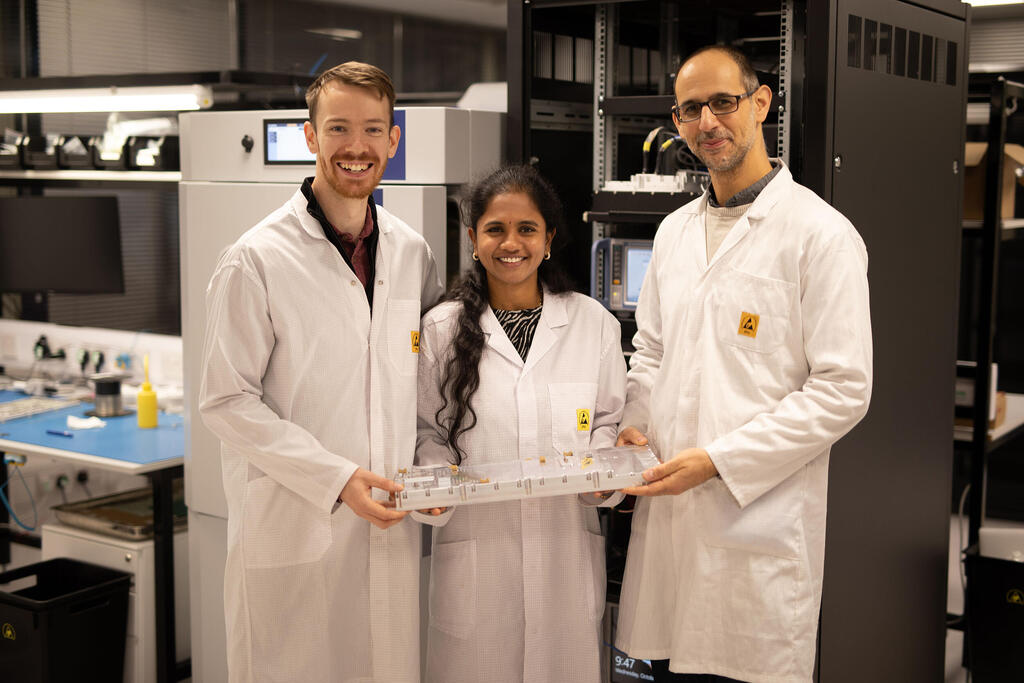
Ramon.Space's systems combine software with specialized AI and machine-learning processors, high-capacity storage, networking, and edge-computing capabilities, allowing data to be processed directly aboard satellites rather than being sent back to Earth. The company says its technology has already been deployed on commercial and government missions in orbit and is designed to deliver performance comparable to ground-based computing systems while operating under the constraints of radiation, extreme temperatures, and limited power.
The company says it has the manufacturing capabilities to produce millions of computing nodes at enterprise scale. Its systems are designed for communications satellite constellations, satellite-based 5G networks known as 5G non-terrestrial networks (5G NTN), Earth observation and remote sensing missions, and future data centers in space.
The investment will support an expansion of production and faster delivery of systems to customers, as well as accelerate the development of the company's next generation of products and its expansion into additional markets. The company says it is seeing growing demand and an expanding pipeline of business opportunities.
"There are two key elements that distinguish these systems. Space applications have specific requirements: image processing and signal processing differ from those used on Earth. A second, fundamental factor is the space environment itself. Outside the atmosphere, there are significant challenges related to radiation, temperature, and more. We must ensure the system functions reliably under complex environmental conditions over many years, while acknowledging that on-site maintenance or repairs are impossible; only remote software-based intervention is an option," Shabtai said.
"This new funding will allow us to advance to the next stage of our company's growth and scale up significantly. We are a truly global company, with a presence in the U.S. and Europe, and our goal is to become the world's leading player in space-based computing infrastructure. Our journey is fascinating; we are making a broad international impact, and there is currently immense interest in the space sector," he added.
Ramon.Space employs approximately 130 people across Israel, the U.S., the U.K., and Germany. The company traces its origins to Ramon Chips, founded in 2004. The current operation was established in 2020, building on the earlier company's foundations, by Professor Ran Ginosar and Avi Shabtai, who joined the company that year.



