










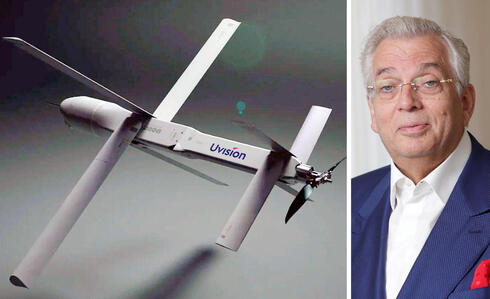
Suicide-drone maker UVision seeks up to $4 billion valuation in Nasdaq debut
Aaron Frenkel takes the defense company to Wall Street after rejecting a $2.9 billion valuation from local investors.
The IPO of defense company UVision Air, controlled by Aaron Frenkel, is moving into its next phase. Calcalist has learned that the company is expected to publish its prospectus during the second week of July and begin a roadshow that could last several weeks. At the end of the process, it will seek to complete an IPO on the Nasdaq stock exchange at a valuation of $3.5-4 billion. In other words, the offering itself is expected to take place during July or August.
The move comes after Frenkel failed to reach agreements with Israeli institutional investors regarding the company's valuation as part of a pre-IPO fundraising effort. Frenkel sought to bring in three to four institutional investors to invest in the company, which specializes in developing and manufacturing loitering munitions, often referred to as suicide drones , that can locate a target, loiter over an area, and strike with precision.
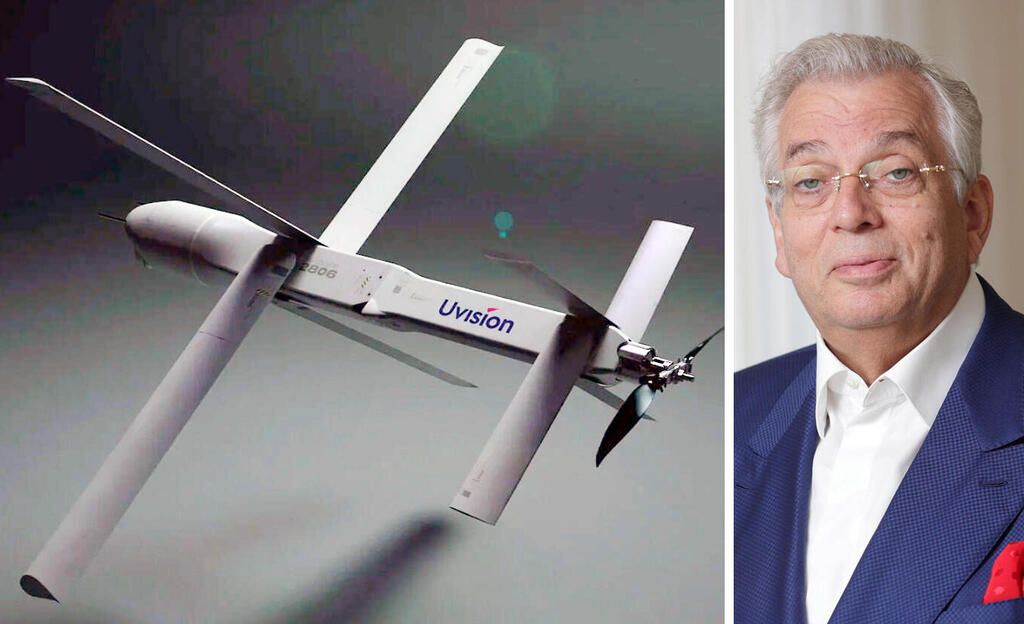
As previously reported by Calcalist, the main discussions were held with Clal Insurance, Migdal Insurance, Meitav, and More Provident and Pension Funds. Ultimately, however, the institutions that came closest to making an investment were Leumi Partners and Phoenix. According to proposals submitted during the process, institutional investors were willing to invest at a valuation of approximately $2.9 billion. Frenkel refused to compromise on valuation and instead chose to proceed directly with a Nasdaq listing.
UVision aims to raise between $500 million and $1 billion, depending on investor demand. A significant portion of the proceeds will be used to repay shareholder loans that Frenkel provided to the company over the years. In addition, the IPO is expected to include a substantial secondary component, allowing Frenkel to sell part of his holdings to public investors.
The offering is being led by U.S. investment bank JPMorgan. It comes at a time when many defense-sector stocks have undergone a correction after surging in the wake of conflicts around the world. The pullback has been partly influenced by emerging understandings between the United States and Iran.
NextVision, which is traded on the Tel Aviv Stock Exchange and develops imaging systems for drones, has lost approximately 28% of its value over the past three months. Elbit Systems has also declined by roughly 20% since March. However, from a longer-term perspective, NextVision's shares remain up approximately 1,700% over the past three years, reflecting the enormous demand generated by military technologies and unmanned systems.
In Israel, the offering is being accompanied by Barak-Leumi Underwriting, led by Zvi Manes. Meetings with institutional investors are expected to begin during the second week of July, shortly after publication of the prospectus. The goal will be to convince investors to participate in the offering despite the higher valuation now being sought compared with the valuation they were willing to accept during the pre-IPO process.
It will be interesting to see whether institutions that effectively rejected the company's valuation three months ago will be willing to participate in the public offering at an even higher valuation. JPMorgan appears to believe that a global investor base will be willing to assign a richer valuation to an Israeli defense company. Accordingly, the roadshow is expected to begin in Israel before continuing in the United States and Europe.
As part of the pre-IPO process, Frenkel sought to sell between 5% and 10% of the company to institutional investors. To make the proposal more attractive, he offered downside protection mechanisms. Under the proposed structure, if a future fundraising round were completed at a lower valuation than the pre-IPO investment, investors would receive compensation through options designed to reduce their effective purchase price retroactively.
During the due diligence process, representatives from most of the institutional investors visited the company's headquarters and production facility in Emek Hefer, where they met CEO Ran Gozali and received a detailed presentation on the company's operations.
One of the key assets UVision is highlighting to investors is a major contract signed in October 2025. The agreement, signed together with U.S.-based Mistral and the U.S. Army, has a cumulative value of up to $982 million over five years.
UVision was acquired by Frenkel in 2010 through his private company Magnus and has operated under his control since 2011. For the past year and a half, the company has been led by Ran Gozali, a former senior executive at Rafael, where he spent approximately three decades in leadership roles across R&D, engineering, and global business operations. He succeeded Avi Mizrachi, who served as CEO for five years.
The company’s chairman is Ilan Gifman, a close associate of Frenkel. The board also includes Yedidya Yaari, former commander of the Israeli Navy and former CEO of Rafael, as well as Yair Ramati and Yair Dubester.
Over the past decade, UVision has emerged as a significant global player in the loitering munitions market, driven largely by its HERO family of suicide drones designed for both tactical and strategic missions. These systems combine the capabilities of unmanned aerial vehicles and guided missiles: they can loiter over a target area, gather real-time intelligence, and execute a precision strike once a target is identified. In some cases, the attack can be aborted, allowing the system to return and be reused.
The wars in Ukraine, the Middle East, and other conflict zones since 2022 have underscored the growing importance of drones and loitering munitions on the modern battlefield. The result has been a sharp increase in global demand for both offensive systems and counter-drone technologies. UVision is now seeking to capitalize on that trend through what could become one of the largest defense-sector IPOs by an Israeli company in recent years.
UVision's ownership structure also makes the offering unusual. Unlike many companies seeking to go public, it is wholly owned by Frenkel. As a result, the IPO is expected to significantly increase the liquidity of the controlling shareholder, who has become a prominent figure in Israel's capital markets through a series of lucrative investments.



