










“Crazy salary levels”: The deal that exposed Israel’s defense paradox
Why foreign capital, national security, and a revolving door collided over a single Rafael subsidiary.
1. Even Israel’s defense industries, capable of inventing groundbreaking weapons seemingly out of thin air, have yet to invent a way to eat their cake and keep it whole. It would be wise for the Defense Ministry to recognize this, as for now, the ministry appears confused, and is confusing the market in the process.
Israel’s military needs exceed its ability to finance them, even before considering the potential cancellation of the U.S. defense assistance framework, which currently provides Israel with $3.8 billion annually for weapons procurement, funded by American taxpayers.
On the one hand, the Defense Ministry wants investors with deep pockets to pour capital into defense industries and defense-tech companies, enabling accelerated investment in research and development and the creation of next-generation combat systems that would preserve the IDF’s qualitative regional edge.
On the other hand, those same investors are running into regulatory roadblocks.
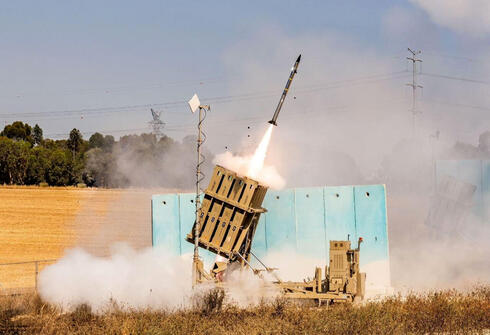
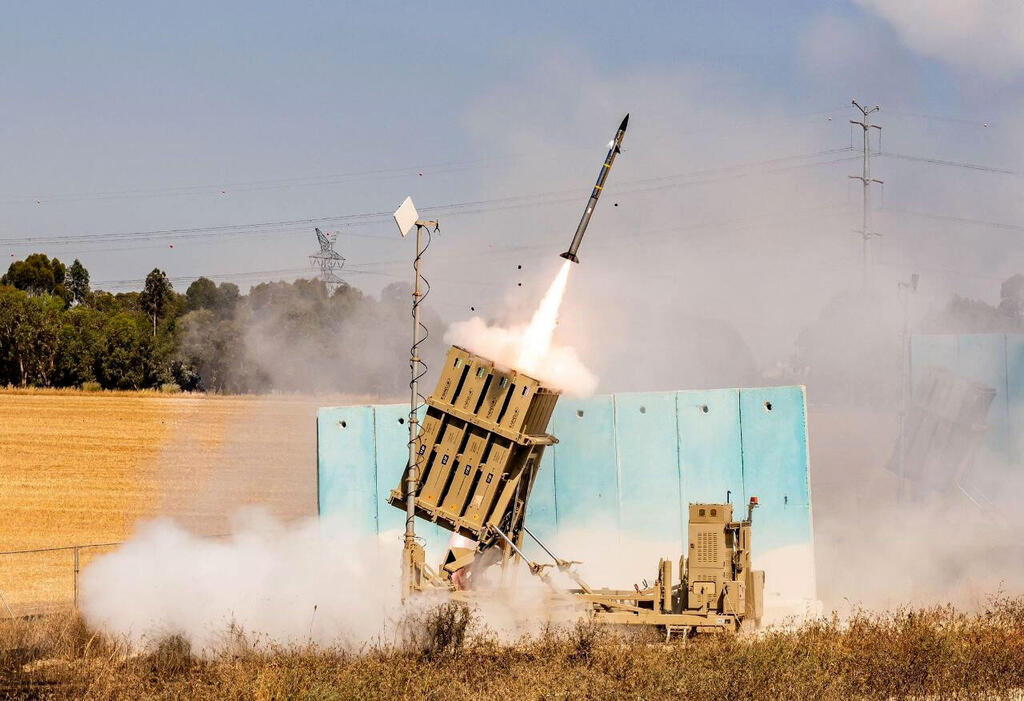
Earlier this week, Calcalist revealed that Ondas, a U.S.-registered holding company, is seeking to acquire control of mPrest, a Rafael subsidiary that develops the command-and-control software for the Iron Dome air defense system. Ondas recently completed a fundraising round of roughly $1 billion to finance its expansion strategy. In addition to mPrest, it is also attempting to acquire Controp, another Rafael subsidiary.
The Director of Security of the Defense Establishment, who is responsible for safeguarding classified assets within the defense industries, has been delaying approval of the transaction for several months. Under the proposed deal, Ondas would acquire the shares of mPrest’s existing shareholders, reducing Rafael to a minority stake. The Director of Security of the Defense Establishment’s primary concern appears to stem from the fact that Ondas is registered in the U.S., creating uncertainty about its future ownership and business trajectory.
Opposing this cautious approach is the Directorate of Defense Research & Development (DDR&D), which is tasked with safeguarding the IDF’s long-term technological capabilities. DDR&D has been actively courting the local defense-tech ecosystem, seeking to bring private capital closer to the core of Israel’s military-technological power. Messages emerging from DDR&D, echoed by Defense Ministry Director General Amir Baram, emphasize the importance of tightening ties between investors and domestic defense industries.
Yet seasoned investors tend to realize their investments when the time is right. This is where the Ondas-mPrest case becomes a cautionary tale. Ondas seeks to purchase its stake for about $100 million, implying a company valuation of roughly $200 million, an offer that has collided with the Director of Security of the Defense Establishment’s high regulatory walls. Other investors examining similar opportunities, and watching this clash unfold from the sidelines, may well reconsider their appetite for the sector.
2 View gallery
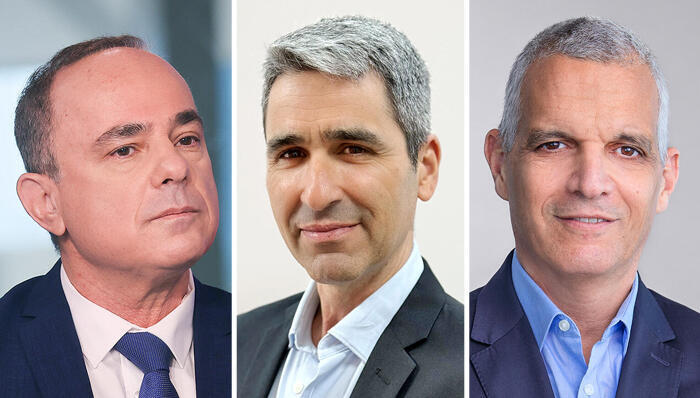
Former Rafael CEO Yoav Har-Even (from right), Ondas co-CEO Oshri Lugassy and Rafael chairman Yuval Steinitz.
(Photos: Inbal Marmari and Yariv Katz)
2. Ondas has effectively become a kind of “golden parachute” for Rafael alumni.
Former Rafael CEO Maj. Gen. (res.) Yoav Har-Even serves on Ondas’ advisory committee, which also includes Dr. Irit Iden, Rafael’s former Executive Vice President for Research and Development. Ondas’ co-CEO is Brig. Gen. (res.) Oshri Lugassy, former chief of the IDF Combat Engineering Corps and, until the end of 2023, VP of Sales & Marketing at Rafael.
Even after formally leaving Rafael, Lugassy continued to act as an external consultant to the company, an arrangement that raised questions among Rafael board members. In a response to Calcalist, Rafael justified the engagement by citing the exceptional workload following the outbreak of the October 7 war, stating that Lugassy’s consultancy was carried out “with permission and authority.”
Another Rafael veteran now joining Ondas is Efrat Lazari, until recently chief of staff to Rafael Chairman Yuval Steinitz, who is expected to be appointed vice president of strategy. The name of Moshe Maor-Miara, Rafael’s former vice president of mergers and acquisitions, also surfaces repeatedly in discussions with senior defense officials monitoring the rapid revolving door between Rafael and Ondas. He, too, is widely expected to join the company.
Ondas’ senior ranks also include Brig. Gen. (res.) Yaniv Rotem, former head of the IDF’s R&D unit, and Brig. Gen. (res.) Avshalom Amossi, a former Air Force officer who most recently commanded the Hatzerim airbase and previously headed the aircraft branch and weapons department in the Air Force.
While salaries at Rafael, like those at Israel Aerospace Industries, are capped and supervised by the Government Companies Authority, Ondas operates without such constraints. According to a source in the defense sector, the company offers what are described as “crazy salary levels” to individuals it believes will help propel it toward its ambitions.
And those ambitions are considerable. Ondas has assembled a portfolio of nine Israeli defense companies, most of them acquired over the past year. Controp and mPrest appear to be just two more entries on an expanding shopping list. The technologies being accumulated are meant to build capabilities in autonomous systems, robotics, unmanned vehicles, drones, and integrated platforms, areas widely viewed as the future of warfare. Ondas is targeting what it estimates to be a global market worth approximately $130 billion.
3. For years, the defense establishment struggled to address the revolving-door phenomenon between the IDF and the defense industries. The landscape is filled with examples of senior officers trading uniforms for business suits and moving directly into top positions at Rafael, Elbit Systems, Israel Aerospace Industries, and others.
“I’ve been in the army my whole life, I’m a security expert, and that’s what I know how to do,” one retired major general who later joined Elbit once remarked to Calcalist. “Where do you want me to work, send my résumé to the Batsheva Dance Company?”
Recent wars in Israel and abroad have dramatically elevated the profile of defense companies, driving sales to historic highs. Where money flows, competition intensifies, particularly for talent. Companies expand, rivalries sharpen, and recruitment battles escalate.
In recent weeks, Rafael has reportedly sought to recruit Adi Dulberg, VP & GM, Intelligence, Communications & EW Division at Elta Systems, an IAI subsidiary. Rafael CEO Yoav Turgeman led Elta until about two years ago, and IAI fears Dulberg’s potential move could be only the first in a series. Expectations of sustained global demand for weapons, combined with the technological lessons emerging from wars in the Middle East and Ukraine, may further accelerate the revolving-door dynamic across the defense sector.
The movement of senior figures between Rafael and Ondas raises pressing questions about the role of the Government Companies Authority, which is charged with overseeing state-owned defense companies. These questions are particularly acute given that former Rafael executives are now leading a private company seeking to acquire Rafael subsidiaries.
As far as is known, the Companies Authority has not been actively involved, despite calls for it to be. Its representatives attend Rafael board meetings, are exposed to strategic decisions, and have the authority to ask difficult questions and demand explanations. Rafael is a state asset, especially now that the Authority has announced preparations for a potential IPO.
History offers a warning. The Aeronautics affair emerged after lapses in oversight. Only last April, nearly six years after Rafael and businessman Avichai Stolero acquired the drone company Aeronautics, did findings from an external audit commissioned by the Companies Authority come to light. The report pointed to information being withheld from the board and the Authority, a flawed management culture, poor communication among senior executives, and a deal structure that left Rafael bearing most of the risk while benefiting Stolero.
Two central figures in that episode were former Rafael CEO Har-Even and former M&A chief Maor-Miara, both of whom may now find themselves working together again, this time at Ondas.
Rafael has said it learned the necessary lessons from an affair that cost hundreds of millions of shekels in public funds. One can only hope that the Government Companies Authority has done the same.



