











Teva CEO cashes in $30 million in shares in two weeks
Richard Francis sells stock after Teva’s 110% rally over the past year.
Teva’s stock may no longer be what it was a decade ago, but its 110% surge over the past year is certainly benefiting its CEO.
Over the past two weeks alone, Richard Francis, CEO and president of the Israeli pharmaceutical giant, has sold shares worth about $30 million.
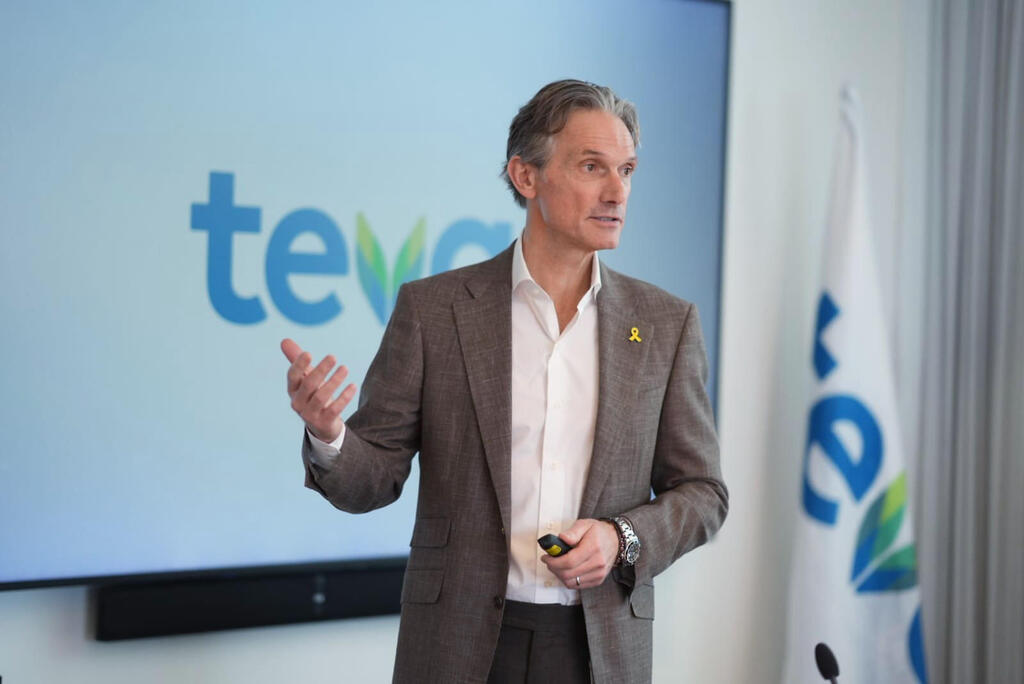
Most of the sales were carried out in two tranches. The first came in mid-February, when Francis sold 447,000 shares for $15.3 million. A second tranche followed last week, when he sold 443,000 shares for $14.3 million. In addition, he sold another 23,000 shares for $759,000 at the end of last week for tax purposes.
These sales represent the realization of restricted shares Francis received when he took over as Teva’s CEO three years ago. Since then, the company’s share price has tripled. The restricted shares were granted based on both operational performance and stock price growth.
This marks Francis’s first significant realization of shares since taking the helm. Even without the sale, he ranks among the highest-paid executives on the Tel Aviv Stock Exchange thanks to his salary and performance bonuses.
Until mid-February, Teva was, as in the past, the largest company listed on the Tel Aviv Stock Exchange, with a market value of around $40 billion. However, since Palo Alto Networks’ dual listing in Tel Aviv and the war-driven surge in Elbit Systems’ stock, Teva has lost its position at the top.
Alongside Francis, other Teva executives have also exercised restricted shares, including Israeli CFO Eli Kalif, though in significantly smaller amounts.
After the recent sales and a new allocation of restricted shares under Teva’s compensation plan, Francis now holds 1.1 million Teva shares, currently worth about $35 million.
Francis became Teva’s CEO after his predecessor, Kåre Schultz, carried out a deep “housecleaning” at the company. Teva had been struggling with a severe financial crisis following the failed $40 billion acquisition of Allergan’s generics division.
Shortly after taking office, Francis introduced a strategic plan called “Pivot to Growth,” aimed at transforming Teva from a traditional generics manufacturer into a biopharmaceutical company focused on innovative drugs.
Under his leadership, Teva has improved profitability and significantly reduced the heavy debt burden taken on to finance the Allergan acquisition, a debt load that once threatened the company’s stability. However, the company has not yet returned to strong overall growth.
In 2025, Teva reported modest revenue growth of 5%, reaching $17.3 billion.
The company’s innovative drug segment, however, is expanding much faster, with 35% growth. Revenue from Teva’s three leading innovative drugs surpassed $3 billion for the first time.
For 2026, Teva forecasts revenue of $16.4-$16.8 billion, reflecting another transitional year.
Investors appear largely supportive of Teva’s long-term strategy to develop innovative medicines.
One of the key drivers is Duvakitug, a drug currently entering Phase III clinical trials after producing leading results among competitors in Phase II studies. The treatment targets inflammatory bowel diseases such as Crohn’s disease and ulcerative colitis, a market estimated at $28 billion.
To accelerate development, Teva last week signed a $400 million financing agreement with Blackstone’s healthcare fund.
This agreement complements a joint development partnership with Sanofi, under which the French pharmaceutical giant is expected to pay Teva up to $1.5 billion.



