










Israel puts another $33 million behind its quantum computing ambitions
The Innovation Authority is seeking proposals for new national infrastructure as the first government-backed quantum center serves more than 30 customers, including all of Israel's leading research universities.
The Israel Innovation Authority has issued a NIS 100 million ($33.3 million) call for proposals to establish a new national research and development infrastructure for quantum computing, marking the next stage in Israel's national strategy to strengthen its capabilities in the field and reduce its dependence on foreign technologies.
The initiative is intended to provide Israeli industry and academia with an advanced laboratory combining several quantum computing technologies. The broader goal is to build domestic research capabilities and give Israeli companies and researchers access to infrastructure that could otherwise be prohibitively expensive or difficult to develop independently.
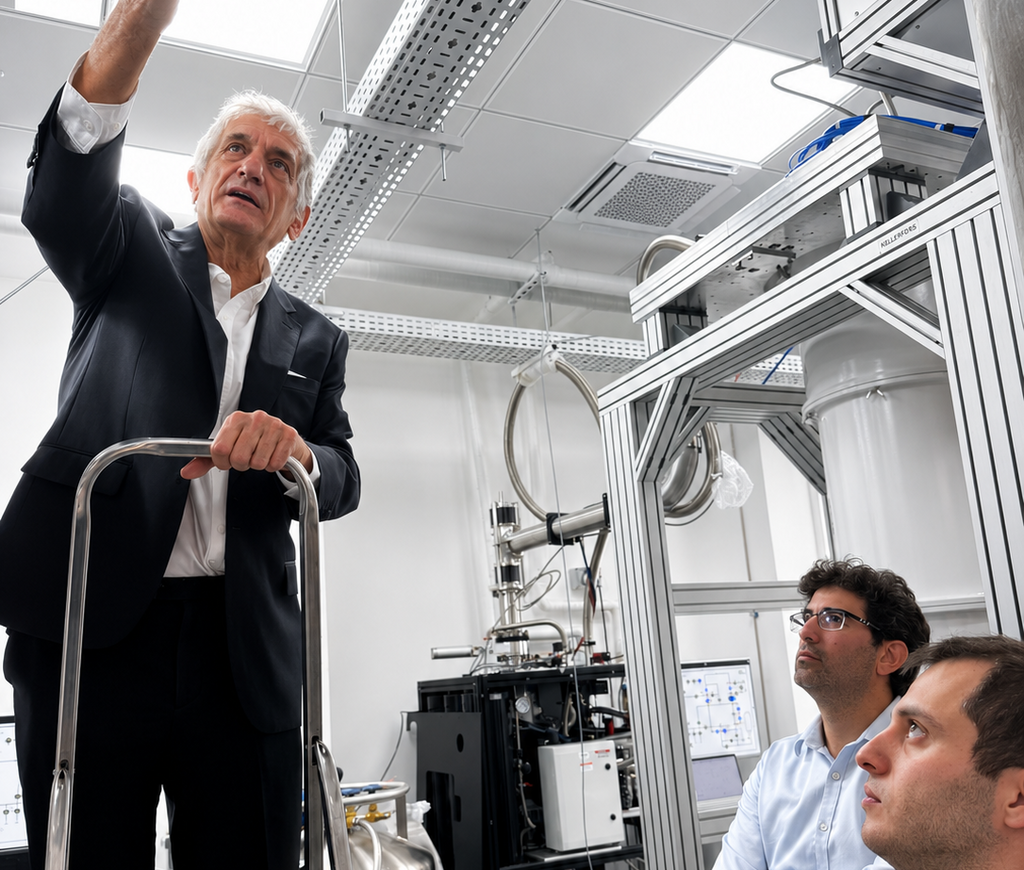
The new initiative comes as the first data on the activity of the Israeli Quantum Computing Center (IQCC), established as part of an earlier NIS 100 million ($33.3 million) government investment, is being revealed. The figures provide the clearest indication yet of whether public investment in quantum infrastructure is translating into actual research and development activity, and whether there is sufficient demand for a shared national facility.
Established in 2024 at Tel Aviv University by Quantum Machines with support from the Innovation Authority, the IQCC now serves more than 30 customers from Israel and abroad. More than 10 are Israeli organizations, including all of the country's leading research universities: Tel Aviv University, Bar-Ilan University, the Technion, Ben-Gurion University and the Hebrew University.
That means the center is not serving only as a national laboratory for a handful of researchers. It has become shared infrastructure for much of Israel's academic quantum research community, while also attracting commercial users from the country's emerging quantum industry.
Among the Israeli startups using the center is QuamCore, which relies on the IQCC as part of the development and characterization of its technology.
QuamCore's development process requires thousands of measurements of components at temperatures of around 10 millikelvins. To accelerate the process, the company conducts measurements simultaneously at several laboratories, including the IQCC, as it works toward producing a complete quantum processor.
The center has also attracted international technology companies and researchers. IQCC developed an advanced connection between quantum and classical computing in collaboration with Nvidia, based on the Nvidia DGX Quantum architecture, allowing researchers to integrate quantum processors with high-performance classical computing. Quantum Machines and NVIDIA have described DGX Quantum as a tightly integrated quantum-classical computing platform, and the IQCC was among its early deployments.
The center has also become the first facility in the world to deploy Qolab's superconducting quantum processors. Qolab was founded by Prof. John Martinis, who was awarded the Nobel Prize in Physics in 2025. The deployment was announced in December 2025.
The IQCC was designed from the outset to bring different quantum computing technologies under one roof rather than betting on a single architecture. When it opened, the center included multiple quantum systems and was designed to integrate them with classical high-performance computing and cloud infrastructure.
That model is now being replicated abroad. Quantum Machines is establishing another quantum computing center in Chicago in collaboration with the state of Illinois, as part of the Illinois Quantum & Microelectronics Park. The center will draw on knowledge, infrastructure and control systems developed in Israel.



