










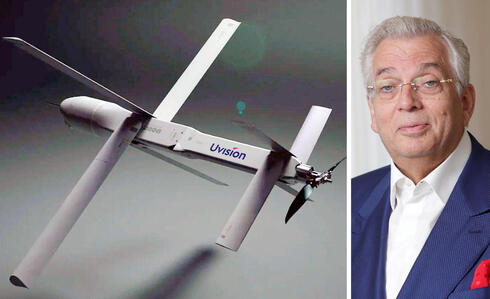
UVision CFO exits as suicide-drone maker's $3.5 billion Nasdaq IPO hits valuation hurdles
Ronny Barak has left the company as defense stocks retreat, raising pressure on owner Aaron Frankel to lower his IPO ambitions.
The departure of a CFO while a company is preparing for an IPO is anything but usual. Calcalist has learned that Ronny Barak, CFO of UVision, recently left the company under unclear circumstances. Eyal Rubin, CFO of Nasdaq-listed Nasus Pharma, is expected to replace him. Rubin announced his retirement from Nasus Pharma on Wednesday, effective in September.
UVision, the suicide-drone company owned by Aaron Frankel, is conducting a roadshow ahead of a planned Nasdaq IPO, targeting a valuation of $3.5 billion before cash. But reaching that valuation is proving difficult as defense stocks have come under pressure after a two-year rally.
NextVision, for example, has fallen about 40% on the Tel Aviv Stock Exchange from its peak in early March and is currently valued at around NIS 20 billion.
Frankel initially held discussions with Israeli institutional investors about selling a 5%-10% stake in UVision. The institutions were willing to value the company at between $2.5 billion and $2.9 billion, but Frankel rejected the range and continued to pursue the higher valuation.
Since then, the broader sell-off in defense stocks has made the target even harder to achieve. According to estimates in the institutional market, UVision may now struggle to secure even the $2.5 billion-$2.9 billion valuation previously offered by Israeli investors.
Although the planned IPO will take place in the U.S., UVision, led by CEO Ran Gozali, began its roadshow in Israel about a month ago, meeting with local institutional investors.
The valuation remains one of the main obstacles to the offering. Frankel may ultimately have to accept a lower valuation if he wants to complete the IPO this year. The company had initially targeted a summer offering.
The move comes after Frenkel failed to reach agreements with Israeli institutional investors regarding the company's valuation as part of a pre-IPO fundraising effort. Frenkel sought to bring in three to four institutional investors to invest in the company, which specializes in developing and manufacturing loitering munitions, often referred to as suicide drones , that can locate a target, loiter over an area, and strike with precision.



