










Israel’s long arm of air power faces new crossroads
IAI urges local production of refueling jets, while Boeing’s big contract locks up U.S. funding.
Israel Aerospace Industries (IAI) wants a share of the Air Force’s multibillion-shekel plan to acquire new aerial refueling aircraft, a program estimated to exceed NIS 10 billion (approximately $3B). Calcalist has learned that while the Air Force is pressuring the Ministry of Defense to speed up the purchase of two additional KC-46 tankers from Boeing, IAI is pushing to supply the next tankers itself. These would be based on Boeing 767s that IAI’s aviation division would convert and adapt for aerial refueling. Such aircraft are critical for long-range strike missions, including potential operations in Iran and Yemen.
About three years ago, Israel ordered four KC-46 tankers from Boeing at a total cost of roughly $930 million. The first of these aircraft is expected to arrive in the first half of 2026. U.S. government approval allows Israel to buy up to eight KC-46s, and the Air Force is determined to use this opportunity to fully replace its aging fleet of six converted tankers that have served for decades.
1 View gallery
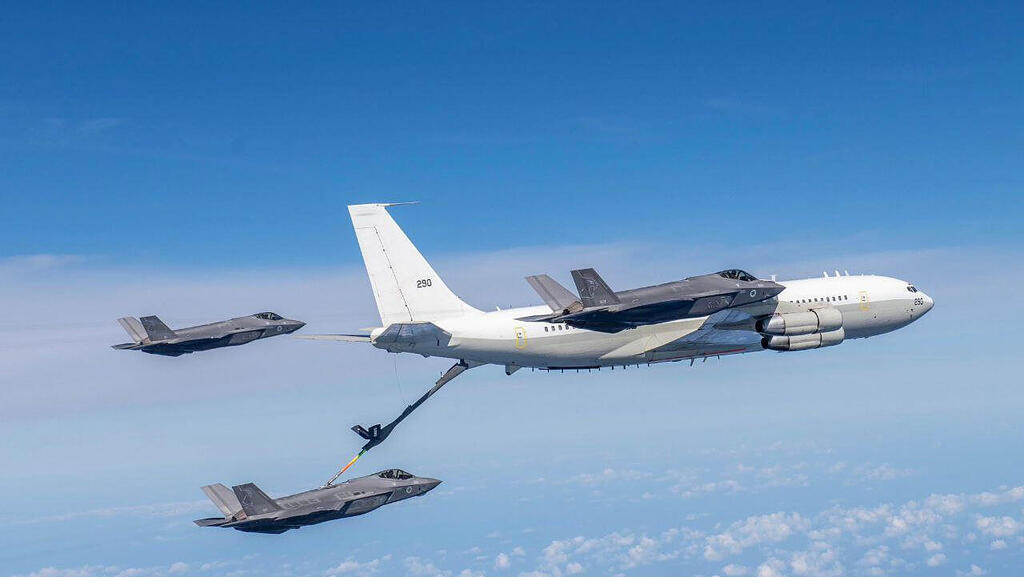
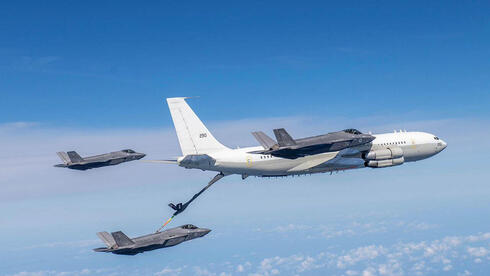
Aerial refueling of fighter jets during the military operation against Iran.
(IDF Spokesman's Office)
Those are Boeing 707s, originally converted by IAI into tankers known as “Reem” in the Air Force. Despite their age, they have enabled Israel’s long-range aerial refueling capability, including during operations deep inside Iran, some 2,000 kilometers from home bases. During 12 days of recent fighting, these tankers performed hundreds of refuelings, allowing Israeli fighter jets to stay in Iranian skies longer and maintain air superiority.
From the Air Force’s perspective, now is the ideal moment to push forward decisions and plans to renew and expand its aerial refueling capability. The defense establishment also believes circumstances require not only a renewal but potentially an expansion, possibly even doubling capacity to a squadron of 12 tankers. The multiple distant theaters that have engaged the Air Force since October 7, 2023, have only increased the urgency.
“The IDF needs to change course”
The planned grounding of the aging “Reem” tankers, along with the arrival of new Boeing-made aircraft that will be maintained by Boeing teams, could sideline IAI’s longstanding role in Israel’s refueling capability. IAI warns that relying entirely on U.S.-made tankers risks eroding Israel’s independent strategic know-how, which has been sustained through the decades-long maintenance and development of the Reem fleet.
The company argues that shifting completely to KC-46s could make it unnecessary for IAI to maintain its refueling aircraft know-how, potentially leading to the loss of its capabilities, and closure of operations in this critical field.
Two weeks ago, Defense Minister Israel Katz toured IAI’s main facility in central Israel, where senior company executives presented their offer to supply some of the new tankers and asked for his support. Meanwhile, American crews are already building hangars and support infrastructure at Nevatim Airbase to prepare for the arrival of the first four KC-46s.
IAI’s push to stay in the game may test the Defense Ministry’s commitment to its “independence in production” policy, a principle emphasized since the war began to strengthen the Israeli defense industry amid new export restrictions from foreign governments. Three years ago, IAI tried to promote a similar plan for converted tankers but was rejected. Now it hopes the Defense Ministry and Air Force will “change course,” as a senior IAI official told Calcalist. “Every past decision must be re-examined to ensure the Air Force’s freedom of action in distant theaters, without risking our true long arm being neutralized by political pressures.”
Experts in IAI’s Aviation Division, headed by Yaakov Berkowitz, say its converted tankers would be identical to Boeing’s models, meaning no additional storage or maintenance infrastructure would be needed beyond what the KC-46s require. The KC-46 itself is based on the Boeing 767, an aircraft IAI knows well. Notably, Israel’s “Wing of Zion” VIP jet, used by the President and Prime Minister, is also a 767 converted by IAI in 2016 from a Qantas airliner into a state VIP aircraft.
Cheaper than the Americans?
It remains unclear how attractive IAI’s alternative would be on cost. Under the 2021 deal, each new U.S.-made KC-46 costs about $230 million. Defense sources estimate IAI’s converted option would be cheaper, but the exact savings depend on the cost of acquiring secondhand 767s on the civilian market for conversion.
Another key question is how to pay for them. Tankers purchased directly from Boeing are funded by the $3.8 billion in annual U.S. defense aid that must be spent in the United States. But any deal with IAI would need to be funded from the shekel portion of Israel’s defense budget, which is already stretched thin across many competing needs.
IAI’s push to stay involved could force the Defense Ministry to clarify the limits of its local procurement policy, a policy introduced by former Defense Ministry Director General Eyal Zamir, now IDF Chief of Staff, and supported by his successor Maj. Gen. (res.) Amir Baram. Under this policy, the Defense Ministry has recently channeled billions of shekels to Israeli shipyards and weapons makers, including last year’s NIS 2.4 billion deal for new Navy ships.
Last week, IAI celebrated the successful launch of the national communications satellite Dror-1, built by its Missiles and Space Division and launched via Elon Musk’s SpaceX. The project cost about $200 million and was funded by the state, part of a government effort to keep IAI’s satellite know-how alive amid stiff global competition. That move followed recommendations by a government panel formed after the 2018 Amos-6 disaster, when IAI’s satellite was lost in a rocket explosion. Spacecom, its only customer, then turned to Boeing instead, threatening IAI’s future in communications satellites. The panel recommended the state purchase a new communications satellite every five years to sustain the technology. IAI expects talks to begin soon on Israel’s next satellite, Dror-2, for launch in the early 2030s.
The Ministry of Defense declined to comment.



