










A regime on edge: Assassinations expose Iran’s economic and political fault lines
From street control to currency collapse, Tehran’s tools are narrowing.
After a dramatic wave of assassinations over the past 24 hours, the Iranian regime faces a dual test, perhaps the most severe in its history: military survival against an external enemy and internal stability against a restless public waiting for a moment to erupt.
The killings of Ali Larijani, head of the Supreme National Security Council, and Gholamreza Soleimani, commander of the Basij, represent not only a significant operational blow but a simultaneous hit to two critical pillars of the regime. On one hand, Iran has lost a key figure responsible for political-strategic coordination and the delicate interface between military and civilian leadership; on the other, it has lost the commander overseeing the apparatus tasked with suppressing dissent and maintaining control on the streets.
1 View gallery
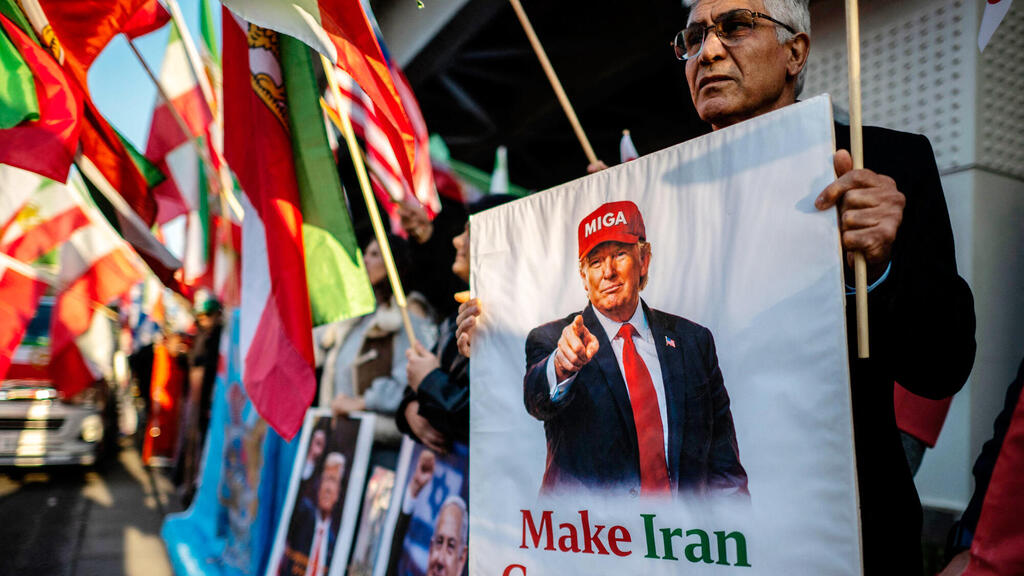
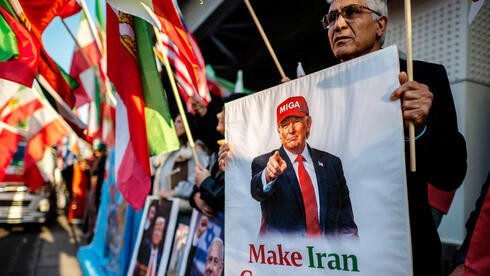
Demonstration in support of President Trump outside the Iranian embassy in Tokyo
(Philip Fong/ AFP)
The importance of the Basij commander extends far beyond the military sphere. The Basij functions as the regime’s last line of defense against its own citizens, a paramilitary force designed to enforce order, disperse protests, and deter dissent. Soleimani led the repression campaigns of recent years, including the violent crackdown on protesters. His removal creates both a symbolic and operational vacuum at a time when the regime most needs internal deterrence.
Now, more exposed than ever, the regime appears to be turning to its final lever of control: the economy. Yet here, too, its options are limited.
To understand the anxiety gripping Tehran’s leadership, one must recognize that the current conflict has struck not a resilient economy, but one already in deep distress. Official data from the Central Bank of Iran indicate persistent structural weakness, with annual inflation exceeding 46% and consumer prices rising sharply month to month. The rial has lost nearly half its value over the past year, trading at around 1.5 million to the dollar on the open market.
The relative stability seen in recent days is misleading. Currency trading has slowed dramatically, with many Iranians holding back from converting their savings amid uncertainty. This pause reflects hesitation, not confidence, a temporary calm that could quickly give way to renewed depreciation once conditions shift.
Economic measures introduced since the outbreak of fighting on February 28 reflect crisis management rather than recovery. A ban on food exports aims to secure domestic supply, while the expansion of the Kalabarg electronic coupon system signals a return to wartime rationing reminiscent of the Iran-Iraq War. For the regime, these policies are tools of control as much as economic instruments.
Although the monthly support provided amounts to roughly $6.7 per person, the symbolic message is clear: the state remains the primary provider of basic necessities, and dissent carries tangible risks.
A similar logic underpins the introduction of a new “Iran-Cheque” banknote worth one million tomans. While presented as a technical adjustment, it appears designed to prepare for potential cash shortages. High-denomination currency can ease liquidity pressures but also reflects declining purchasing power. The move highlights a broader reality: attempts to project stability amid deepening economic strain.
Perhaps the most consequential, and risky, measure is a more than 60% increase in the minimum wage. While this injects liquidity into households, it also risks intensifying inflation in an economy already constrained by reduced supply. For the leadership, however, the political calculus appears paramount. With roughly 12 million minimum-wage workers forming a critical segment of the labor force, the wage hike, from about $69 to $111 per month, can be seen as an effort to preserve social stability.
For now, the oil sector continues to provide a degree of financial lifeline. Despite disruptions, exports persist through alternative channels, allowing the regime to sustain subsidies and wage increases. But this remains a race against time. Some officials, including Mohsen Rezaei, have advocated a strategy of pressuring global markets by driving oil prices higher, betting that external actors will feel the strain before Iran does. That assumption carries significant risk.
Historically, economies under prolonged siege face a common danger: internal erosion. Systems reliant on rationing, subsidies, and currency expansion often encounter instability not only from external shocks but from declining public confidence.
In recent weeks, Iran’s economy has effectively been operating under emergency conditions. With the loss of senior leadership figures and increasing pressure on both military and economic fronts, the regime’s margin for error is narrowing. Missteps, whether in monetary policy or supply management, could have consequences that extend beyond economics into social unrest.
The regime in Tehran is not on the brink of immediate collapse. However, its actions suggest a shift into a mode of existential preservation, where short-term stability comes at mounting long-term cost. The greater challenge may lie not only in external threats, but in the moment when citizens begin to question the value, both economic and political, of the system itself.



