










As war threatens the Gulf economy, Israel’s defense edge gains value
Missile attacks on energy routes and airports are pushing Gulf states to seek technologies Israel has developed over years of conflict.
For the Gulf states, the current war is not just a security threat; it is also a deep and wide-ranging crisis that undermines their entire economic model - the foundation of their success.
In recent decades, their strength has been based on open skies, efficient ports, tourism, high-tech industries and global investment. These long-term processes created stable prosperity. But in a single moment last Saturday, it became clear that everything ultimately depends on one question: can these countries ensure operational continuity when the threat of missiles and drones reaches airports, seaports and civilian infrastructure?
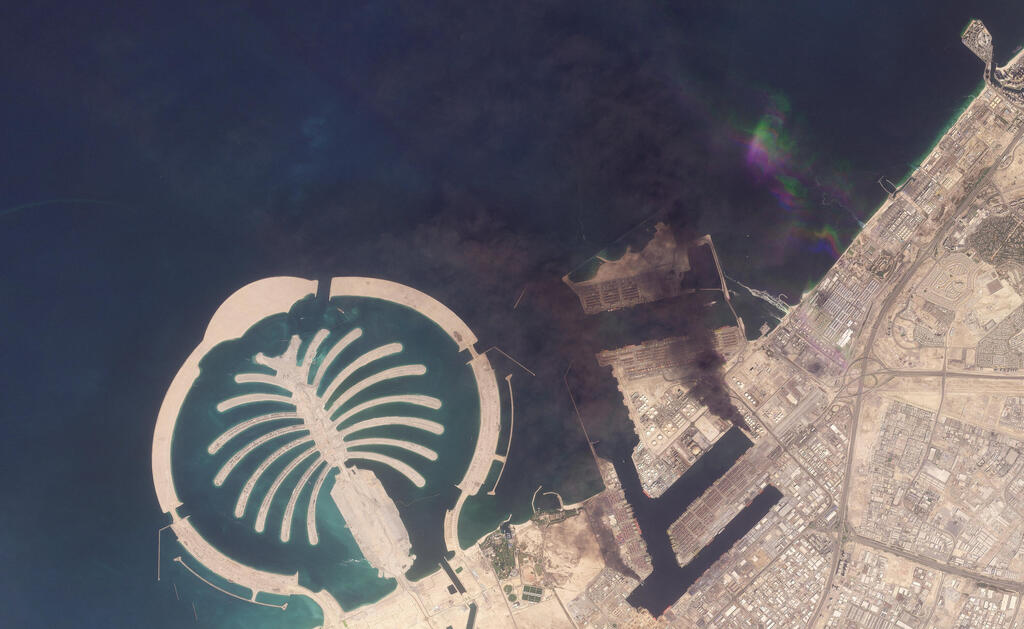
After the initial shock, Gulf leaders began to understand the implications, and their official rhetoric intensified as the week progressed. On Sunday, Anwar Gargash, adviser to the president of the United Arab Emirates, warned Iran: “Your war is not with your neighbors.”
On Monday, the UAE summoned the Iranian ambassador in Abu Dhabi and delivered a strong letter of protest, describing the attacks as “terrorist” and making clear that the Emirates rejects any Iranian “excuse” for them. The statement also emphasized that the UAE “reserves its right to respond.”
Later that day, a joint statement was issued by the UAE, Qatar, Saudi Arabia, Bahrain and Kuwait, together with Jordan and the United States, condemning the Iranian attacks as “indiscriminate and reckless” and warning that they represent a “dangerous escalation.”
The increasingly sharp tone reflects the enormous economic stakes. Every day of attacks on the Gulf states takes a toll through flight cancellations, shipping delays, tourism disruptions, business interruptions and soaring insurance premiums.
Above all, there is the looming risk of missiles or drones striking the oil and gas sector.
After only a few days of fighting it is still too early to assess the full extent of the damage. But consider the importance of the Strait of Hormuz, through which roughly 20 million barrels of oil pass each day, about a fifth of global consumption, worth approximately $1.5 billion on an average day (as of 2024).
The war-risk premium for ships has already jumped this week from about 0.2% of a vessel’s value to roughly 1%. Some insurance companies have already announced they are canceling war-risk coverage in the region, meaning that these additional costs will eventually be passed on to the price of goods and ultimately to consumers.
The effects are already visible across the region.
Almost all of Qatar’s liquefied natural gas industry is concentrated in the Ras Laffan industrial complex, which was temporarily shut down on Monday. Qatar is responsible for about 20% of global LNG exports and in 2025 shipped approximately 81 million tons worldwide, all through the Strait of Hormuz.
Saudi Arabia’s oil exports have also been affected. In 2024, about 5.5 million barrels per day passed through the Strait of Hormuz, although the kingdom can partially offset disruptions through pipelines leading to the Red Sea.
In Kuwait, oil accounts for roughly 68% of GDP, meaning any disruption to the sector poses a serious economic threat.
In the United Arab Emirates, the main damage is being felt in aviation and tourism. Dubai International Airport handled 95.2 million passengers last year. It was closed over the weekend and has only partially reopened since.
In other words, the cost of each day of war amounts to billions of dollars.
Such damage is pushing the Gulf states to seek defense systems capable of ensuring operational continuity and protecting critical energy infrastructure.
Reports in the West indicate that Gulf governments are urgently searching for technologies that can secure ports, cities, industrial facilities and airspace.
Italian Defense Minister Guido Crosetto said on Monday that Gulf states have already expressed interest in purchasing the SAMP/T (MAMBA) air-defense system developed by Italy and France.
This interest will inevitably lead to Israel as well. In the Gulf, Israel is increasingly seen as possessing a rare combination of operational experience in confronting the types of threats these countries now face, along with advanced capabilities in integrating intelligence, sensors and interception systems, supported by a mature defense industry capable of delivering solutions relatively quickly.
And not only in the Gulf. Israel’s strengths in intelligence, defense technology and operational experience are widely recognized around the world and are likely to become even more sought after.
Throughout the week, foreign security commentators repeatedly emphasized the concept of “qualitative superiority,” the idea that intelligence capabilities, air defense and multi-layered protection are essential for maintaining national stability.
In other words: countries that can defend their skies can protect their economies.
That is precisely what the Gulf states are now seeking, and what Israel has developed over many years.
Beyond technology, another factor has drawn attention this week: resilience.
Media outlets across the region have discussed Israel’s ability to maintain a degree of normalcy even under sustained attack.
For example, Al Jazeera published an article describing life in Israel since October 2023, a reality that combines ongoing conflict and constant vigilance with the continued functioning of civilian life.
For Gulf states, this serves as a reminder that strong defense systems and effective emergency management are essential components of economic resilience.
It is no coincidence that several Gulf countries have already shown interest in Israeli defense technologies in the past and have begun purchasing advanced systems.
The United States has also promoted the idea of a regional air-defense umbrella that would include Gulf states, a framework linking demand in the Gulf with advanced technologies from Israel and the West.
This week’s events have given that idea new momentum.
For the Gulf states, the war is a stark reminder that their global brands, Dubai as a hub for trade and business, Doha as an international events center, Abu Dhabi as a capital and technology hub, Manama as a financial center and Saudi Arabia as the region’s rising economic power, are just as vulnerable as oil installations.
As a result, alongside political considerations, a clear economic and industrial need has emerged: to build a defensive layer capable of preventing economic paralysis.
In a market where experience with Iranian threats has become a crucial factor, Israel increasingly appears to be a natural partner.



