









Marvell CTO: "The market has finally reached the bottleneck we solve"
Israeli Noam Mizrahi explains why Jensen Huang believes the company belongs in the trillion-dollar club, and why AI’s future depends on the networks connecting hundreds of thousands of processors.
Nvidia's Jensen Huang is not only the king of technology today (sorry, Elon Musk), but also a kingmaker. In early June, at the Computex conference, Huang declared that Marvell, a relatively sleepy chip company until recently, would be the next member of the trillion-dollar club. That same day, the stock jumped 33% in New York, and since the beginning of the year it has surged 250%.
Marvell's stock will enter the S&P 500 this week and has become one of the market's most richly valued companies in terms of revenue and earnings multiples, following its meteoric rise.
And after all those gains, it is still worth "only" $270 billion. In other words, if you trust Huang, anyone investing in Marvell today could theoretically expect the company to quadruple in value before reaching the trillion-dollar threshold. That may sound ambitious, but in today's AI-driven market, it is not unprecedented. Just ask investors in Broadcom or Micron, two other AI-chip players that rapidly climbed to trillion-dollar valuations and, in Broadcom's case, even approached $2 trillion.
Even today, at its current valuation, Marvell trades at richer multiples than Nvidia itself and Broadcom. But if everything Huang believes will happen does indeed materialize, that valuation gap could quickly narrow.
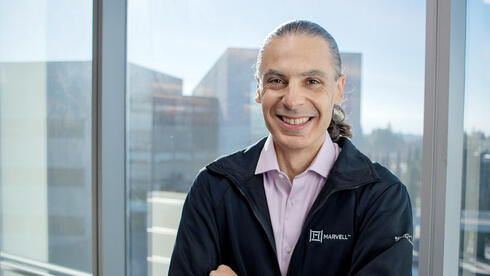
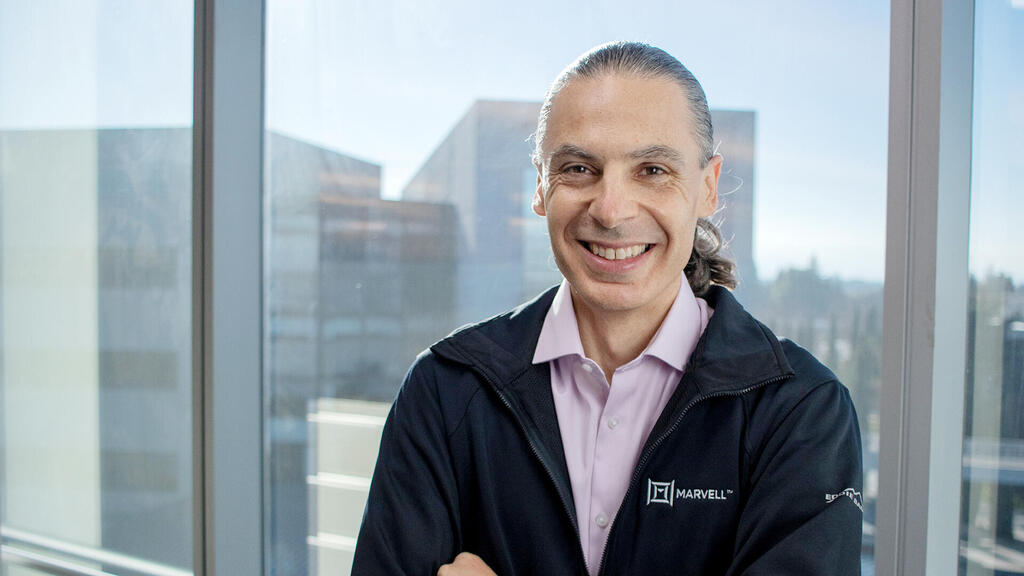
The person largely responsible for the vision that has turned Nvidia into both an investor in Marvell and a major partner is Noam Mizrahi, Marvell's Israeli Chief Technology Officer (CTO). Few people remember today that Marvell was responsible for one of the first major exits in Israeli high-tech history. In October 2000, at the height of the Second Intifada, it paid $2.7 billion for Galileo Technology, the company founded by then little-known entrepreneur Avigdor Willenz.
The acquisition put Willenz, who later completed a series of major exits, on the global semiconductor map for the first time and laid the foundation for Marvell's development operations in Israel.
At the time, Mizrahi was an electrical and computer engineering student at the Technion who worked part-time at Galileo. He effectively found himself at Marvell almost immediately after the acquisition, aside from a brief stint at Intel before returning to Marvell. The company later expanded its Israeli footprint through additional acquisitions, including DSPC from Intel for $600 million in 2006 and RADLAN from the Rad-Bynet Group in 2007 for approximately $50 million.
Today, based on those acquisitions and subsequent growth, Marvell operates Israeli development centers in Petah Tikva and Yokneam, employing about 500 people out of the company's global workforce of roughly 8,000.
Noam Mizrahi, why is Huang so enthusiastic about Marvell that he is publicly praising the company and helping fuel such a dramatic rise in its stock price?
"It's not that Marvell suddenly changed something that got Jensen excited. We've been pursuing the same strategy for a decade, but the market has now reached the bottleneck that we're solving, and his statement effectively served as an endorsement from the world's leading expert on the technology," Mizrahi says in an exclusive interview with Calcalist.
"The first and most obvious AI bottleneck was computing power. But connectivity quickly became the next major constraint. Because the solution to the computing challenge is to distribute workloads across hundreds of thousands of processors, performance increasingly depends on the ability to connect those processors efficiently and make them function as a single computing unit."
So is Marvell essentially doing something similar to what Mellanox did before Nvidia acquired it for $7 billion in one of the most successful deals in semiconductor history?
"Exactly. Over the past several years, Marvell has built an entire portfolio around connectivity. We don't limit ourselves to a single technology. We still offer solutions based on traditional copper connections, but we see that copper is approaching its physical limits. That is driving the transition toward optical communications inside data centers. We also have the industry's most comprehensive optical portfolio."
The shift toward optical communications in data centers is indeed one of the biggest trends in the industry today. One beneficiary in Israel has been Tower Semiconductor, which identified the opportunity early and established dedicated manufacturing lines for photonics-related products. That move helped drive a sixfold increase in Tower's stock price within a single year.
According to Mizrahi, however, Marvell is not betting solely on optical technologies.
"The market is still trying to remain on copper for as long as possible because it remains the most cost-effective solution and is already deployed throughout data centers," he explains. "Everyone is trying to squeeze more performance out of existing infrastructure. That's why we develop components capable of transmitting data at extremely high speeds over copper. But in the end, physics doesn't change. There is a limit to what can be achieved without moving to optical technologies."
But Marvell isn't focused solely on connectivity. You also compete with companies such as Broadcom in developing custom chips for customers.
"We don't compete in GPUs or CPUs, and we don't build processors like Nvidia or Intel. But we do develop custom silicon for customers. They bring us their workloads and requirements, and we turn them into chips ready for production. For example, we have products that allow customer-designed chips to connect directly to Nvidia's ecosystem and benefit from its performance. In some areas we partner with Nvidia, and in others we compete."
Several of Avigdor Willenz's other companies have also been involved in these markets. Annapurna Labs, which Amazon acquired for $350 million in 2015, became the foundation of Amazon's in-house AI chips. Habana Labs, acquired by Intel for $2 billion in 2020, was intended to strengthen Intel's AI ambitions. Today, Willenz remains involved in several Israeli startups developing technologies related to AI chips.
Twenty-six years after the Galileo acquisition, can any Marvell product still be described as "coming from Galileo"?
"A huge number of semiconductor companies in Israel trace their roots back to Galileo. The founders of Annapurna Labs also came from there. But today there is no longer a division by product. Marvell's headquarters are in Santa Clara, which houses the largest development center. The second largest is in India. In addition, we have similarly sized engineering centers in Israel, Vietnam, and Singapore.
"The company operates as a single global engineering organization. There are no products developed exclusively in one location.
"The Israeli organization, which is managed by Eran Herooti, leads development efforts across many types of chips and components. But it's no longer possible to point to a specific product and say, 'This came from Galileo,' just as Nvidia can no longer isolate what came solely from Mellanox. Israeli engineers are highly versatile and can move quickly between projects, which is one of our advantages."
Mizrahi, currently Marvell's most senior Israeli executive and the only one reporting directly to CEO Matt Murphy, was appointed CTO in 2020, during a period of profound transformation for the company.
Marvell was founded by two brothers and the wife of one of them. But by 2016, after years of stagnant operational performance and a stock price that left the company stuck at a valuation of roughly $10 billion, activist investor Starboard Value pushed out the founders and installed new management.
Murphy led a sweeping transformation, largely through a series of bold acquisitions. The most significant included the $6 billion acquisition of Cavium in 2018 and the $10 billion acquisition of Inphi in 2021. Last December, Marvell paid $3.25 billion for photonics company Celestial, further strengthening its position in optical connectivity technologies.
"Marvell has undergone a tremendous transformation over the last decade," says Mizrahi. "When Matt Murphy became president and CEO, the stock was trading at only a few dollars per share, and most of our revenue came from consumer markets such as smart TVs. Only about 10% of revenue came from data centers.
"Murphy quickly realized that the world was moving to the cloud and fundamentally changed Marvell's direction. That required changing the company's DNA, developing new technologies, and integrating a long list of acquisitions. It has been a decade-long transformation process, and now we're starting to reap the rewards.
"We used to be just another company in our market. We weren't inventing anything new. Today, Marvell is viewed as a technology leader."
Following its acquisition spree, Marvell now sits at two of the most important intersections in the AI infrastructure market. On one hand, it addresses the connectivity bottleneck inside data centers through optical technologies. On the other, it provides the neutrality that major AI companies increasingly seek as they try to reduce dependence on Nvidia.
Companies such as Google, Amazon, and Meta are developing their own AI processors and are turning to companies like Broadcom and Marvell to help design and manufacture them.
Financially, however, Marvell remains much smaller than its largest peers. To justify a trillion-dollar valuation using multiples similar to Nvidia's or Broadcom's, its revenue would likely need to grow several-fold.
Marvell is growing rapidly. Revenue rose 42% in fiscal 2025 to approximately $8.2 billion. By comparison, Broadcom's revenue grew 24% but reached nearly $64 billion. Marvell is expected to generate about $11.5 billion in revenue this year and has outlined ambitions to reach $30 billion by 2030.
The company is also less profitable than some of its peers, largely because of the many acquisitions it has completed and the associated integration costs. Nevertheless, Marvell's gross margin remains strong at approximately 51%.
Huang's endorsement and the subsequent rally in the stock have created significant expectations. Are you increasing hiring in Israel?
"We are hiring aggressively in Israel. We have dozens of open engineering positions, including for experienced professionals, but we're not afraid to hire junior engineers either, unlike many companies today.
"As Marvell has changed and the stock has appreciated, more people have become aware of the company, and recruiting has become easier."
Both you and the head of the Israeli site started at Marvell as students. Today it is very difficult for junior candidates to enter high-tech, especially companies at the center of the AI boom. What should students study? Is computer science still the best option, or are physics and electrical engineering becoming more important? And will AI replace large numbers of workers, as some fear amid the current wave of layoffs?
"I really don't think so. AI allows engineers to define what code should do and then use AI agents to help execute those tasks instead of writing every line themselves. That doesn't mean engineers are no longer needed. It means they can accomplish much more.
"The best comparison is the Industrial Revolution. A carpenter once needed several days to build a table. Today, machines can produce thousands of tables per day based on human designs."
That's true, but there are far fewer carpenters than there used to be.
"The profession changes, but the need for people to define, supervise, and manage the process remains.
"An engineer today can work alongside hundreds of AI agents that increase both the quality and quantity of output. I don't want to replace people; I want people to become more productive.
"One of the first processors ever developed contained just over 2,000 transistors, connected manually by engineers. Over time, automation tools emerged that could automate the physical design process on a much larger scale. Did that make engineers obsolete? Quite the opposite.
"Automation enabled us to build far larger and more complex chips. Engineers moved up a level of abstraction, from manually connecting thousands of transistors to managing systems that connect tens of millions of them.
"Today's Nvidia AI processors contain tens or even hundreds of billions of transistors. The problems that need to be solved are vastly larger and more complex than before. As a result, we need more engineers with broader and more sophisticated skills than ever."



