










“I am confident we will see a trillion-dollar Israeli company”
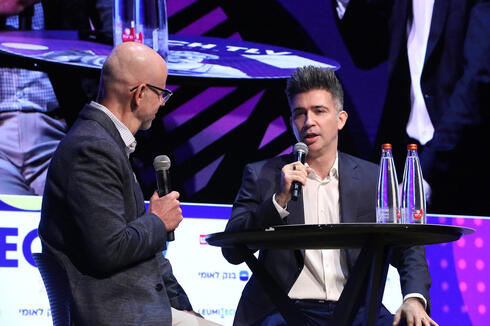
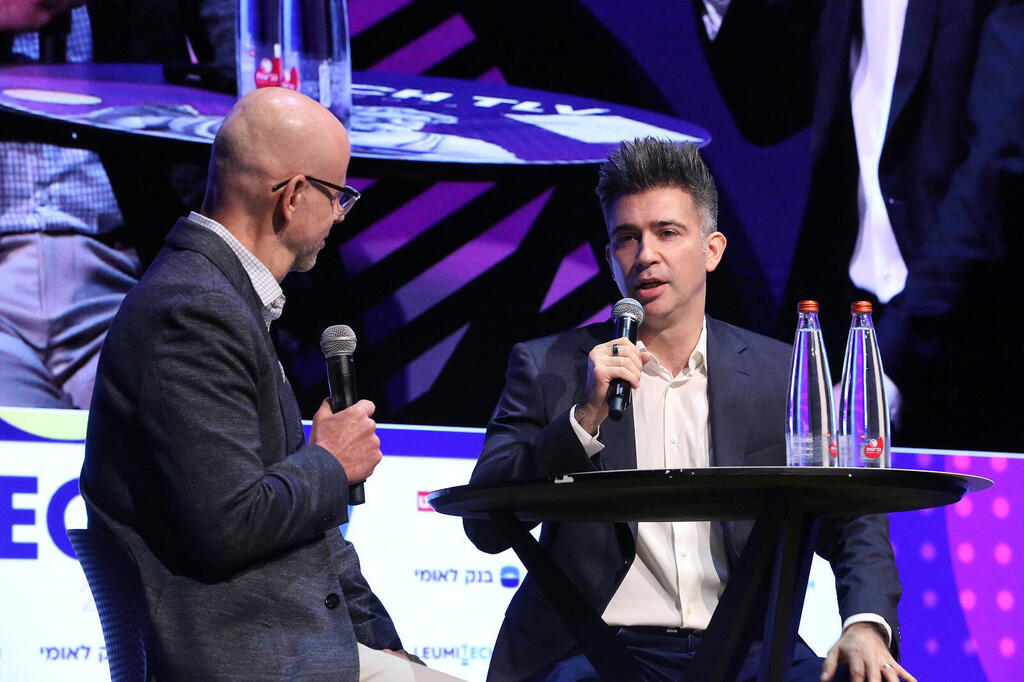
Dror Bin, CEO of the Israel Innovation Authority, was speaking alongside Yevgeny Dibrov, co-founder and CEO of Armis, as part of Calcalist's Tech TLV conference.
About a month and a half after software giant ServiceNow announced its intention to acquire Israeli cyber unicorn Armis for $7.75 billion, Yevgeny Dibrov, co-founder and CEO of Armis, met with Dror Bin, CEO of the Israel Innovation Authority, to discuss the future of Israeli high-tech and the path to growth for large companies. The conversation took place at Calcalist’s Tech TLV conference, held in collaboration with Leumi.
“How does it feel to be part of one of Israel’s biggest exits?”
Dibrov replied: “It’s exciting. There’s still time until the deal closes, but we see it as just the beginning, a new chapter in the life of Armis.”
“Tell us how it all started and how you grew into a company being sold at such a valuation?”
Dibrov reflected: “It’s been exactly ten years since Nadir Izrael and I founded Armis. It has been a rollercoaster ride, with peaks and valleys. What has always guided us is staying very close to our customers. CEOs need to be in the field, not just behind an Excel chart. I see at least ten customers every day, which builds strong relationships. It helps us anticipate their needs and develop our product platform. Today, we have seven products on the platform, and many customers use three or even five Armis products. That’s why we’re still growing at 50% per year, even though revenues are already in the hundreds of millions of dollars.”
Dror Bin, how do you summarize 2025 and look ahead to 2026?
Bin said: “I’ve been in high-tech for thirty years. When I entered, even before the dot-com bubble, there were only a few giants, like Comverse and ECI. I asked myself why Israel didn’t have more large companies. The answer was simple: we are a young country. Over time, managers gain experience and grow large companies, and I am confident we will see a trillion-dollar Israeli company.
“If you look at 2025, the numbers were remarkable. Exits totaled $80 billion, an all-time record. Today, 60% of Israel’s exports are high-tech. For the first time in a decade, more startups were established than in the previous year. This is an astounding statistic that impresses investors globally. We are no longer just a startup nation but a country of large companies. Yevgeny, you will also continue to grow Armis as an independent company.”
Dibrov added: “This is the power of large acquisitions, you don’t just buy a product, but a business you want to grow into the next major player.”
Bin: “Yevgeny, growth and building a giant company is also a story of acquisitions and mergers. Tell us about it.”
Dibrov explained: “In recent years, we’ve been developing that muscle. We acquired three companies in the past year and a half, two Israeli and one American, based on customer feedback on what our next steps should be. We tested these companies with 40 customers to gauge trust and examined the DNA of their teams. They must be committed for the long term and eager to build within Armis. For example, we acquired Silk, which had $600,000 in revenue at the time. Today, it is approaching $50 million, thanks to the hard work of the founders within Armis.”
Bin: “We definitely want to see more mergers between Israeli companies.”
Dibrov: “What is your view on Israel’s role in the AI revolution?”
Bin: “Contrary to some narratives, Israel is well-positioned in the AI race, consistently ranking in the top ten globally. AI is not just a sector, it’s a technology that will transform everything. Significant investments are still required from both the state and industry. The Innovation Authority’s first supercomputer has started operating. This is arguably the greatest revolution in human history, not just technology, but intelligence itself. We need to fasten our seatbelts for the race ahead.”



