










Growth+
"You have to know how to work fast and fix things on the go"
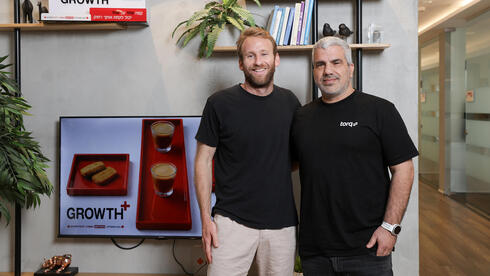
As part of the Growth+ project by Calcalist and Poalim Tech, Ofer Smadari, CEO and Co-Founder of Torq, met with Lior Ziv, Founder and CEO of Zing: “We raised initial funding and deliberately moved fast to meet the market, and if we had to fail, we wanted to fail fast and fail forward. And that's exactly what happened.”
Ofer Smadari, CEO and co-founder of Torq, met with Lior Ziv, founder and CEO of Zing, which has developed a solution for events and conferences aimed at enabling true presence by disconnecting from phones.
The conversation was held as part of the Growth+ project by Calcalist and Poalim Tech, now in its third year, a series of one-on-one meetings between founders of leading tech companies in Israel and entrepreneurs of promising startups, with the goal of providing advice, support, and practical tools on entrepreneurship, creativity, startup management, and building companies for growth.
"There is a recurring moment in the lifecycle of technology when enthusiasm is confused with value. At first, the novelty itself is enough. Something feels fast and different, and that alone generates interest. That's what happened with AI over the past two years," said Michal Kissos Hertzog, CEO of Poalim Tech, which is supporting the project. "But enthusiasm is not a business model. High tech is not a field separate from the business world, it is simply a way to build businesses, and a business is measured in a simple way: does it solve a problem for someone who is willing to pay for it? Today, the question is no longer who uses AI, but who knows how to turn it into a practical tool. The entrepreneurs and CEOs in this project are already there. They have moved from talking about potential to focusing on measurable value and models that stand the test of reality. The ability to take innovation and turn it into value is proper management. This is the stage where it becomes infrastructure."
Ofer, tell us about a crisis or challenge you encountered early on and what you learned from it.
"The whole journey is full of crises and challenges, there is no stage without them. It starts at the idea stage. One day you think your idea is great, you run with it, and then you discover it's not that good. You go back and fix it. After that, the challenge is to build a logical financial model. When you invest your own money, you need to show how you generate returns. The main thing I learned is that you need to set goals for each stage and look ahead to where you want to be in the coming months. Beyond the idea itself, which can change, the most important thing a startup needs is the ability to move quickly. Make assumptions, understand that there is a high chance you’ll be wrong, and adjust as you go."
Lior, what was the biggest challenge you had this year?
"We set out with an idea that we were in love with, and others loved it too. We raised initial funding and deliberately moved fast to meet the market, and if we had to fail, we wanted to fail fast and fail forward. And that's exactly what happened. We arrived in the United States, met the market, and got hit hard. Quite a few people warned us this would happen, but we weren’t ready to hear it until we experienced it ourselves. You suddenly realize you’re not where you thought you’d be. It’s not easy to let go and move forward, not to discard everything, but to understand that what we started with isn’t quite right. Now we take the next step, knowing we may fail again, because that’s the stage we’re in."
Ofer, what advice did you give Lior?
"I advised him to stay grounded in reality. There is a difference between something that feels right or meaningful and something that can sustain a real business. We spoke specifically about how to think about a viable business model. Since there are relatively few entrepreneurs in Israel with a consumer-focused background, I suggested connecting him with relevant entrepreneurs, mainly from the U.S."
What did you learn from each other?
Ofer: "Lior made me think about how important it is for adults to disconnect, not just kids."
Lior: "I learned how his mind works. He cuts straight to the point and asks what the actual business behind it is."
Is there anything surprising you discovered about each other?
Lior: "We realized that we are both fighting our own kind of war right now. He is focused on scaling his company, while I am still in the early stage of finding the right direction."
Ofer: "It made me think about the importance of stopping. I don’t think I’ve ever had a conversation about how important it is for adults to disconnect."
Ofer Smadari’s golden advice: “Everything must be anchored in the business. Ultimately, we are all measured by revenue and growth. A company that doesn’t grow has no real value. That’s the foundation, you can’t just build something that is merely ‘nice.’”



