










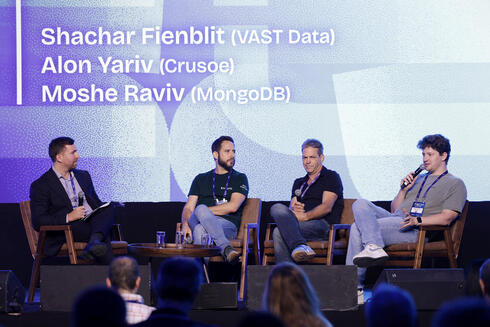
“Every GPU arriving by 2028 is already sold,” says Crusoe executive
Alon Yariv says demand for AI computing remains strong even as financing becomes harder to secure, widening the gap between technology-driven neo-clouds and companies built around access to power and hardware. Yariv was speaking on a panel with Shachar Feinblit, a co-founder of VAST Data, Nate Rosen of Blackstone, and Moshe Raviv of MongoDB.
“Blackstone is a strong believer in the ‘picks and shovels’ investment thesis: the essential components needed to make the AI revolution possible.” With that, Nathaniel (Nate) Rosen of Blackstone opened the “Picks and Shovels” panel at the Tech1 conference, featuring Shachar Feinblit of VAST Data, Alon Yariv of Crusoe and Moshe Raviv of MongoDB.
“We’ve done this before in e-commerce. We identified the ongoing digitization process and acquired distribution centers, the ‘last mile’ of the supply chain, which we then leased to Amazon, enabling it to deliver products to customers. Now, we are applying this approach on a massive scale to artificial intelligence by investing in data centers, the energy that powers them, and the cooling and mechanical systems that keep them operational.
1 View gallery
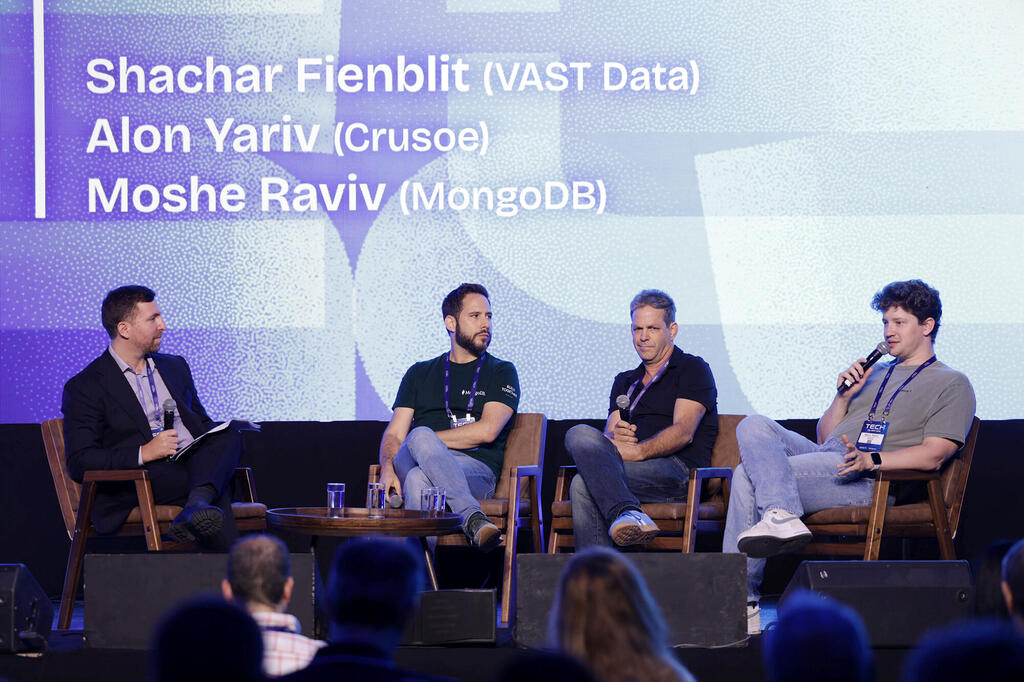
TECH1 2026 Conference: From right: Alon Yariv: (VAST), Shahar Feinblit (Crusoe), Moshe Raviv (MongoDB), and Nate Rosen (Blackstone).
(Photo: Orel Cohen)
“Today, Blackstone has approximately $160 billion invested in data centers globally, with another $160 billion worth of projects in development.”
The three panelists represent companies supplying the infrastructure underpinning the AI boom. Their discussion explored the risks facing these businesses, the changing economics of AI infrastructure and the question of which companies will capture the most value as adoption expands.
Rosen asked Yariv: “Crusoe is one of the prominent neo-cloud companies. How are you navigating the extreme stock-market volatility in this sector? We’ve seen what has happened to your competitor CoreWeave, whose stock has plunged in recent weeks.”
“I couldn’t be more confident about future demand. Every GPU scheduled to arrive by 2028 is already sold to customers,” said Yariv, who heads Crusoe’s Israeli operations. Crusoe acquired Atero, a startup Yariv co-founded.
“It’s an excellent market to be in when everyone wants to secure supply two years in advance. However, we are seeing changes in the debt market, where raising capital has become increasingly difficult. There is a bottleneck here that demands creative solutions. Some of our competitors are seeing their stock prices crash because of these concerns.
“We are witnessing a bifurcation in the market. On one side are neo-cloud companies that have invested heavily in building high-quality technology, the engine of their operations, which delivers tangible value to clients such as OpenAI, Anthropic and Cognition. These companies have access to the most advanced models and can effectively develop almost any software product themselves.”
Yariv argued that the difference between the two groups would become increasingly important as the sector matures.
“Some neo-cloud companies will succeed in clearing the bar and delivering enough value to end customers to sell products such as a compute-management layer. On the other side are neo-cloud companies facing balance-sheet challenges whose main reason for existence is that they secured access to a particular resource: available megawatts on the power grid. These companies essentially just buy GPUs and resell them.
“That second type has a more challenging business model, and it is difficult to see how it can avoid consolidation,” Yariv concluded.
The changing foundations of AI
Rosen then asked Feinblit: “What do you see in the AI landscape today compared with six months ago?”
“NVIDIA’s Jensen Huang has said that we are building new ‘factories’ for AI. The foundational layer is energy, followed by chips, then software and, finally, applications. At VAST Data, we work on the software layer in the middle.
“Today’s data is unstructured, comprising video, audio, text and information from sensors. That is very different from the past, not to mention the sheer scale involved. As a result, companies looking to enter the AI space cannot rely on legacy solutions,” said Feinblit, VAST Data’s co-founder and head of R&D in Israel. The company was valued at nearly $30 billion in its latest private funding round, which included an investment from NVIDIA.
Raviv of MongoDB also pointed to a shift in how businesses are using AI, saying customers are moving beyond experimentation and toward broader deployment.
“We see customers shifting from experimenting with AI to deploying it at a larger scale. This requires a fresh approach to managing data volumes that are growing at an accelerating rate,” he said.
To close the discussion, Rosen asked the panelists who would emerge as the winners in AI: established technology giants or a new generation of companies.
“We will see entirely new companies. It’s a different type of business that requires a different DNA,” Yariv said.
Feinblit argued that established cloud providers could struggle to catch up if they failed to adapt quickly enough.
“It’s hard to catch up when you’re starting from scratch. It took the major cloud companies some time to realize what needed to change, both in their operating methods and in the underlying technology. That is where younger competitors like Crusoe come in. I wouldn’t bet against Microsoft, but it already recognizes that significant changes are required if it wants to stay in the game.”
Raviv said newer companies could also rely on MongoDB’s technology as they build and deploy AI systems.
“If these newer players want to close the gap with the incumbents, for instance by running agents responsibly, we provide the means to do so. At MongoDB, we are indifferent about who takes the lead, because the solution is ours,” he said.
Asked what could emerge as the biggest surprise in artificial intelligence, Feinblit pointed to the possibility of moving computing infrastructure beyond Earth.
“SpaceX will spring a surprise. Musk is going to bring data centers into space, and that will be a massive shift. Without us even noticing, they are effectively becoming the world’s largest neo-cloud.”



