










“History clearly suggests that investors should not assume guaranteed success in the coming year”
Three consecutive years of strong S&P 500 performance often precede modest or negative outcomes.
After a 16% gain in the S&P 500 in 2025, the flagship index of the U.S. stock market, most forecasts for 2026 remain broadly optimistic. According to recent surveys, 88% of analysts expect a positive return on Wall Street by year-end, with 53% predicting a double-digit increase. However, Alex Zabezhinsky, chief economist at Meitav, warns that historical data from the past 100 years suggest such optimism may be misplaced.
Between 2023 and 2025, the S&P 500 posted a cumulative return of 78%. Zabezhinsky notes that in most instances where the three-year cumulative return exceeded 60%, the following year recorded a negative return, on average, around –2%. For example, after the three-year gain of 91% ending in 2021, the index fell 19% in 2022. Similarly, following a 63.7% increase from 2012 to 2014, the index ended 2015 with a 1% decline.
1 View gallery
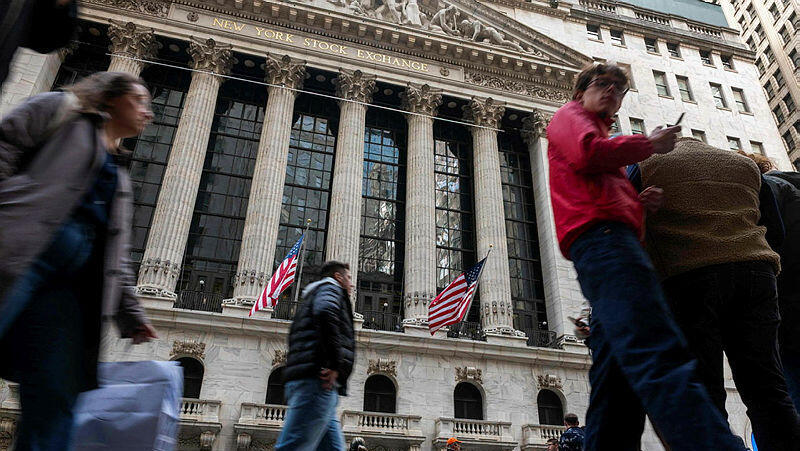
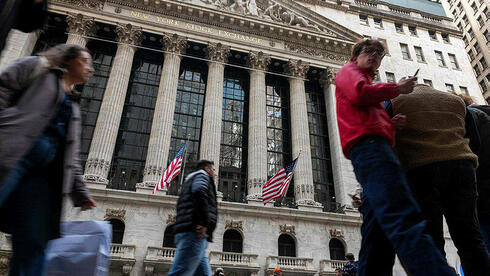
New York Stock Exchange Wall Street
(Spencer Platt/ Getty Images/AP North America/AFP)
Exceptions to this trend are rare. In the late 1990s, the S&P 500 rose 27% in 1998 and 20% in 1999, only to fall 10% in 2000 with the burst of the dot-com bubble. Another historical sequence occurred in 1956, when a three-year cumulative return of 88% was followed by a 12% decline in 1957. These examples serve as a cautionary reminder for investors approaching 2026.
If the current forecasts hold and the S&P 500 rises by 10% next year, the cumulative return for 2023-2026 would reach 96%, marking the fourth-highest four-year gain in the index over the last century. Only the post-Great Depression recovery in 1936, the post-World War II surge in 1945, and the late-1990s dot-com boom produced higher four-year returns.
Zabezhinsky also highlights broader economic and market conditions that may temper expectations. The U.S. economy is in the late stage of the business cycle, having already peaked and potentially heading toward a recession after five years of rapid expansion. Household and institutional exposure to equities is near an all-time high, accounting for roughly 30% of public asset portfolios. The market is expensive, with the CAPE ratio developed by economist Robert Shiller reaching its second-highest level in history. High investor optimism surrounding artificial intelligence has so far failed to deliver tangible financial gains.
“This is a classic situation where investors need to be careful,” Zabezhinsky says. “Many studies show that in similar circumstances, the common outcome is not necessarily a market crash, but lower-than-expected returns, high volatility, and occasional sharp corrections, even if the final annual return is not negative. The reasonable consensus should not be another strong bull market like recent years, but a stock market with a modest positive bias and risk tilted to the downside.”
He concludes: “This time it may be different, and statistics may not prevail, but history clearly suggests that investors should not assume guaranteed success in the coming year.”



