










Analysis
To save his job, Intel CEO needs to play Trump’s favorite game
Precedent shows praise, lavish gestures, and promises can sway Trump.
Intel CEO Lip-Bo Tan is scheduled to meet with Donald Trump at the White House on Monday in an effort to defuse tensions after the president publicly called for his immediate resignation over an alleged “conflict of interest.” If Tan follows the playbook used by other technology leaders in recent months, it’s a challenge he may be able to navigate.
Last week, Trump launched a direct attack on Intel and Tan, citing his extensive past business dealings in China: “The CEO of INTEL is highly CONFLICTED and must resign, immediately,” Trump wrote on his Truth Social platform. “There is no other solution to this problem.”
1 View gallery
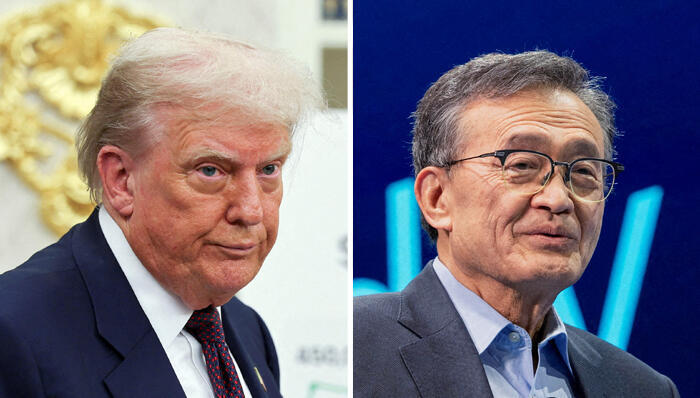
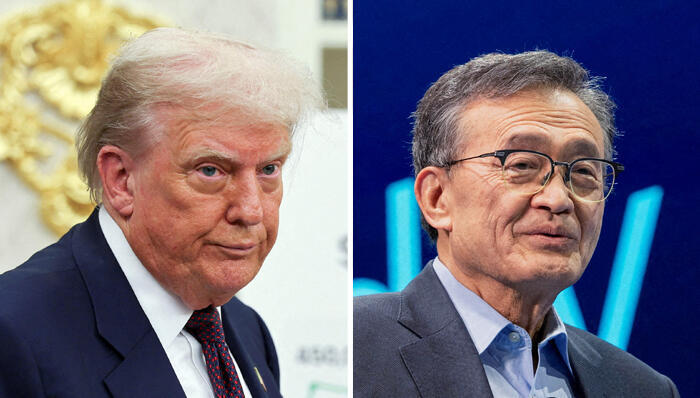
Intel CEO Lip-Bu Tan (right) and Donald Trump.
(Photos: REUTERS/Laure Andrillon REUTERS/Jonathan Ernst )
The demand is unprecedented, and comes at a difficult time for Intel. The company is trailing rivals in the fast-growing AI chip market, and former CEO Pat Gelsinger’s ambitious plan to transform Intel into a major player in the semiconductor foundry business has been slow to gain traction despite tens of billions in investment.
The Trump administration also holds several points of leverage over Intel, including an $8 billion subsidy for U.S. chip plant construction, the power to limit export licenses for sales to countries such as China, and the authority to deny exemptions from steep 100% tariffs on imported chips.
A direct confrontation with the administration could be devastating for Intel. Tan’s White House visit is designed to prevent that outcome. Reports say he will present his personal and professional background to Trump, stress his commitment to the United States, highlight the strategic importance of Intel’s domestic manufacturing capabilities, and propose ways for the company and government to collaborate.
If Tan hopes to keep his job, he will need to rely on a three-pronged strategy that has helped other CEOs win Trump’s favor: flattery, gifts, and commitments.
Flattery – Trump has repeatedly shown himself to be more receptive when praised by business leaders. After his election victory, tech CEOs rushed to laud him, hoping to secure goodwill ahead of his return to the White House. Mark Zuckerberg and Jeff Bezos attended his inauguration, while Nvidia’s Jensen Huang recently called Trump “America’s unique advantage” and described the administration’s AI policy as a “phenomenal result.”
Gifts – Trump appreciates personal gestures of value. Following his election, Apple, Google, Microsoft, Meta, OpenAI, Amazon, and others donated $1 million each to his inauguration fund. During a White House meeting, Apple’s Tim Cook presented Trump with a glass sculpture on a 24-karat gold base engraved with the Apple logo.
Commitments – Promises of substantial U.S. investments or direct contributions to government coffers have also proven effective. Last week, Apple pledged to add $100 billion to its planned $500 billion U.S. investment. On Monday, it was reported that Trump approved AI chip exports to China by Nvidia and AMD after the companies agreed to transfer 15% of their Chinese chip revenue to the U.S. government.
If Tan can combine warm praise for Trump’s business acumen with a striking gift, preferably featuring gold, and a multi-billion-dollar U.S. investment pledge, Intel’s crisis could be over by the end of the meeting.



