








"Everybody has access today. I think that's beta": PE investors say AI's edge is in data and judgment
Executives from Vista Equity Partners, Veritas Capital and Tikehau Capital said proprietary data, workflow context and human judgment, not model access, will separate the winners.
Every private equity firm now has access to the same AI models. What still sets a firm apart, according to investors from Vista Equity Partners, Veritas Capital and Tikehau Capital, is not the models but the data, the context and the people using them.
That was the consensus of a panel on AI in private equity at the Israel Private Markets Summit (IPM), the main annual conference of the institutional capital market for alternative investments, which was held on Tuesday at the Peres Center for Peace and Innovation in Tel Aviv. Moderator Ofir Reiner Sigler, Head of Direct and PE Investments at Menora Mivtachim Group, framed the discussion as a split between "AI alpha" and "AI beta."
1 View gallery
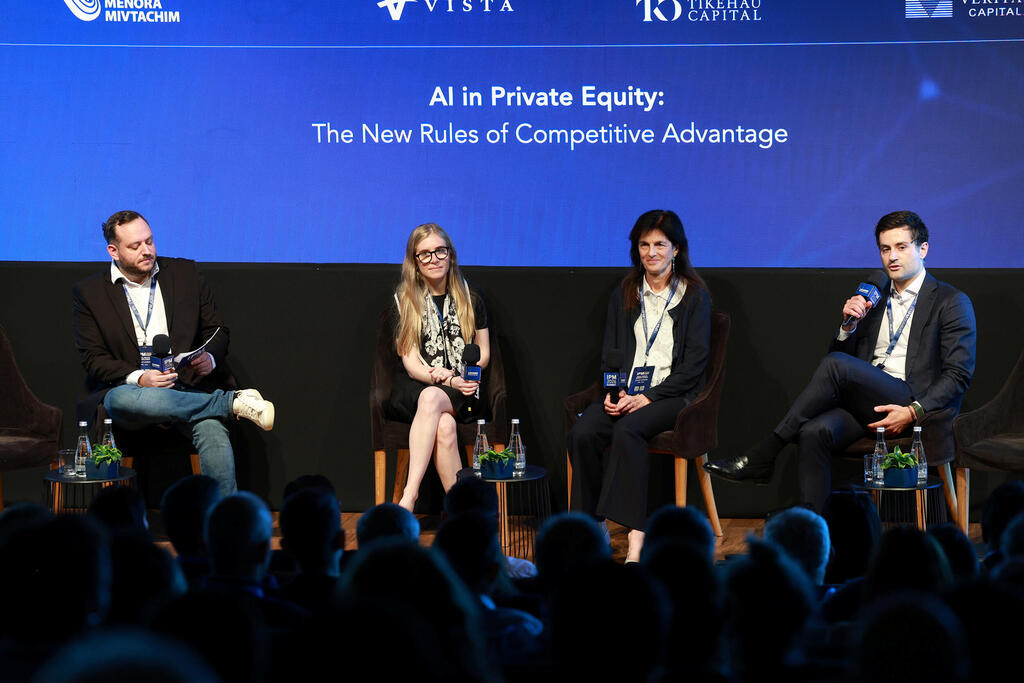
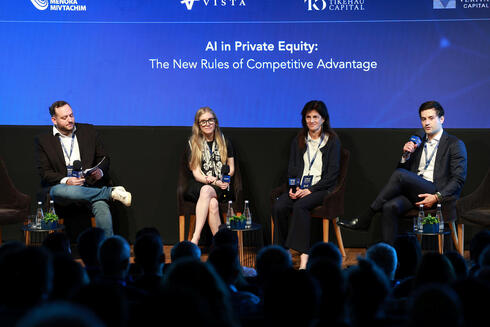
Panel participants, from right: Nicolas Schaufele, Cécile Mayer-Lévi, Hannah Dolgin, and Ofir Reiner Sigler.
(Photo: Orel Cohen)
Nicolas Schaufele, Managing Director at Veritas Capital, drew the line plainly. "Everybody has access today. I think that's beta," he said. Integration "will commoditize over time," he added, while the alpha comes from the proprietary data inside a firm's portfolio companies and knowing how to harvest it.
Hannah Dolgin, Senior Vice President at Vista Equity Partners, made a similar case. "AI models give businesses access to general intelligence," she said. "I think what really sets us apart is the access to context, trust, and scale." She pointed to Duck Creek, a Vista portfolio company that supports underwriting for property and casualty insurers. "They're not giving that information away to general purpose models," she said.
Asked what had surprised them most about AI, the panelists pointed in the same direction. Schaufele said that a year ago he would have named hallucinations, but "today that's mostly solved." The gap now is the firms themselves. "What's lacking is really us right now," he said, pointing to workflows, willingness to adopt AI and the way data is structured.
For Dolgin, the surprise was speed. Over Vista's 25 years, she said, technological change took longer to reach the business model. Today, "the speed of adoption has been much faster than we've historically seen."
Cécile Mayer-Lévi, Head of Private Debt at Tikehau Capital, said AI now shapes how her team evaluates credit. "It's part of the underwriting," she said. Every deal is assessed for whether AI is a risk or an opportunity.
On cost cutting, Mayer-Lévi cautioned that savings are not automatic, citing a large insurer that rolled out a copilot tool, saw no efficiency gains and switched it off. The real gains, she argued, come from freeing people from repetitive work, and from recognizing the difference between automating a task and replacing a job.
Schaufele said the effect reaches beyond tech. At one Veritas manufacturing portfolio company, AI was used to retool the entire production process, cutting the time to launch new products "from two years to six months" and increasing yields "by up to 30%."
Revenue is the less proven side. "The cost side is a given," Dolgin said, noting that all of Vista's portfolio companies run AI cost-saving initiatives. The growth play, she said, is tapping labor spend as a new addressable market and turning existing software into agentic products, using what Vista calls its "agentic factory" to place engineers inside portfolio companies. Schaufele was more measured: revenue is accelerating where companies hold data assets, but it is not yet clear "how much of it is AI driven versus just other innovations."
Reiner Sigler raised the question of junior professionals, whose groundwork is increasingly handled by AI. Mayer-Lévi said the era of long, painful hours on presentations that hardly anyone read is ending. Schaufele saw an upside: with less number-crunching, juniors may join management meetings sooner and "get exposed earlier to judgment."
By the end, Reiner Sigler noted, the discussion had come full circle, back to trusting the judgment of people as the real source of alpha. Dolgin pointed out that models produce probabilistic rather than deterministic outcomes, which makes a human in the loop even more essential. As firms come to rely on the same tools, the question becomes how to avoid drawing the same conclusions. Schaufele's answer was to treat the model like a red team, forcing it to challenge the firm's underlying assumptions, then reviewing past mistakes together. "You need to be careful and not just rely on the models blindly," he said.