










Iron Beam’s hype meets reality: Israel’s laser defense still a work in progress
Despite technological breakthroughs, operational deployment faces range, cost, and logistical hurdles.
Even when the IDF began receiving the Iron Beam, the innovative defense system based on a powerful laser, it was clear that the road to full implementation would be long and extremely expensive, given the complexity of systematically intercepting aerial threats directed at Israel.
During its development, Rafael and the Ministry of Defense nurtured the expectation that the costs of intercepting rockets and UAVs using the Iron Beam, also known as Or Eitan, would be dramatically reduced. If the price of a "Tamir" missile launched by the Iron Dome at a simple rocket is about $50,000, interception using a laser beam would cost "a few shekels," according to senior defense officials.
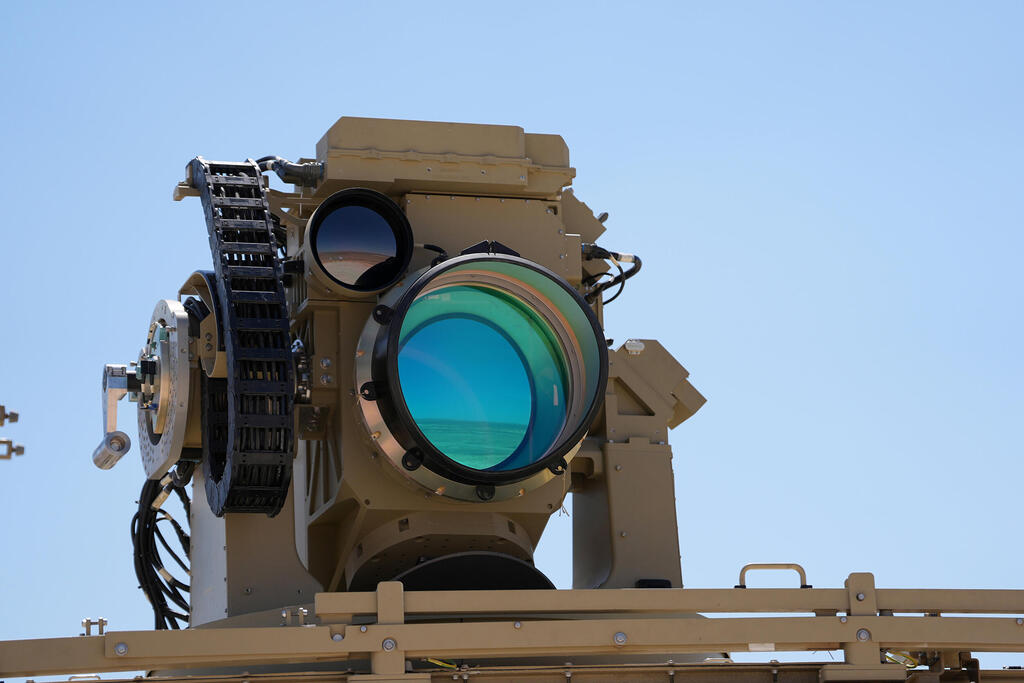
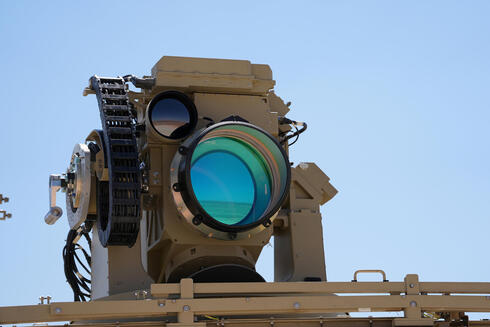
This figure is dramatic in itself, but in the enthusiasm over the technological achievement, another important figure was often overlooked: the price of each laser pointer that directs the formidable beam capable of incinerating aerial threats is estimated at several tens of millions of dollars. Rafael refuses to disclose the exact cost of each unit, but considering that the effective range of the laser beam is currently only about 10 km, protecting large areas would require the deployment of dozens, if not hundreds, of laser targeting units.
Since its first operational interception in April 2011, Iron Dome, also developed and manufactured by Rafael, has intercepted more than 10,000 rockets launched at Israel from Gaza and Lebanon. Initially designed to intercept short-range threats of a few dozen kilometers, the system has undergone a long series of updates and improvements, extending its interception range to approximately 120 km.
The defense establishment believes that the improvement and updating processes that Iron Dome underwent will also accompany the new laser system. In addition to delivering the first laser units for IDF use, Rafael engineers are working to extend the beam’s range, increase the number of targets it can handle simultaneously, and improve performance under challenging weather conditions, such as storms, clouds, and haze. A senior defense official told Calcalist that even the initial version of the laser system is capable of operating about 90% of the time, thanks to breakthroughs that overcame various atmospheric anomalies.
However, in the near future, Iron Beam will not operate as a standalone system. It will function as a complementary layer to Iron Dome. Soldiers manning Iron Dome command and control vehicles will decide in real time whether to deploy a cheap laser beam against an incoming threat or launch an expensive interceptor missile. In scenarios of heavy barrages involving dozens of rockets, both capabilities will be activated in combination.
According to the defense establishment, as Iron Beam experiences real combat conditions, its capabilities will improve. Even today, after almost every significant interception by Iron Dome, the Air Force's air defense system feeds Rafael with performance data, which is analyzed and forms the basis for software upgrades.
During the recent war with Hezbollah in the north, and amid the IDF’s struggle with drone threats, Rafael and the Air Force deployed several prototypes of the laser system and tested them in operational conditions. According to the defense establishment, the results were satisfactory, accelerating the development of Iron Beam.
In prior field tests, the laser system also successfully intercepted rockets launched at Israel over the past two decades and, notably, during the October 7 war. With its current range limitation of approximately 10 km, the system’s effectiveness depends heavily on the placement of its targeting units. In ideal conditions, overlapping laser units can perform silent and invisible interceptions. Iron Beam also represents the first serious response to mortar bombs (MRBMs), which previously could rarely be intercepted by Iron Dome due to their short flight time.
In a comprehensive and rare interview with Calcalist, the system’s development team stated that, unlike missile-based interception, rockets will be neutralized before crossing the Gaza-Israel border, eliminating the need to trigger home-front alarm sirens. This vision may only be realized in the coming years, contingent on significant budget allocations.
The IDF has not specified when Iron Beam will be declared fully operational. Even then, anomalies may challenge its performance, and a new combat doctrine for energy weapons will need to be written.
Although many armies are investing heavily in laser and energy weapons, the IDF is the first to integrate these capabilities into ongoing operations, representing a global technological achievement for Rafael and Israel’s defense industries.
In addition to the laser designators that will equip the Iron Dome system, the defense establishment also plans to deploy mobile laser units to accompany armored and infantry forces, providing point-based defense against UAVs, drones, and mortar bombs.
It is unclear whether the new laser systems will specifically target the growing drone threats along Israel’s long borders with Egypt and Jordan. These threats, centered on smugglers of weapons, drugs, and exotic animals, include large drones capable of carrying payloads weighing tens of kilograms. For now, the Air Force will focus laser capabilities on already critical defense missions.
While the IDF takes its first steps in the new era of energy weapons, it is important to avoid illusions: Iron Beam is not designed to intercept ballistic missiles, such as those launched by Iran or the Houthis. The only current response to ballistic threats is kinetic, via interceptor missiles like Arrow 3 and THAAD.
Elbit Systems is developing high-powered airborne lasers for fighter jets and mission aircraft, intended to intercept ballistic and hypersonic missiles at high altitudes. Operating above the cloud layer, these systems can maintain higher energy concentrations and penetrate the thickness of a missile, far exceeding what is required to destroy rockets or UAVs made of plastic or fiberglass.



