










Bazan puts $5 billion price tag on leaving Haifa Bay
The oil refining group is seeking compensation based on valuations of up to $3.8 billion, plus hundreds of millions of dollars tied to expected refining margins and additional costs. The government, which wants the complex evacuated by the end of the decade, says its compensation offer will be nowhere near that amount.
The Bazan Group is putting a price on its planned evacuation from Haifa Bay, and it is a very high one: more than $5 billion, Calcalist has learned.
The sum includes valuations of the group's operations conducted for Bazan over the past four years by BDO and KPMG, which put the value of its operations at between $3.2 billion and $3.8 billion. Bazan is adding another $600 million to $800 million to that figure, based on its forecasts for refining margins and their expected increase.
Bazan CEO Rafael Maman presented the figures to Prof. Avi Simhon, head of the National Economic Council and the prime minister's economic adviser. Simhon heads the steering committee for the development of Haifa Bay, which is working to advance the government's 2022 decision to evacuate the Bazan complex from Haifa Bay by the end of the decade.
1 View gallery
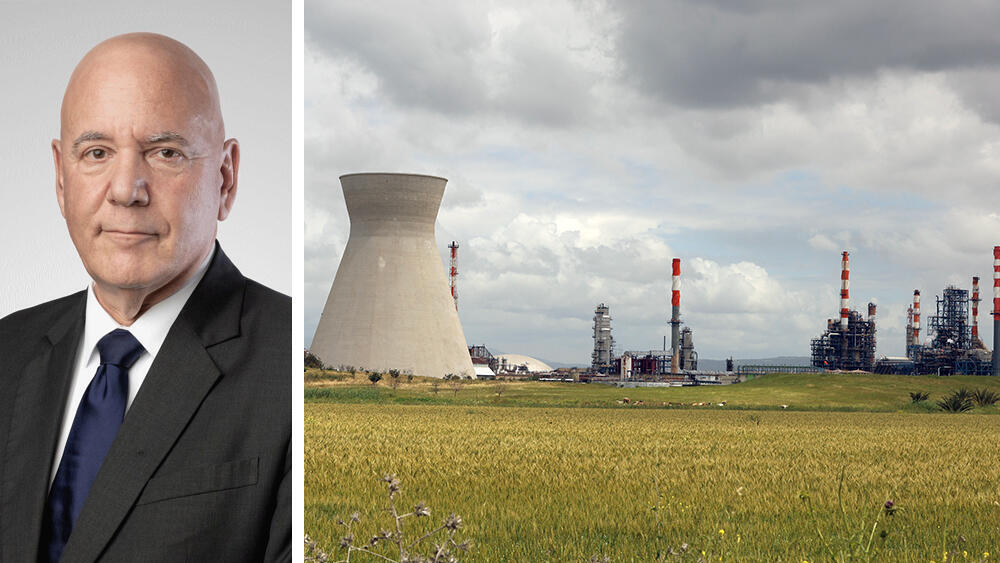
The Bazan complex in Haifa Bay, alongside Rafael Maman, CEO of Bazan.
(Photography: Elad Gershgorin, Sagi Moran)
In July, Calcalist revealed that Simhon had appointed an inter-ministerial team, headed by him, to examine steps that would allow government ministries to meet the timetable set by the government's decision to evacuate Bazan. The move came amid concerns over delays, including in establishing dedicated sites around the country to store the fuels Israel intends to import to replace the refining operations in Haifa, which are scheduled to close.
Bazan management opposes the planned evacuation of the group's plants from Haifa Bay and is seeking to draw on lessons from the long war in the Middle East, which it says demonstrated the importance of preserving Israel's energy independence.
That argument has gained particular weight for the company after Iranian missiles struck the Bazan complex several times during the war. In one attack, three employees were killed and a steam power station was completely destroyed.
Maman's approach to Simhon was made as part of the new inter-ministerial team's work and comes against the backdrop of a 2007 agreement between Bazan and the state governing the group's rights to the land in Haifa Bay.
The agreement granted Bazan a 49-year lease, with an option for an additional 49 years, allowing it to maintain stability and continuity of operations for decades. The same agreement paved the way that year for Bazan's privatization and the sale of control to the Ofer family's Israel Corporation, which generated more than NIS 6 billion for the state.
According to Bazan, the valuations cited in its approach to Simhon were conducted at different points between 2022 and 2025 in order to normalize the volatility in the group's value. Bazan argues that the resulting range of $3.2 billion to $3.8 billion is conservative and does not reflect structural changes in global refining capacity or their potential future impact on refining margins.
The company's submission to Simhon also indicates that the compensation it is seeking does not include several hundred million dollars in additional damages it says it has incurred since the government began preparing for its evacuation from Haifa Bay.
Bazan also believes the state should cover the costs of shutting down and clearing the facilities from the complex and provide a safety net for its employees.
"We believe this is critical information that must be taken into account in any discussion or decision on the matter," Maman wrote to Simhon.
The gap between Bazan's expectations and the government's position is substantial.
Speaking to Calcalist about Bazan's demand, Simhon said: "The State of Israel is determined to evacuate Bazan, because this is a plant that causes illness and death and prevents the development of the northern metropolis. We are holding discussions regarding the compensation to be given to Bazan, but its scope does not come close to the sums stated in the letter."



