









How Chinese cars became a national security issue in Israel
What was once viewed as a routine procurement decision has evolved into a debate over cyber risks, military access and foreign influence.
About a week ago, a significant event occurred for Chinese automakers in Israel: Elbit informed employees that leased vehicles made by Chinese manufacturers, including Geely, were being phased out of the company’s fleet.
The process will not be immediate. Instead, it is expected to continue well into next year, as Elbit gradually terminates existing leasing contracts and replaces the vehicles with non-Chinese models. Elbit’s fleet includes approximately 4,400 vehicles, making it one of the larger corporate fleets in Israel. Employees will now receive vehicles from brands such as Skoda, Toyota, and Hyundai.
Elbit’s decision does not come as a surprise. In recent months, Calcalist has reported that several security organizations have introduced new restrictions on Chinese-made vehicles. Initially, the restrictions applied only to intelligence bases, where Chinese vehicles were barred from entering. The policy was later expanded to all military bases, and the IDF eventually removed Chinese vehicles from the fleets used by career personnel.
The IDF and Elbit are not alone. Rafael had previously acquired vehicles manufactured by Chery, but those vehicles have gradually been removed and replaced with non-Chinese models.
Other government bodies also purchased Chinese vehicles. Israel Police officers have been driving BYD vehicles, despite the fact that the US Pentagon recently designated BYD as a company with ties to the Chinese military. Last week, Calcalist reported that the police had decided to phase out Chinese vehicles as well.
According to sources familiar with the matter, Mekorot operates a fleet that includes vans and trucks as well as BYD and Chery passenger vehicles. Those sources said that “the issue of Chinese vehicles is currently under review.”
Similar discussions are taking place at the Israel Electric Corporation. In the company’s latest leasing tender, employees were offered vehicles from MG and BYD. Employees who chose electric vehicles were also granted a higher taxable benefit category as an incentive. According to data obtained by Calcalist, most of the electric vehicles chosen by IEC employees were Chinese-made. Employees who preferred non-electric vehicles could choose models such as the Chery Tiggo 8. The IEC also said that the issue is under review.
In other words, some of Israel’s largest vehicle fleets, comprising thousands of vehicles, may eventually move away from Chinese brands.
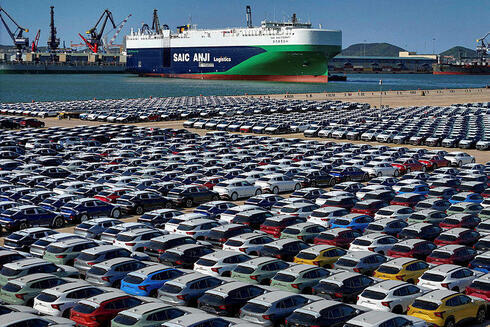
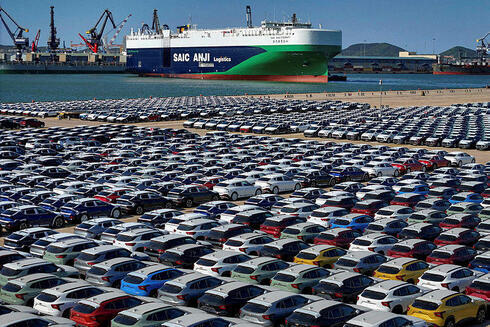
For organizations seeking electric or plug-in hybrid vehicles, however, the market offers relatively few alternatives. As Calcalist recently reported, most electric models offered through leasing programs in Israel are Chinese. Most plug-in hybrids are Chinese, and most six-seat SUVs offered to fleet customers are also Chinese.
Internal Transportation Ministry data reviewed by Calcalist shows that fleet registrations are heavily concentrated among brands such as Chery and Jaecoo, as well as other Chinese manufacturers. Large fleet operators, including government-related organizations, therefore have relatively few alternatives in the electric and plug-in categories.
As a result, the question of whether Chinese vehicles should be used in state-linked fleets has become a highly sensitive issue.
What makes the shift particularly notable is that only two years ago, security and regulatory authorities did not view Chinese vehicles as a significant threat. In March 2024, after the previous US administration classified Chinese automakers as a potential security risk, Calcalist contacted the Finance Ministry, the National Cyber Directorate, and the Transportation Ministry. At the time, Israel was preparing to add Chinese electric vehicles to the government fleet through a tender that was later canceled. The responses from those agencies indicated that additional caution was advisable, but that they had no fundamental objection to Chinese vehicles.
What has changed since then? One explanation is that policies that were previously considered acceptable, such as the acquisition of Chery vehicles by the IDF and Rafael and Geely vehicles by Elbit, were eventually reassessed. The first personnel barred from arriving at bases in Chinese vehicles were members of intelligence and cyber units in Tzrifin.
Another factor is the possibility that the US government could pressure Israel to reduce contracts involving Chinese automakers in fleets connected to security activities. Given the extensive US security presence in Israel, it is understandable why American officials might object to BYD vehicles used by Israeli police officers operating near sensitive American assets.
The emerging restrictions have implications on two levels: commercial and civilian.
Commercially, the impact could be substantial. The Israeli government fleet numbers tens of thousands of vehicles. According to automotive industry sources, Elbit’s decision to remove Chinese vehicles “made waves” among other companies with security-related activities, even though it has not yet triggered widespread operational changes.
In the private sector, including high-tech companies and service providers, leasing industry sources say that business continues largely as usual. However, the close relationship between the defense sector and the broader Israeli economy complicates the picture.
IDF data released for Reservists Appreciation Day showed that Tel Aviv has about 42,000 reservists and Jerusalem about 23,000. Tel Aviv has roughly 27,000 privately owned electric vehicles and another 6,000 leased electric vehicles, most of them Chinese-made. Jerusalem has approximately 12,500 privately owned electric vehicles and several hundred leased electric vehicles.
If Chinese vehicles are barred from entering military bases, thousands of reservists may be forced to leave their cars outside, exposing them to theft and vandalism. Given that Chinese brands account for more than 40% of Israel’s vehicle market, the number of affected drivers could be substantial.
The issue also affects private companies that provide services to defense organizations. Several high-tech executives told Calcalist that attitudes toward Chinese vehicles have changed significantly in recent years. “In Israel, the military is closely tied to the state, and high-tech is closely tied to the military,” one executive said. “If the military has decided that Chinese vehicles are a concern, there is probably a reason.”
The fact that organizations such as Mekorot are reviewing their policies, while the Israel Police and Elbit have already decided to move away from Chinese vehicles, suggests that additional agencies may follow.
The broader question is how Chinese vehicles became “undesirable” in certain sectors despite the fact that the underlying technologies, including cameras, over-the-air software updates, and energy management systems, are not fundamentally different from those used by Korean manufacturers. In practice, the restrictions are being imposed by the organizations that own the fleets, rather than through a comprehensive national regulatory framework.
The Transportation Ministry has been examining automotive cybersecurity issues for several years. The proposed legislation would apply to all vehicles, regardless of whether they are made by Chery or Mercedes. However, the legislation has stalled.
A bill granting the Transportation Ministry authority over vehicle cybersecurity was published in December 2025 and submitted to the Knesset for initial approval, but it has not advanced. In the meantime, the ministry says it is preparing professional guidelines for organizations operating vehicle fleets, while assessing the economic implications for both businesses and vehicle owners.
The ministry said that once the process is completed, the guidelines will be formally published.



