











5 Israeli defense-tech stocks to watch amid the war in Iran
While the war in the Middle East exacts a heavy toll on human life, property, and the commodity and stock markets, one sector is reaping the benefits: the weapons industry, and specifically the Israeli defense-tech industry.
While the war in the Middle East - spanning Iran, Israel, the Gulf States, and the US army - exacts a heavy toll on human life, property, and the commodity and stock markets, one sector is reaping the benefits: the weapons industry, and specifically the Israeli defense-tech industry.
Iran's retaliatory missile and drone campaigns targeting Israel and Gulf states have turned technologies that were once considered emerging into urgent battlefield necessities. Autonomous drones, AI-guided fire control, and counter-UAS systems are being consumed at a pace that is reshaping revenue forecasts across Israel's defense sector, and investors are taking notice.
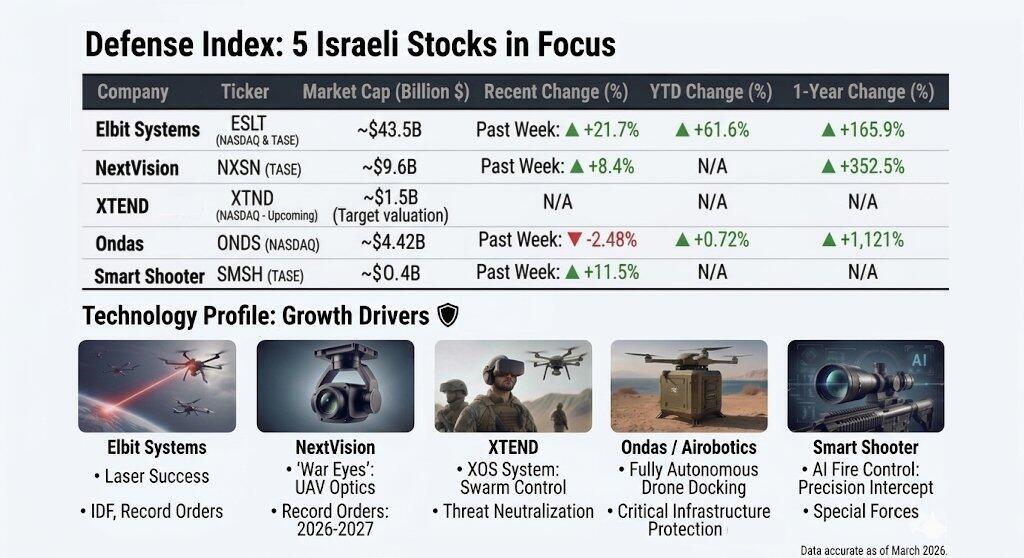
Here are five listed companies at the center of that shift.
1. Elbit Systems (ESLT)
Sector: Multi-Domain Defense Giant
Product Portfolio: A global powerhouse providing everything from Unmanned Aerial Systems (UAS) and electronic warfare to "Iron Fist" active protection systems and advanced laser interceptors.
Listing: Dual-listed on TASE and NASDAQ (Ticker: ESLT).
Market Cap: ~$43.5 Billion (approx. 134.4B ILS).
Performance: * Past Week: +21.7% (One of the strongest weeks in the company's history).
YTD: +61.6%.
1-Year: +165.9%.
The X-Factor: Elbit is the "backbone" of the IDF. Recent Insight: The stock surged this week following the successful real-world deployment of its new directed-energy laser systems against Iranian drone swarms.
2. Smart Shooter (SMSH)
Sector: AI Fire Control
Product Portfolio: Developer of the SMASH family of robotic "one shot, one hit" fire control systems that turn standard rifles into counter-drone machines and precision sniper tools.
Listing: TASE (Ticker: SMSH).
Market Cap: ~$397.5M.
Performance: * Past Week: +11.5% (Highly volatile following its March 2026 IPO).
YTD/1-Year: N/A (Newly listed).
The X-Factor: Its systems are being rapidly integrated by US Army and the UK Ministry of Defence to combat the rising threat of loitering munitions.
3. NextVision (NXSN)
Sector: Micro-Stabilized Gimbals
Product Portfolio: Known for "The Eyes of the Drone," NextVision produces world-leading, ultra-lightweight stabilized cameras and sensors used in tactical drones and loitering munitions (suicide drones).
Listing: TASE (Ticker: NXSN).
Market Cap: ~$9.6 Billion (approx. 34.8B ILS).
Performance: * Past Week: +8.4%.
1-Year: +352.5%.
The X-Factor: NextVision has become a stock market darling due to its incredible profit margins. As the "drone war" with Iran escalates, the demand for their high-precision gimbals has led to a record-breaking backlog for 2026-2027.
4. XTEND (XTND)
Sector: Human-Guided Autonomy
Product Portfolio: An operating system for drones (XOS) that allows soldiers with zero flight experience to perform complex indoor/outdoor missions using VR goggles and intuitive controllers.
Listing: To be listed on NASDAQ following upcoming merger with JFB mid-2026 (Ticker: XTND).
Market Cap: ~$1.5 Billion (Target valuation).
Performance: N/A (Not yet listed).
The X-Factor: Backed by high-profile investors (including a $152M pre-IPO round with Eric Trump’s participation). Several of their drones are used for entering tunnels and buildings before human troops to neutralize threats.
5. Ondas (ONDS)
Sector: Autonomous Drone-in-a-Box
Product Portfolio: An American-listed firm that acquired Israel’s Airobotics. It provides fully autonomous drone docking stations for 24/7 surveillance and industrial inspection without a human pilot.
Listing: NASDAQ (Ticker: ONDS).
Market Cap: ~$4.42B (approx. 12.7B ILS).
Performance: * Past Week: -2.48%.
YTD: +0.72%.
1-Year: +1,121%.
The X-Factor: While not a "pure-play" Israeli firm, its core tech is the Airobotics platform. Anecdote: Their systems are currently being deployed in the Persian Gulf to monitor maritime threats near critical energy infrastructure.



