











When war hits the sports economy
Flight disruptions, canceled tournaments and relocated teams are costing the global sports industry millions.
In the world of sports in 2026, victory is no longer decided only on the grass, the court, in the pool, or on the racetrack. Increasingly, it is determined in logistics departments, along flight paths, and in the conference rooms of financial managers.
As the year progresses, it is becoming clear that the war in the Middle East, recently escalated by the combined U.S. and Israeli attack on the Iranian regime, is not merely a disruptive geopolitical event. It has become a powerful market force reshaping one of the world’s most valuable entertainment industries.

According to an analysis by the German broadcaster DW, the conflict has already triggered widespread cancellations of strategic sporting events in the region and the most severe travel disruptions seen in a decade. Thousands of flights have been canceled, leaving elite athletes stranded in Gulf countries.
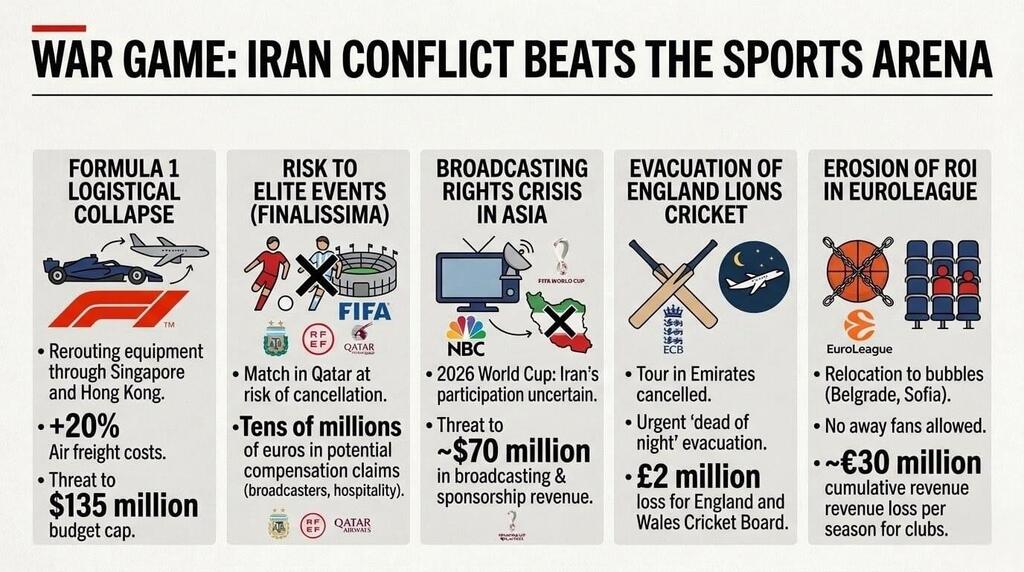
For Israeli and international sports organizations, the crisis is first and foremost a logistical and economic event. The forced rerouting of travel, via Singapore or Hong Kong instead of Dubai or Doha, along with the need for alternative charter flights, has created budget gaps of millions of dollars for sports federations.
Amid this chaos, a new “solution economy” is emerging: the ability of sports organizations to build operational models that treat uncertainty as a permanent line item on the balance sheet.
Disruptions Across Global Sports
The war has also affected national teams and international competitions.
The European Handball Federation (EHF) recently postponed two European Championship qualifying matches between Israel’s women’s team and Greece. The decision followed warnings from the Israeli federation that reaching Greece now requires complex travel routes that undermine both preparation and player well-being.
The delay carries both sporting and financial consequences. Rescheduling the matches for next month will create a significant logistical burden, as the federation must secure flights, training camps, and accommodations during an ongoing regional crisis, all while preparing for upcoming matches against Spain and Austria.
Paralympic sports have also been affected. At the Milano-Cortina Winter Games, which opened this weekend, organizers confirmed that the conflict delayed the arrival of several delegations.
The global sports industry in the Gulf has also been hit hard. The Adidas NextGen youth basketball tournament in Abu Dhabi was canceled midway through the opening game between Monaco and Aris Thessaloniki, resulting in significant financial losses after the transportation and accommodation of eight European teams had already been arranged.
At the same time, the professional tennis tour faced its own logistical crisis when Daniil Medvedev, along with 30 officials and staff members, became stranded in Dubai due to airspace closures.
Cricket, Formula 1 and the Cost of Detours
One of the largest financial hits occurred in cricket.
The England and Wales Cricket Board (ECB) was forced to cancel the England Lions tour of the UAE and evacuate the delegation, which included star players such as Ben Stokes. The financial damage from the cancellation and emergency logistics is estimated at millions of pounds.
Even Formula 1 has felt the impact. Approximately 1,000 team members were forced to reorganize their travel plans for the season-opening race in Melbourne.
Alternative routes via Singapore and Hong Kong added roughly $500,000 in additional travel costs per major team.
From an accounting perspective, each hour of a heavy cargo aircraft flight costs around $35,000, meaning every airspace detour eats into budgets originally intended for car development.
The Rescue Flight Mechanism
The political dimensions of the war have also surfaced in unexpected ways.
During the Asian Cup in Australia, Iran’s women’s national team chose not to sing the national anthem as a form of silent protest.
Meanwhile, uncertainty surrounds Iran’s participation in the upcoming Men’s World Cup in the United States. The president of the Iranian Football Federation has acknowledged that participation under the current circumstances is uncertain, a scenario that could lead to major losses in Asian broadcasting rights and regional sponsorship deals.
In Israel, Minister of Culture and Sports Miki Zohar has called for the creation of a special rescue flight mechanism for approximately 700 Israeli athletes currently abroad.
The goal is to prevent long-term economic damage: missing international competitions could lead to sanctions and jeopardize years of investment in Olympic sports.
At the same time, the prestigious Finalissima match between Spain and Argentina, scheduled to take place in Qatar, is now at risk of cancellation. If necessary, FIFA will have to find an alternative venue within weeks, a logistical effort that could cost tens of millions of euros in compensation and broadcasting adjustments.
Belgrade and Sofia Instead of Tel Aviv
The Israeli case is at the forefront of this economic adaptation, with Tel Aviv’s basketball teams becoming a kind of living laboratory for risk management.
While Israel’s domestic soccer and basketball leagues were officially suspended during operation Roaring Lion, Israeli clubs competing in European competitions were forced to find logistical solutions that significantly increased operating costs.
For Maccabi Tel Aviv, the loss of home games translates into a direct revenue loss of approximately 1.5-2 million shekels per game at Menora Mivtachim Arena. Over an entire season played abroad, this amounts to more than 25 million shekels in lost revenue.
The solution has been what some call “regulated nomadism,” adopting Aleksandar Nikolić Hall in Belgrade as a temporary home arena. Maintaining this arrangement costs the club roughly $150,000 per week for accommodation, training facilities, and operational logistics abroad.
Head coach Oded Kattash described the strain of this model, noting that the team essentially lives in Israel while playing its home games in Serbia, a routine that creates both physical and mental fatigue.
From a business perspective, however, the arrangement is essential: maintaining participation in the Euroleague preserves international broadcasting and sponsorship contracts, which account for roughly 30% of the club’s revenue.
Meanwhile, Hapoel Tel Aviv, owned by Ofer Yannay, faces an even more complex financial challenge.
The club assembled a star roster with a net player salary budget of about €20 million, the third-largest in the EuroLeague, while simultaneously relocating its operations to Sofia.
According to figures revealed by Calcalist, the club finished 2024 with a loss of roughly 40 million shekels. In response, Yannay launched a crowdfunding campaign valuing the club at 180 million shekels (about $55 million) to generate additional liquidity.
The cost of relocating to Bulgaria is estimated at millions of dollars, with the rental of Arena 8888 Sofia, player housing in a dedicated apartment complex, and enhanced security creating fixed monthly expenses of hundreds of thousands of euros.
At the same time, the club must continue to finance massive player contracts, such as Vasilije Micić’s $5.6 million annual salary, while domestic revenues have sharply declined.
Hapoel Jerusalem, which competes in the Eurocup, has also relocated its European games to Belgrade, intensifying competition for training facilities and logistical resources in the Serbian capital, which has effectively become a hub for Israeli professional sports.



