











"We could be facing a tsunami": Finance ministry convenes emergency meeting with tech leaders
Industry warns that the strong shekel is eroding profits and shortening startup runways.
The math behind this crisis is simple. With an average monthly salary of NIS 30,000 and an average dollar exchange rate of NIS 3.53 over the past decade, each high-tech employee costs an exporting company roughly $8,500 per month. At an exchange rate of NIS 3 to the dollar, that same employee costs approximately $10,000 per month, an increase of $1,500.
Based on these figures, Ronen Nir, a managing director at VC firm PSG, calculated that for an industry employing roughly 400,000 workers, the stronger shekel adds about NIS 21 billion in annual labor costs. That amount is equivalent to the cost of employing roughly 40,000 workers, or, more accurately, the number of jobs that could be at risk of being relocated abroad in pursuit of lower costs.
3 View gallery

Michal Braverman-Blumenstyk (from left), Microsoft Israel R&D Center Managing Director; Arik Kleinstein, co-founder of Glilot Capital; Adi Soffer Teeni, General Manager of Meta Israel.
(Photos: Yuval Chen, Orel Cohen, Tommy Harpaz)
In reality, the dollar has already fallen below NIS 3, while the average salary in high-tech climbed to a record NIS 38,000, according to data published last week. That means the burden is even greater and the number of jobs potentially at risk is even higher.
Although the dollar strengthened slightly over the weekend following sharp declines on Wall Street and is currently trading at around NIS 2.96, policymakers and economists, including officials at the Bank of Israel, acknowledge that this time the exchange-rate story is not entirely under the central bank’s control. The shekel is being driven more than ever by external factors, including the Trump administration’s efforts to weaken the U.S. dollar, the continued rally in U.S. equity markets, and Israel’s declining risk premium.
Evidence of this can be seen in the dollar’s broad weakness. Since January 2025, the beginning of Donald Trump’s second term in the White House, the U.S. currency has weakened by double-digit percentages not only against the shekel, but also against major currencies including the euro and the Swiss franc.
Nir made his calculation in early May, shortly after the dollar first fell below NIS 3. Yet only a month later, and after a quarter-point interest rate cut failed to weaken the shekel, did the Ministry of Finance begin treating the issue as more than a temporary market fluctuation. The concern is no longer limited to what some policymakers once dismissed as the "spoiled" high-tech sector. It is increasingly viewed as a threat to one of Israel’s primary growth engines.
On Wednesday, senior Finance Ministry officials, including Accountant General Yali Rothenberg , Director General of the Budget Department Yogev Gradus, and Chief Economist Shmuel Abramzon, held an emergency discussion with leading figures from Israel’s technology sector. At the end of the meeting, it was decided to establish a task force to formulate recommendations for immediate implementation aimed at mitigating the effects of the strong shekel.
The seriousness of the issue was reflected in the list of participants.
According to information obtained by Calcalist, the meeting included Michal Braverman-Blumenstyk, Microsoft Corporate Vice President, CTO Microsoft Security, and Microsoft Israel R&D Center Managing Director; Adi Soffer Teeni, General Manager of Meta Israel; Ofir Ehrlich, co-founder and CEO of unicorn startup Eon; Hedva Ber, former Supervisor of Banks and currently Deputy CEO of eToro; and venture capital representatives including Adam Fisher, managing partner at Bessemer Venture Partners, and Arik Kleinstein, co-founder of Glilot Capital.
The preparations for the meeting were led by Israel Advanced Technology Industries and its CEO and President, Karin Mayer Rubinstein.
3 View gallery
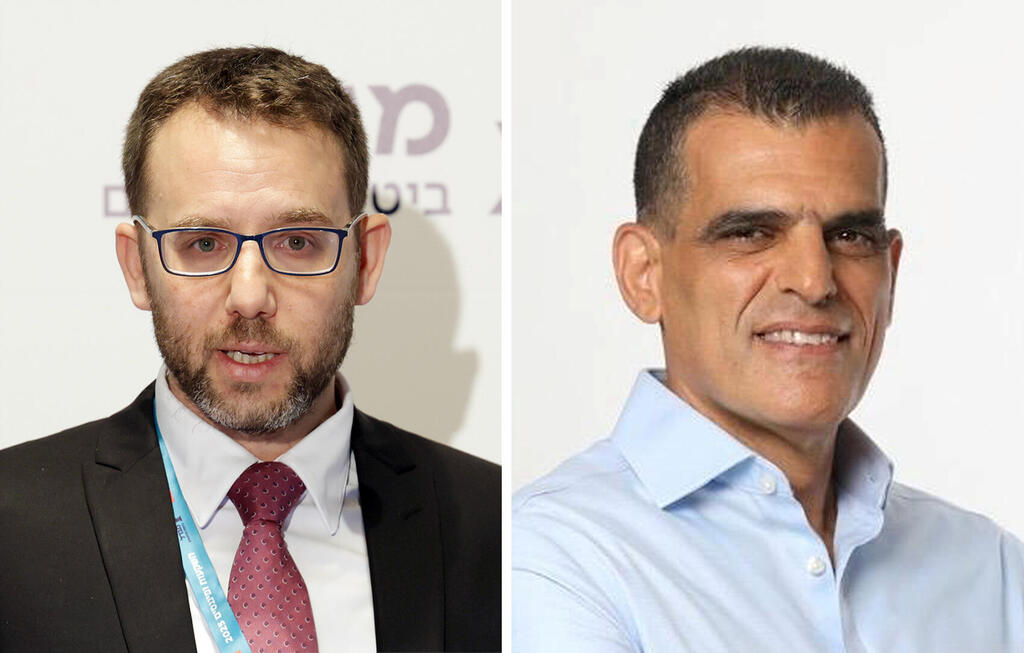
Chief Economist Shmuel Abramzon (left) and Alon Ben-Zur, chairman of the High-Tech Association.
(Photos: Orel Cohen and Bynat)
Also participating were Dror Bin, CEO of the Israel Innovation Authority, representatives of the Growth Companies Forum, which includes many of Israel’s largest public and private technology companies, and the High-Tech Association of the Manufacturers Association, which presented survey results that raised significant concerns.
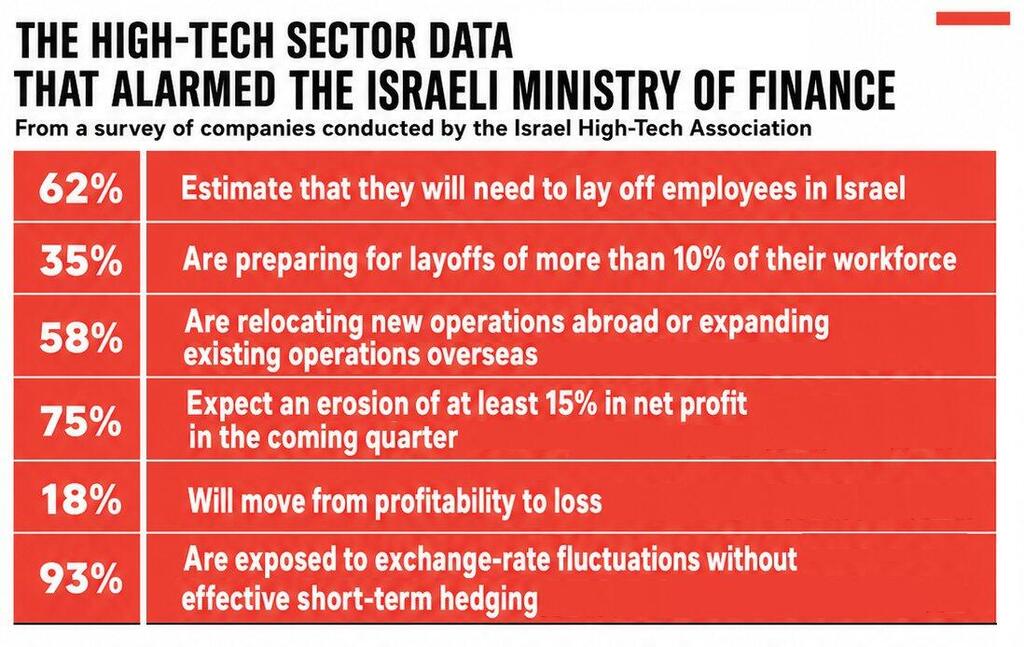
According to the survey, conducted in May among dozens of companies employing a combined 12,000 workers, most respondents expect profit erosion of at least 15%, potentially leading to layoffs and the relocation of operations abroad. The respondents included companies of varying sizes, from early-stage startups to multinational corporations.
Because the impact varies across different types of companies, participants agreed that solutions must also be tailored accordingly.
Last week, Calcalist revealed discussions between Nvidia, Google, and the Ministry of Finance regarding the possibility of allowing certain companies to pay corporate taxes in dollars rather than shekels. However, such a solution offers little benefit to startups that are still loss-making and pay minimal corporate tax, yet suddenly find their cash runway shrinking because of currency movements.
The consensus emerging from the meeting was that any response must be implemented quickly. With elections approaching, participants stressed that solutions requiring lengthy legislative processes would arrive too late.
"We need to act fast because layoffs will come immediately and jobs can disappear very quickly. Otherwise, we could be facing a tsunami," Aric Kleinstein of Glilot Capital told Calcalist.
Glilot invests in dozens of cybersecurity companies. While cyber remains one of the strongest sectors in technology, Kleinstein argues that even these companies are vulnerable.
"If the industry raised $15 billion in 2025, that amount has effectively shrunk to $12 billion because of currency movements. That means companies need to start raising more capital now, and urgently."
Kleinstein proposes reviving programs operated by the Israel Innovation Authority during the COVID-19 crisis and at the beginning of the war in 2023. Under those programs, grants were provided that later converted into royalty-based repayments tied to company revenue.
"This time, an emergency fund of NIS 400 million will not be enough," he said. "We believe at least NIS 1 billion should be allocated."
The grants would cover a fixed percentage of monthly operating expenses, with repayment beginning only after companies achieve meaningful revenue.
Ahead of the meeting, the High-Tech Association prepared a position paper containing several proposals that go beyond calls for Bank of Israel intervention or interest-rate cuts.
Among the ideas discussed were municipal tax discounts for major exporters and reductions in employer-related tax burdens. Such measures could lower labor costs without reducing employees’ take-home pay.
Association officials say additional proposals are being developed that would reduce costs borne by exporters and help offset the impact of the strong shekel.
"The fact that this meeting took place at the initiative of the Finance Ministry is already a positive signal," said Alon Ben-Zur, chairman of the High-Tech Association and CEO of Bynet Communications. "Now the team needs to move quickly and make decisions."
According to Ben-Zur, even industry representatives were surprised by the survey results.
"The salary data published last week is also concerning," he said. "What is driving wages higher are the large multinational companies operating in Israel. They are willing to pay premium salaries for a relatively small number of employees working on critical and complex projects, while moving simpler development roles abroad. We are also seeing a decline in the hiring of junior employees."
Ben-Zur warned that Israel is beginning to lose not only jobs, but knowledge and capabilities.
"A dangerous situation is developing in which knowledge is gradually leaving Israel. The impact will not stop with the high-tech sector. It will eventually spill over into other industries as well."
The strong shekel may prove to be the latest challenge for an industry that has already endured three years of upheaval. Those disruptions began with political uncertainty surrounding the judicial overhaul, intensified after the outbreak of war, and were compounded by prolonged reserve duty service and disruptions to international travel.
Data from the Aaron Institute, later confirmed in the Israel Innovation Authority’s annual report, showed that 2025 marked the first decline in the number of R&D jobs in Israel. At the same time, more than 50% of newly established startups were incorporated outside Israel, compared with roughly 30% over the previous decade.
Participants in the Finance Ministry meeting came away with the impression that policymakers finally recognize both the severity of the problem and the urgency required to address it.
Industry executives believe the concern became particularly tangible after the government saw the enormous tax revenues generated by deals involving Wiz, Armis, and CyberArk, which helped reduce the deficit despite soaring defense spending. The prospect of losing future tax revenues from a weakened high-tech sector has suddenly become much more real.



