










Nvidia, Google in talks with Israel over dollar-based tax payments
The move could reduce pressure from the strong shekel while helping the government service foreign-currency debt.
The shekel is becoming a powerful force shaping behavior across the Israeli economy. Calcalist has learned that, following a roughly 20% appreciation of the Israeli currency over the past year, the American chip giant Nvidia is considering paying taxes in Israel in dollars rather than shekels, as it has done until now. Google is also examining the option, and according to sources in the high-tech industry, several other large multinational companies that pay taxes in Israel are considering a similar move. The issue is currently under advanced discussion between the companies, the Ministry of Finance, and the Israel Tax Authority. Nvidia and Google declined to comment.
The emerging solution would allow companies such as Nvidia to reduce the impact of the strong shekel on their expenses while also preventing additional demand for shekels that could further strengthen the currency. Under the proposal, the Ministry of Finance would use the dollar-denominated tax receipts to service Israel’s foreign-currency debt, eliminating the need to convert the funds into shekels.
1 View gallery
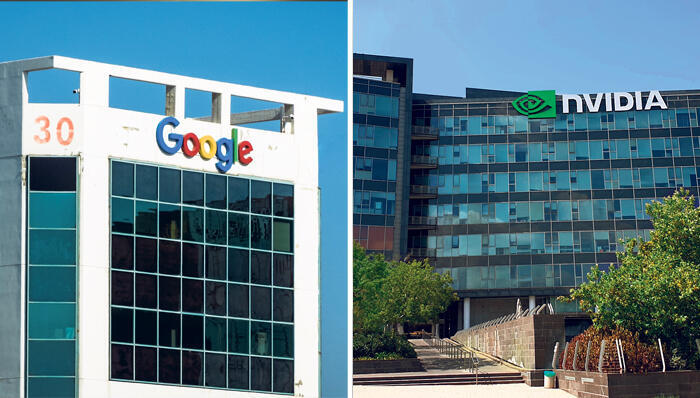
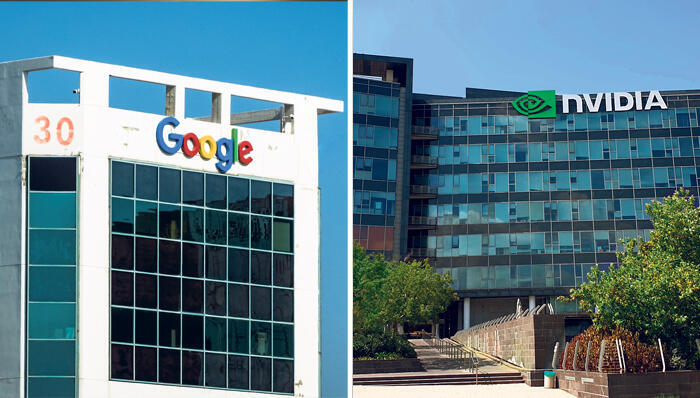
Google Haifa office and Nvidia Yokneam office.
(Photo: Michael Berlfein/ Shutterstock, NVIDIA)
A precedent for such a move was established in two of Israel’s largest recent exits: Wiz, which was sold to Google for $32 billion, and Armis, which was sold to ServiceNow for nearly $8 billion. In both cases, agreements were reached with the Tax Authority allowing tax payments to be made in dollars without conversion into shekels. These arrangements relate only to corporate taxes paid by the companies and not to income taxes or other payroll-related taxes paid by employees. Most multinational companies operate in Israel under a “cost-plus” model, under which they report local operating expenses, such as salaries and rent, plus a profit margin that typically ranges from 5% to 10%.
Nvidia’s case is different, however, which helps explain its urgency in reducing the impact of the strong shekel on its tax burden. The company’s Israeli operations are based on Mellanox, the Israeli company it acquired in 2020 for $7 billion. Because Mellanox remains an Israeli entity, Nvidia is subject to Israeli corporate taxation, making it one of the country’s largest taxpayers. In the previous fiscal year, when the dollar traded at roughly 3.3-3.5 shekels, Nvidia paid approximately $1.28 billion in taxes in Israel.
Since then, the dollar has weakened while Nvidia’s Israeli operations have expanded dramatically. According to the company’s latest financial statements, published about a week ago, its operations in Israel are now generating almost $15 billion in quarterly revenue. That represents a roughly 200% increase compared with the corresponding quarter a year earlier, accompanied by strong profitability. As a result, Nvidia’s tax bill in Israel is expected to rise significantly in 2026. The same reports indicate that Nvidia now employs more than 6,000 people in Israel, up sharply from the previously reported figure of 5,000 employees. That represents nearly 20% of the company’s global workforce, meaning that the rise in already high Israeli engineering salaries has significantly inflated costs.
Google employs fewer people in Israel, approximately 2,200 employees. However, following the completion of its acquisition of Wiz, the scale of its operations and the costs associated with its Israeli development activities are expected to increase significantly, with headcount potentially approaching 3,000 employees. Until now, a substantial portion of Google’s activity in Israel has been related to advertising and media operations that are booked through Google Ireland and therefore do not generate significant Israeli corporate tax liabilities. The Wiz acquisition is expected to increase the relative weight of local development activity. Although Wiz is incorporated in the United States, a dispute remains between the company and the Israel Tax Authority regarding the ownership of its intellectual property, much of which was developed in Israel. If that intellectual property is ultimately recognized as Israeli, Google could face a significantly higher tax burden in Israel over the coming years.
According to data published by the Ministry of Finance’s Revenue Administration, high-tech companies accounted for 12% of all corporate tax revenue in Israel, although the figures refer to 2021. The average corporate tax rate paid by high-tech companies that benefit from tax incentives is approximately 12%, compared with the standard corporate tax rate of 23%. An even larger contribution comes from employee taxation, with the sector accounting for approximately 25% of all direct tax revenue in 2025.
The strong shekel, which briefly strengthened to below 2.8 shekels per dollar over the weekend, is creating challenges for exporters across Israel, particularly in the high-tech industry. The primary issue is the sharp increase in local labor costs, which were already among the highest in the world even before the currency’s appreciation. This has already led many technology companies to freeze hiring in Israel, while some have announced layoffs and explicitly cited the strong shekel as a contributing factor.
Although the exchange rate is not always the primary cause of a company’s difficulties, it adds another challenge beyond management’s control. For startups, it widens the gap between capital raised in dollars and operating expenses paid in shekels. For publicly traded Israeli companies whose revenues are largely dollar-denominated, it significantly increases costs. For multinational development centers such as Nvidia and Google, it raises questions about the economics of continued expansion in Israel.
Following the shekel’s appreciation, Israeli engineers have effectively become among the most expensive in the world. This comes at a time when companies are also dealing with ongoing security challenges, including military reserve duty, which can suddenly remove employees from the workforce, and missile threats that periodically disrupt day-to-day operations. Together, these factors place Israeli development centers at a disadvantage relative to competing locations abroad.
From a technical perspective, Israel’s tax system already allows companies to report in dollars under what are known as the “dollar regulations.” However, companies wishing to adopt this framework must generally notify the authorities before the start of the tax year and commit to it for at least three years. As far as Calcalist has learned, discussions with multinational companies began only after the start of the current tax year, following the precedent established in the Wiz and Armis transactions. It remains unclear whether the intention is to create a permanent framework for dollar-denominated tax payments or merely a temporary solution.
Many in the high-tech industry had hoped that the Bank of Israel’s latest interest-rate decision would help reverse the shekel’s appreciation. However, even after the central bank reduced rates by 0.25 percentage points last week, the trend continued and the shekel strengthened further. This suggests that the currency’s appreciation is being driven by broader forces that monetary policy alone cannot offset.
Bank of Israel Governor Amir Yaron acknowledged as much following the rate decision, saying: “The shekel is strengthening because of fundamental economic forces, and we must begin thinking about other tools.” Those forces include a sharp decline in Israel’s risk premium after more than two years of conflict, the Trump administration’s efforts to weaken the dollar in order to improve the U.S. trade balance, and the continued rally on Wall Street. The latter has prompted Israeli institutional investors to hedge their exposure to U.S. equities, creating additional demand for shekels.
With a growing recognition that the strong shekel may represent a new normal rather than a temporary phenomenon, the industry is beginning to explore creative solutions. Many exporters, including technology companies, are already running financial models based on exchange rates of 2.5 shekels per dollar and recognize that, at those levels, labor and operating costs in Israel could create substantial budgetary pressures.
Yet the interests of exporters are not necessarily aligned with those of importers, consumers, or even the Bank of Israel. From their perspective, a stronger shekel is beneficial. It lowers inflation, reduces the cost of imported goods, improves purchasing power, and makes overseas travel cheaper. At the same time, Israel’s economy remains heavily dependent on high-tech, which accounted for roughly half of economic growth last year and nearly 60% of exports.
Multinational corporations represent approximately one-third of Israel’s technology sector, which employs around 400,000 people, excluding the defense industry, and includes nearly 500 foreign-owned development centers. In a reality where the Bank of Israel appears reluctant to intervene directly in the foreign-exchange market, additional creative solutions are likely to emerge as companies seek ways to mitigate the impact of the strong shekel on the high-tech sector.



