










JFrog’s recovery defies the SaaS sell-off as AI makes its software more essential
The Israeli company lost $700 million in market value in minutes after Anthropic’s Mythos announcement, but its shares have since surged. Investors are increasingly distinguishing JFrog’s software infrastructure from conventional SaaS products that could face greater disruption from AI.
On February 20, JFrog CEO Shlomi Ben Haim watched investors deliver a brutal verdict on the Israeli software company. Within 15 minutes of the opening bell in New York, roughly 12 million shares changed hands amid a wave of selling, wiping $700 million off the company’s market capitalization.
The trigger was Anthropic’s announcement of Mythos, a new artificial intelligence model capable of identifying security vulnerabilities in software and computer systems. Investors feared that increasingly powerful AI models could upend the cybersecurity industry, threatening companies whose products were designed to protect against weaknesses that AI could now find and exploit.
Cybersecurity stocks tumbled, while software companies more broadly were already struggling with fears that AI would undermine their business models. JFrog was caught in both sell-offs. Although its business includes security, the company was largely viewed as another software-as-a-service (SaaS) provider, vulnerable to the same doubts hanging over the sector.
Between December 2025 and the February sell-off, JFrog’s stock fell by roughly 50%, reaching about $34 per share. Other Israeli software companies, including monday.com, Wix and Nice, suffered similar pressure.
But JFrog’s subsequent performance has told a different story. Its shares have climbed to around $92, having briefly touched $100, and the stock has delivered a positive return of approximately 55% since the beginning of the year. At a market capitalization of about $11.5 billion, JFrog is now worth roughly as much as monday.com and Nice combined.
The valuation is striking given JFrog’s relative size. By revenue and headcount, the company is smaller than monday.com, Nice, Wix and Check Point. Yet it has become one of the five largest Israeli high-tech companies by market capitalization, behind Palo Alto Networks, Elbit Systems, Tower Semiconductor and Check Point.
Its resurgence offers a potential counterpoint to the narrative of a SaaS apocalypse. Rather than treating every software company as equally vulnerable to AI, investors appear to be distinguishing between products that AI could replace and those that become more important as AI changes how businesses operate.
For much of the past year, investors have questioned whether AI tools will reduce demand for traditional software. The concern is that businesses will increasingly build their own tools using AI, automate tasks that once required paid software and rely less on established vendors.
The cybersecurity sector has offered a more complicated picture. As AI agents become more capable, they can expose vulnerabilities and create new security challenges, potentially increasing the need for tools that help organizations manage and protect their software.
JFrog occupies a position at the intersection of these trends. Founded in 2008, the company develops software used to manage the packages, components and binary artifacts that move through the software development process. Its technology helps organizations track, store, secure and distribute the building blocks of applications as they move from development toward production.
That role has become more consequential as AI coding tools accelerate software development. AI agents can generate code at a pace that far exceeds what individual programmers can produce, increasing the volume of software that companies must test, manage and secure. More code and more frequent releases also create additional complexity for organizations trying to ensure that the software they deploy is reliable and has not been tampered with.
JFrog’s systems help companies manage those artifacts and enforce controls over what moves through their development pipelines. As AI-generated code becomes more prevalent, the company argues, organizations need greater visibility and control over the software being produced and deployed.
JFrog is not simply selling protection against a particular cyberattack. Its products are embedded in the process by which software is built, distributed and maintained. That can make them harder to replace than applications that perform more discrete business functions.
In the software industry, one of the most valuable positions a company can occupy is that of a system of record: a platform that becomes deeply integrated into an organization’s operations and holds information or manages processes that are difficult to migrate without significant disruption.
For companies in this category, replacing a vendor can involve more than purchasing an alternative product. It may require changing established workflows, moving data and artifacts, retraining employees and taking on operational risks.
JFrog’s growing role in software development gives it some of those characteristics. As companies produce and release more code, the infrastructure that tracks and manages their software components can become more central to their operations.
This helps explain why investors may value JFrog differently from SaaS companies whose products face more direct competition from AI-generated alternatives. It also helps explain the gap between its valuation and those of some Israeli software peers.
JFrog trades at nearly 20 times projected revenue, compared with single-digit revenue multiples for Nice, Wix and monday.com and an average of approximately four times projected revenue for the broader software industry. Such a premium suggests that investors are assigning considerable value to the company’s growth prospects and strategic position. It also leaves the stock vulnerable if expectations fail to materialize.
The company’s performance stands out for another reason. Many software companies have used share buybacks to support their stock prices, while JFrog announced a $300 million buyback plan earlier this year that has not yet been fully executed. The company has also avoided layoffs.
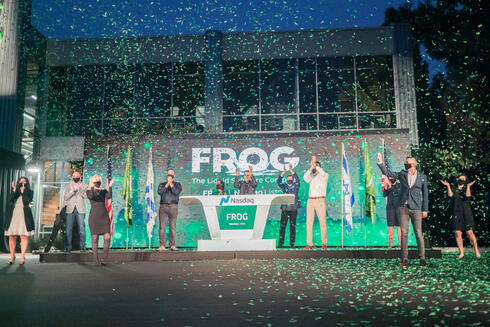
JFrog’s current position reflects a gradual expansion beyond its original software management business. After going public in 2020, during the boom in technology listings, the company acquired Israeli startups to broaden its capabilities, including in software security and code analysis.
In the summer of 2024, JFrog acquired Qwak in a cash-and-stock transaction aimed at accelerating its entry into AI. The deal brought approximately 45 employees with AI expertise into the company, adding talent in a field where experienced specialists are in high demand.
The acquisition also reflected a broader strategic shift. As companies incorporate AI into software development, JFrog can seek to provide tools not only for managing conventional development workflows but also for the new processes created by AI systems.
The risks associated with AI-generated software extend beyond coding mistakes. Organizations must also be able to identify the origin of software components, control which artifacts are allowed into production and detect potentially malicious activity within increasingly automated development pipelines.
JFrog’s products can help establish those controls, although they are not a substitute for every layer of cybersecurity. Their value lies in giving organizations visibility into the software supply chain and helping them govern the movement of code and related artifacts through development and deployment.
The concern is becoming more pressing as AI agents perform more work with less direct human oversight. In a development environment where code can be generated, modified and moved between systems at machine speed, organizations need reliable ways to track what is happening and prevent untrusted components from reaching production.
Since that difficult day in February, the company has successfully communicated a new narrative to investors. However, given its current valuation and the high multiple at which it trades, the burden of proof is immense. Its financial results still fall short of justifying that valuation. JFrog ended the second quarter of 2026 with $164 million in revenue, representing annual growth of 29%.
Another advantage JFrog has over a company like monday.com is its pricing model. Rather than charging customers on a per-employee or per-seat basis, JFrog ties its pricing to resource consumption, storage volume and other usage metrics. As a result, even if a customer does not increase its number of developers, the volume of software, updates and binary files it generates can grow dramatically, driving higher payments to JFrog.
JFrog serves 6,600 customers, including a substantial number of large enterprises that pay more than $1 million annually. Its net revenue retention rate reached a record 121% in the second quarter, indicating that existing customers are expanding their use of the platform. Its customer base includes major companies such as Netflix, PayPal, Barclays, Airbus, Uber and Qualcomm, giving it exposure to a broad range of industries.
Despite these positive indicators, JFrog issued a conservative forecast for the third quarter, projecting revenue to remain roughly in line with the previous quarter. The company expects full-year revenue to reach $650 million, representing annual growth of 22%. By comparison, both monday.com and Nice have surpassed $1 billion in annual revenue. Nice is growing more slowly but is highly profitable, while monday.com continues to deliver strong double-digit growth.
JFrog is not yet profitable and reported an operating loss of $13 million in the second quarter. Although that was half the loss recorded in the same period last year, it remains a disappointing result for an established software company. When JFrog reports its next financial results in two weeks, investors will be looking for evidence that growth is accelerating and profitability is improving.
For now, the market is valuing JFrog as a star performer, despite financial results that suggest the company has yet to fully emerge from its difficulties.