










"One of today's biggest dangers is that thinking is no longer a prerequisite for creating something"
Executives from AppsFlyer, monday.com, JFrog and Fiverr discuss the skills that will define the next generation of tech workers.
Artificial intelligence is no longer just changing products, it is reshaping how technology companies are organized, how software is built and, increasingly, what skills they look for in new employees.
Speaking at Calcalist and the Holon Institute of Technology's Future of Industry conference, executives from monday.com, JFrog, Fiverr and AppsFlyer described an industry undergoing one of its most profound transformations since the rise of cloud computing. While AI is dramatically accelerating software development, they said, companies now value critical thinking, adaptability and sound judgment more than ever.
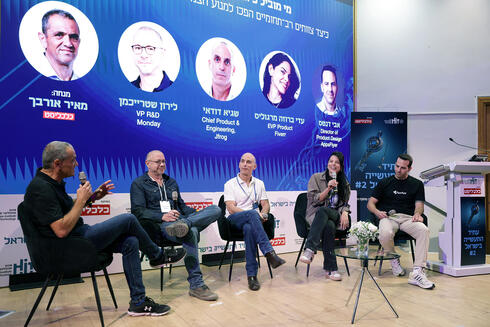
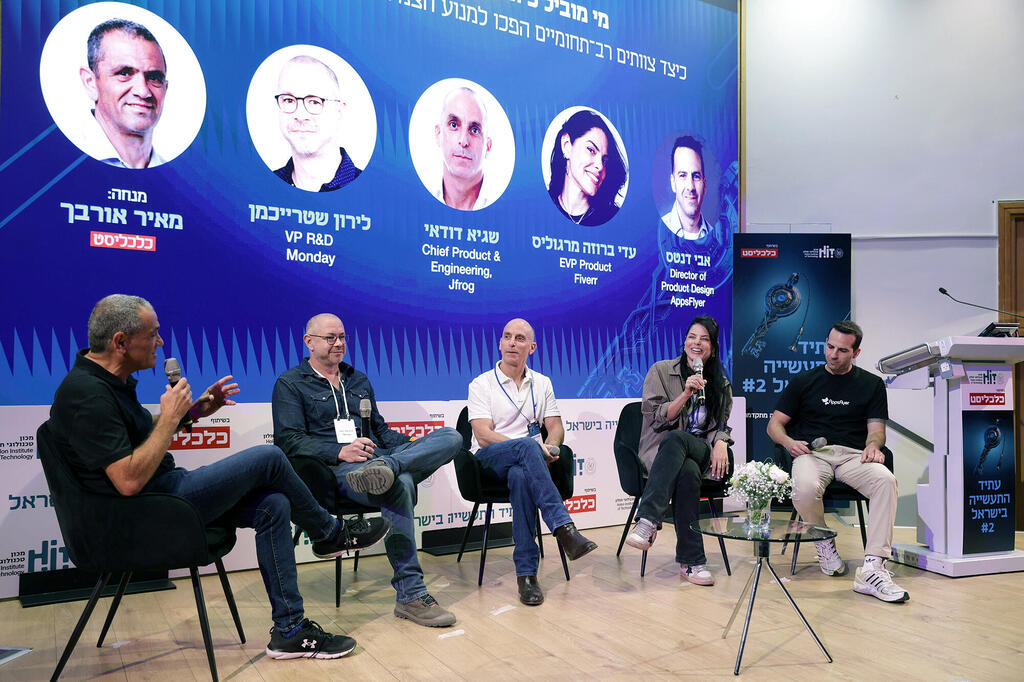
The panel featured Liron Shtraichman, VP of R&D at Monday.com; Sagi Dudai, Chief Product & Engineering Officer at JFrog; Adi Broza Margolis, EVP of Product at Fiverr; and Avi Dantess, Director of Product Design at AppsFlyer. It was moderated by Calcalist reporter Meir Orbach.
Monday.com pauses development to reinvent itself
According to Shtraichman, monday.com's transformation extends far beyond adding AI features.
"Monday understood that it was time for a fundamental change," she said. "Instead of helping customers manage work, our products are increasingly doing the work itself."
The shift required an equally dramatic internal transformation.
"A year ago we realized our entire engineering organization had to change," she said. "We stopped almost everything for a month because our attempts to introduce AI gradually weren't reaching everyone. During that month we focused almost entirely on AI."
Shtraichman compared today's AI revolution to previous technological breakthroughs but argued that today's developers need a different skill set.
"Writing code from scratch is no longer the main challenge," she said. "The real value lies in defining the right rules, understanding performance and scalability issues, and making the right engineering decisions."
She added that while recent graduates generally arrive with solid theoretical knowledge, companies still need engineers capable of understanding the deeper implications of the systems they build.
AI is changing how products are built
For Fiverr, AI has fundamentally changed product development itself.
"The models have become dramatically more capable over the past year," said Broza Margolis. "We created dedicated AI task forces to rethink how different parts of the company operate."
Rather than simply adding AI features, Fiverr is redesigning the way products are created.
"We're rebuilding our development processes to become much more agentic, enabling teams to deliver products that have business impact much faster."
The company relied both on existing employees and outside experts.
"We brought in external consultants and freelancers, but we also identified people inside the organization who could lead this transformation," she said.
Software development enters a new phase
JFrog has also seen AI fundamentally change the pace of software development.
"We develop the software supply chain, and AI has reached every part of our business," Dudai said.
He pointed to the rapid advances in large language models over the past several months as a turning point.
"Since November, with Claude and the latest models, we've seen a dramatic leap. Our development speed has changed dramatically, and so has that of our customers."
But the same technology is also empowering cybercriminals.
"Hackers have access to the same frontier models that we do," he said. "That means they can launch increasingly sophisticated attacks, which makes software security even more important."
AI is creating a new organizational brain
AppsFlyer has focused less on replacing employees and more on making institutional knowledge accessible.
"We've stopped looking at departments as isolated silos," said Dantess. "Instead, we've created an information layer that combines structured business data with knowledge that previously existed only inside people's heads."
The result, he said, is an AI-powered organizational knowledge base that helps employees make better product and business decisions.
"AI allows us to leverage knowledge that already exists across the company."
AppsFlyer is still hiring designers and product managers, but the company increasingly looks for candidates who know how to work alongside AI rather than simply rely on it.
"We want people who know how to lead AI, not let AI lead them."
Judgment becomes the most valuable skill
Despite AI's rapid progress, none of the executives argued that human expertise is becoming less important.
"What I still need from academia is to teach people how to think," Dudai said. "Curiosity and passion remain the most important qualities."
He also warned about another emerging challenge: the exploding cost of AI itself.
"Token usage is growing exponentially," he said. "Some companies budgeted hundreds of thousands of dollars a year and suddenly discovered they needed millions. Many are now optimizing their AI infrastructure or using smaller models for routine tasks."
Broza Margolis agreed that technical expertise alone is no longer enough.
"Human expertise is more important than ever, especially when it comes to decision-making," she said. "Mental flexibility has become critical because the technology changes constantly."
Dantess concluded with a broader warning.
"One of today's biggest dangers is that thinking is no longer a prerequisite for creating something," he said. "AI can generate polished results very quickly, but polished doesn't necessarily mean thoughtful. We need to teach people to think critically because, ultimately, they remain responsible for the products they deliver."



