









"AI not only learns, it participates in decision-making and is beginning to exercise context-based judgment"
Alon Haimovich, GM of Microsoft Israel, was speaking on a panel as part of Calcalist and Commit's AI Week. Nati Amsterdam, Senior Country Director at Nvidia Israel: "We believe that in the future every employee will have some kind of agent that assists in daily activities and makes them much more efficient and effective."
"AI is changing entire industries. We see large investments by countries in establishing AI infrastructures and computing infrastructures to support the industries they lead. And beyond government investment, we also see other sectors, not necessarily technological ones, investing heavily in building infrastructures to accelerate their capabilities," said Nati Amsterdam, Senior Country Director at Nvidia Israel, as part of Calcalist and Commit's AI Week. Amsterdam was asked about organizations' attitudes toward AI and what they can realistically do.
He said, "For example, a pharmaceutical company like Lilly uses a thousand processors to discover drugs much faster. Samsung is investing in building a huge computing infrastructure to improve its factory production. But beyond that, we see organizations in Israel today, across a variety of industries, including healthcare, integrating agents into their work. These tools help doctors be more productive and have far more effective interactions with patients. We also see this in customer service. This field of smart agents is evolving quickly and helping organizations significantly, and we believe that in the future every employee will have some kind of agent that assists in daily activities and makes them much more efficient and effective."
1 View gallery
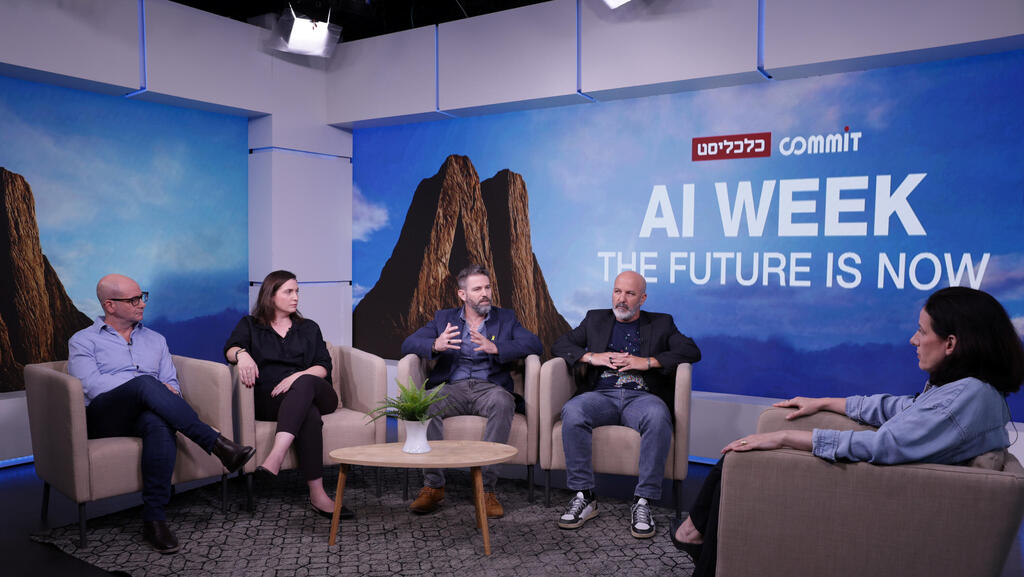
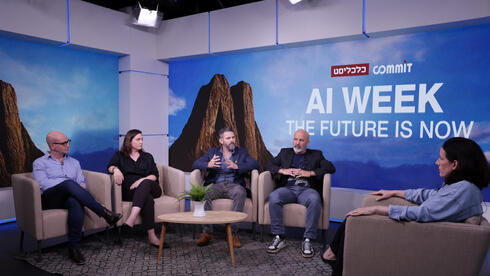
AI Week panel (from left): Eyal Efrat, Ayelet Gilan-Segal, Alon Haimovich, Nati Amsterdam
(Orel Cohen)
Alon Haimovich, GM of Microsoft Israel, how do you define the stage we are in today?
"If until now AI was mainly about training and coaching, I think we are moving to the stage of inferencing. Artificial intelligence is beginning to understand; it not only learns, it generates insights, participates in decision-making, outlines strategy, and, no less importantly, begins to exercise context-based judgment."
It is not without reason, he added, that AI has become the fastest and most central growth engine in the global economy.
"We are seeing tremendous use of agents, whether for productivity, cybersecurity, or education. And the beauty is that we are starting to see these applications produce real breakthroughs. At Microsoft, we are already looking at the next significant revolution, the computing revolution. We believe that to accelerate entire fields of research, traditional computing, no matter how powerful, will not be enough. That is why we are investing heavily in quantum computing."
Ayelet Gilan-Segal, Israel Country lead at Palantir, how do you integrate artificial intelligence solutions in an organization where information is scattered across systems, branches, and different countries?
"Palantir’s approach for 20 years, long before there were language models or GPT on every phone, has been that the most important step is first organizing the information. We work on infrastructure that creates digital coordination across the organization. It essentially takes the entire business world and turns it into a network of entities, relationships, and actions that can be performed on those entities. In other words, we sit on top of different ERP systems and create a single layer where decisions can be made. Language models, on top of this, are a very powerful event. Now, when you want to ask a question about customers, you can understand it in depth because the groundwork has already been done.
"Within this, we see implementation in relatively complex areas that are difficult to move. These organizations want to adopt AI but often don’t know how. They typically begin with a simple chatbot that you feed documents into, allowing basic interaction. This is a very initial stage, more of a productivity tool than a true organizational transformation. To reach the point where AI can make or support substantive decisions, there is a significant process of organizing information."
Eyal Efrat, First Executive VP & Chief Information Officer at Bank Leumi. At Bank Leumi, you started using AI quite early. How do you introduce such technology into an old and large organization like a bank?
"The fact that Bank Leumi is sitting on a panel with Nvidia, Microsoft and Palantir is a great honor for the bank and really shows the enormous technological progress we’ve made in recent years. One of the best indicators of this is Bank Leumi's efficiency ratio, which is now one of the best in the world, and these processes are already deeply embedded in the bank. Ultimately, to truly succeed, these transformations require about two-thirds process re-engineering and rethinking. I believe this is why AI implementation fails in many places: it is only one-third technology, and the rest is cultural and process change.
"You have to constantly examine your processes, look at your customers, and understand what truly drives impact. It’s something you need to introduce into the organization, teach, and embed in a cycle of continuous improvement. This is what we are working toward at the bank, integrating technology, processes, and continuous improvement."



