










Israel spends more on education than any developed country. So why are the results so poor?
Israel devotes 4.7% of GDP to education, but Finance Ministry analysis finds that it gets less from that spending than any other developed country.
Israel consistently tops the list of developed countries in national spending on education as a share of GDP. But the statistic is misleading. It does not necessarily reflect a greater commitment by Israeli governments to education or the success of innovative reforms. Much of the difference can be explained by Israel's unusually high fertility rate.
The Ministry of Finance presented statistics that offer a more revealing picture of the education system at an emergency conference on education held at the Knesset in June. It examined the efficiency of education spending by comparing average spending per student with countries' average PISA scores.
Israel ranked last in the efficiency of education spending, with a gap of 1.52 standard deviations. In this analysis, the standard deviation is used as a measure of the gap between the educational outcomes that might be expected from Israel's spending per student and the results actually achieved.
1 View gallery
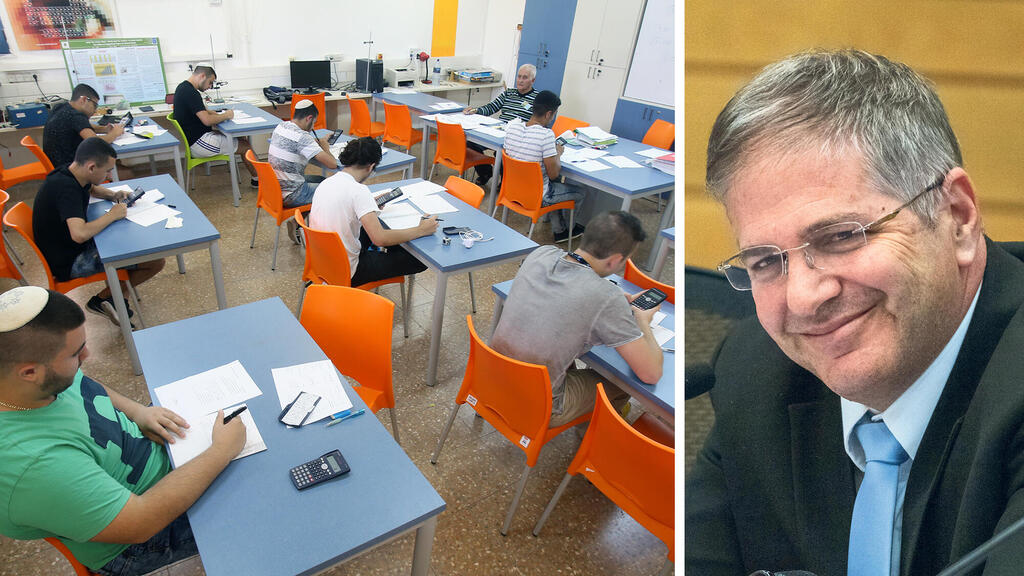
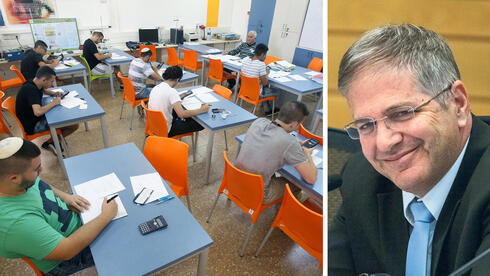
Yoav Kish, Minister of Education, next to students in a school classroom
(Shalev Shalom, Elad Gershgoren)
Only four countries recorded a gap of more than one standard deviation, with Israel at the bottom of that group. Japan and South Korea ranked among the countries that achieved the strongest results relative to spending.
"Israel could have done much more with every shekel spent on education," Hadar Fuks, the education coordinator in the Finance Ministry's Budget Department, said at the conference. "We don't see the needle of achievements moving even when the country is trying to make very significant reforms."
Israel ranked 35th in the 2022 PISA results, putting it near the bottom among developed countries. Its scores in all three testing areas were below the OECD average.
PISA is also fundamentally different from Israel's matriculation exams. While the latter have often been criticized for emphasizing memorization, PISA is designed to test students' ability to think, apply knowledge and solve problems.
Those are precisely the skills that the Israeli education system is expected to develop, particularly in a country whose economy places such a heavy premium on technological and high-tech skills.
The TIMSS results provide another indication of the problem.
Israel has historically performed relatively well in the eighth-grade TIMSS mathematics and science tests, which have traditionally placed greater emphasis on knowledge. But the 2023 tests placed greater weight on thinking and application, bringing them closer in spirit to PISA.
Israel's ranking deteriorated sharply. In mathematics, it fell from ninth place in 2019 to 23rd place. In science, it fell from 16th to 25th. For the first time, Israel was no longer above the international average in science.
National spending on education from kindergarten through high school amounted to 4.7% of GDP in 2022, the most recent figure available. That was higher than in any other country in the comparison, while the OECD average was 3.3%.
But the figure says less than it appears to about Israel's commitment to education.
Israel's fertility rate is 2.9 children per woman, almost twice the OECD average of 1.5. A country with a much larger share of children in its population will naturally spend more on education relative to the size of its economy.
A more meaningful comparison is education spending per student as a share of GDP per capita. On that measure, Israel spends 23.1%, almost identical to the OECD average of 22.8%.
The problem, therefore, is less the amount of money being spent than what happens to it after it enters the education system.
One factor complicating the comparison is Israel's unusually large defense budget, which competes with education and other civilian priorities for government resources.
Shai Piron, president of Inside Israeli Solutions and a former education minister, argues that one of the main sources of inefficiency is the number of intermediaries between the government and schools.
In some countries, he says, governments fund schools directly. In others, there is a single intermediary, such as a district or local authority. In Israel, funding can pass through the Ministry of Education's district, a local authority's education department and, in some cases, an education network.
"9-12% disappears through the overhead pipe and does not reach the student," Piron said. "There is no such model in the world."
The Finance Ministry is attempting to address part of the problem through a reform that would abolish the Ministry of Education's districts and transfer responsibility for employing teachers to local authorities. The reform is also intended to address another structural problem: the Ministry of Education currently has responsibility both for operating the education system and supervising it.
Piron points to other sources of inefficiency, including coalition funds distributed through the Knesset Finance Committee to sectoral organizations.
He also questions Israel's six-day school week. "The whole world teaches for five days. Who said we need six days? We teach in a system that does not exist anywhere else in the world," he said.
The country's headline education results may make the situation look better than it is because large parts of the Israeli education system are effectively missing from international comparisons.
Around half of the education system serves sectors with particularly difficult structural problems, according to the argument presented at the conference. A large portion of ultra-Orthodox education does not teach core subjects, or teaches them at a low level, and much of it does not participate in PISA testing at all.
That means the international results do not capture the performance of a substantial part of Israel's children.
Arab education presents a different problem. Significant additional funding has been allocated through two five-year plans for the socioeconomic development of Arab society, including increased investment in education.
Yet the gap between Hebrew-speaking and Arabic-speaking students in the 2022 PISA results narrowed by only about 15 points, while the average gap remained around 110 points, a difference described as equivalent to more than five years of schooling.
The lesson is not necessarily that additional funding is ineffective. Rather, it demonstrates that funding alone does not guarantee better educational outcomes.
There is also a separate concern: whether Israel is becoming less willing to measure the performance of its education system.
Following the publication of the poor TIMSS results in mathematics and science, Education Minister Yoav Kish said such failures should not be published again.
Kish prevented the National Authority for Measurement and Evaluation in Education from publishing the results of the Tnufa tests, the new version of the Meitzav, in science for ninth graders. Only 3% of students reached the required level.
Kish also initiated proceedings to remove RAMA CEO Gal Alon, further intensifying the dispute over the authority's role.
That creates a final paradox. Israel already spends an unusually large amount on education relative to its economy. The Finance Ministry's analysis suggests that the problem is not simply a lack of resources but the system's ability to convert those resources into learning.
If the country responds to poor results by making them harder to measure, rather than addressing why students are falling behind, it risks making an inefficient system even harder to reform.



