











Azrieli’s data center slowdown weighs on results as company bets on renewed growth
Azrieli’s second-quarter NOI was nearly flat as weaker data center and office performance offset stronger malls. The company expects a new wave of data center projects in Israel and Europe to begin driving growth by the end of the year and more sharply in 2027.
A slowdown in data center growth, the impact of the stronger shekel and the continued effect of Meta’s departure from the Azrieli Sarona Tower weighed on Azrieli Group’s second-quarter results, offsetting improved performance at its shopping malls. It was the third consecutive quarter in which the real estate giant’s operating performance remained relatively weak. The company, however, expects its data center business to return to stronger growth toward the end of the year and accelerate further in 2027, following a series of agreements that are expected to begin generating income in the coming months.
Azrieli’s net operating income (NOI) rose 0.5% in the second quarter from a year earlier to NIS 651 million, after falling 1% in the first quarter. Funds from operations (FFO), a key measure of operating cash flow for income-producing real estate companies, remained unchanged at NIS 426 million. Excluding income from the occupancy of Palace senior housing units, where buyers pay a significant deposit upon moving in, FFO fell 1% to NIS 411 million.
The main weakness came from the data center and office businesses, which offset an improvement in shopping malls.
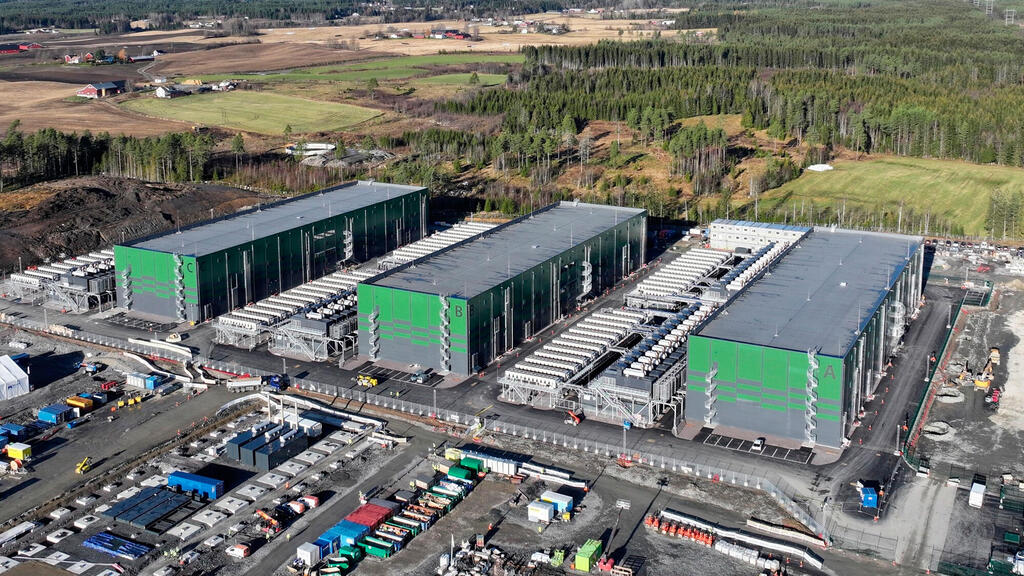
Azrieli’s data center business expanded rapidly from late 2024 through late 2025, following the launch of the TikTok campus. The growth rate subsequently slowed sharply. After NOI growth reached triple digits at one point, it fell to 8% in the fourth quarter of 2025 and turned negative in the first two quarters of 2026.
In the second quarter, NOI from data centers fell 10% from a year earlier to NIS 103 million. Excluding the impact of currency movements, however, NOI increased 3%.
Azrieli is betting that the slowdown will prove temporary. The company expects growth to resume toward the end of 2026 and accelerate more significantly in 2027 as recently signed agreements begin generating income.
In December, Azrieli signed an agreement to build and operate data center facilities with a capacity of 80 megawatts. The project is expected to generate annual NOI of approximately NIS 440 million, with the first stages scheduled to begin operating in March 2027.
Green Mountain, Azrieli’s data center arm, also signed agreements last year and early this year to provide services with an aggregate capacity of 56 megawatts from a facility under construction in Germany. The project is expected to generate average annual NOI of NIS 145 million, with its first phases scheduled to begin operating this year.
This month, Azrieli signed two additional agreements: one covering 13.6 megawatts at a facility being expanded in London, expected to begin generating income in early 2027, and another covering 5 megawatts in Norway. Together, the two agreements are expected to add average annual NOI of approximately NIS 125 million.
Azrieli is also in talks with TikTok over options to expand its existing campus by an additional 60 megawatts.
In total, Azrieli has signed contracts to provide data center services with a combined capacity of 275 megawatts, of which 147 megawatts are already generating income. Once fully operational, the contracts are expected to generate approximately NIS 1 billion in annual NOI, more than twice the NOI generated by the data center business in 2025.
Data centers are currently Azrieli’s third-largest source of NOI, after shopping malls and offices.
The shopping mall business provided a counterweight in the second quarter. Tenant sales, or redemptions, increased 8.3% during the quarter, following a 7% decline in the first quarter, when activity was affected by the war that continued until early April. Visitor traffic in the second quarter of 2025 had also been affected by the previous war with Iran.
Against that backdrop, NOI from shopping malls rose 9% to NIS 261 million.
The office business remained under pressure. NOI from offices fell 4% to NIS 230 million, largely reflecting the impact of Meta’s departure from 33,000 square meters of space at the Azrieli Sarona Tower before the end of its lease in May 2025.
In the corresponding quarter last year, Meta paid Azrieli NIS 14 million in compensation for leaving the space. Excluding that payment, NOI from office rentals increased just 2%, after showing no growth in the first quarter.
Azrieli has since re-leased all of the floors vacated by Meta at higher rents, but the new tenants have not yet fully occupied and utilized the space.
At the office campus Azrieli is developing in Glilot, covering 47,000 square meters, SolarEdge was originally expected to lease the entire project. Under agreements reached last year, SolarEdge will lease 60% of the space. Azrieli is negotiating with other potential tenants for the remaining area but has not yet signed binding agreements.
Net profit fell 52% to NIS 155 million from NIS 320 million a year earlier. The decline reflected, among other factors, negative property revaluations at shopping malls following higher construction costs, investments in the company’s Modi’in project, the withdrawal of rental space at Azrieli Tel Aviv mall as work continues to connect it to the nearby Spiral project, and higher financing expenses.
Azrieli is currently valued at NIS 48.5 billion, making it the largest real estate company on the Tel Aviv Stock Exchange by market capitalization. Its shares have risen 21% over the past 12 months.
The stock has outperformed most of the other major income-producing real estate companies on the Tel Aviv Stock Exchange, including Melisron, Big, Mivne and Amot. The exception is Mega Or, which, like Azrieli, has become increasingly associated with the data center sector.
The results therefore leave Azrieli with a relatively straightforward challenge. Its traditional businesses are showing signs of improvement, but its most important growth engine has slowed. The company is now relying on a pipeline of data center projects that is considerably larger than its existing operation to determine whether that slowdown is temporary or marks a more lasting change in the pace of growth.



