










From defense giants to startups: Israel reconsiders how it buys weapons
Procurement overhaul to weigh flexibility of new entrants against dominance of legacy contractors.
Officials in Israel’s Ministry of Defense and the IDF have learned a stubborn lesson: even a full-scale regional war does little to soften the country’s deeply entrenched procurement bureaucracy. Within the defense establishment, there is a half-joking refrain, if delivering a critical weapons system takes a decade, nine years are spent on internal debates and complex decision-making, and only one year on actual development.
Against this backdrop, a new internal team was quietly formed about two months ago, at a time when public attention was focused on disruptions to daily life caused by the threat of Iranian ballistic missiles. The team is led by Maj. Gen. (res.) Amir Abulafia, who left military service roughly six years ago after serving as head of the IDF’s Planning Directorate.
1 View gallery
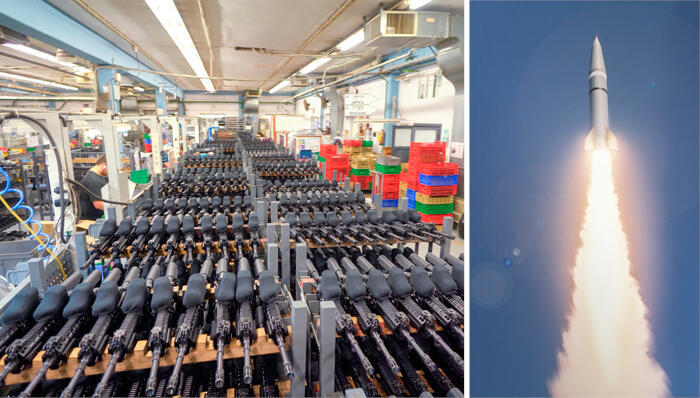
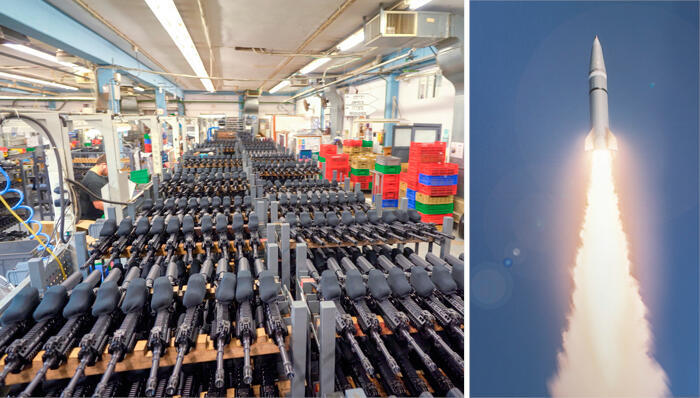
An IWI assault rifle (left), an IAI LoRa missile being launched from a ship
(Photos: Israel Aerospace Industries, IWI)
Abulafia’s team is expected to submit its recommendations by September to Defense Ministry Director-General Amir Baram and Deputy Chief of Staff Maj. Gen. Tamir Yadai. Its mandate is sweeping: to propose a comprehensive overhaul of defense procurement processes that have come under increasing strain since the outbreak of the October 7 attacks and the ensuing war.
Since the start of the conflict through the end of March, domestic defense procurement has totaled NIS 258 billion (approximately $88 billion), roughly four times the average annual level prior to the war. According to Ministry of Defense data, NIS 116 billion ($40B) went to large defense contractors, NIS 101 billion ($34B) to small and medium-sized enterprises, and NIS 41 billion ($14B) to marketers, importers, and suppliers.
Most of this spending has been managed by the Directorate of Defense Research and Development (DDR&D), headed by Dr. Danny Gold, and the Defense Procurement Directorate (DPD), led by Ze’ev Landau.
Yet the scale of spending has not translated into speed. More than two and a half years of sustained conflict have reinforced a growing consensus within the defense establishment: procurement processes remain cumbersome and excessively slow.
The team’s letter of appointment explicitly calls for “recommendations and operational proposals for shortening and streamlining procurement processes for the IDF’s operational needs.”
Its members include analysts, performance experts, and former senior officials from the Defense Ministry, the Finance Ministry, and the IDF. Their task is to identify bottlenecks across the entire procurement chain, from the initial definition of operational requirements to the final delivery of systems in the field.
“What worked for years no longer fits the current reality,” a senior defense official told Calcalist. “The global situation has changed, and there is no choice but to rethink procurement rules and how we contract with suppliers. Every stage of the process must be examined in detail.”
The creation of Abulafia’s team was first announced by Baram at a Calcalist conference late last year, where he sharply criticized the Ministry of Finance for underfunding defense needs. He warned that budgetary constraints risk slowing the pace of military buildup required to meet expanding threats across multiple fronts.
Defense officials say the approval chain for procurement, even in urgent operational cases, is excessively long. Once a military branch identifies a need, the process moves through multiple layers: General Staff approvals, Planning Directorate reviews, Budget Department scrutiny within the Defense Ministry, and finally decisions within the procurement administration on whether to issue a tender or negotiate directly with a supplier.
Even then, delays are common. Losing bidders frequently challenge tender outcomes in court, halting procurement processes until rulings are issued.
“When you are dealing with an active battlefield that demands immediate responses, this is time we simply do not have,” said a senior defense analyst involved in the team’s work.
The review will also examine the Defense Ministry’s relationship with major contractors such as Israel Aerospace Industries, Elbit Systems, and Rafael Advanced Defense Systems, alongside the growing role of smaller defense-tech startups.
These younger companies are often more agile, with faster development cycles and greater flexibility, qualities that the traditional procurement system has struggled to accommodate.
In a sign of shifting thinking, Palmer Luckey, founder of Anduril Industries, made a discreet visit to Israel shortly before the outbreak of the second war with Iran. Luckey’s company is involved in advanced U.S. missile defense initiatives, including proposals for a “Golden Dome” system.
His visit, initiated by the Defense Ministry, was described as an effort to broaden strategic thinking and accelerate collaboration with defense-tech firms.
Recent battlefield challenges have underscored that urgency. Israeli forces have faced threats from explosive drones guided via optical fibers by Hezbollah in southern Lebanon, systems for which no immediate technological solution currently exists. Defense officials increasingly believe that answers may come from smaller, innovative companies, including Kela, led by Hamutal Meridor, and Magos, which is developing AI-based detection systems.
Abulafia’s team is also expected to examine processes beyond the Defense Ministry itself, including those within the Prime Minister’s Office, the National Security Council, and the Ministry of Finance, which controls budget flows.
Officials argue that meaningful reform will require coordination across all these bodies. Even a single point of bureaucratic resistance can delay an entire procurement chain.
One proposal under consideration is the creation of a dedicated mechanism within the Defense Ministry tasked with removing obstacles to procurement in real time.
At the same time, defense contractors are preparing to push back. Industry executives are expected to argue that delays often stem from the ministry itself, particularly in issuing orders and approvals.
“If we are serious about identifying bottlenecks, the Defense Ministry must also examine its own conduct,” a senior industry analyst said.
Abulafia’s team is the third committee established by Baram since the war began.
Another panel, led by Prof. Shlomo Mor-Yosef, is expected to soon submit recommendations on improving care for wounded IDF soldiers. A separate team headed by former Defense Ministry Director-General Maj. Gen. (res.) Udi Shani has already proposed reforms to accelerate defense exports.
Those efforts appear to be yielding results. The Defense Ministry is expected to publish updated export figures in the coming weeks, after defense exports reached a record of nearly $15 billion in 2024.



