










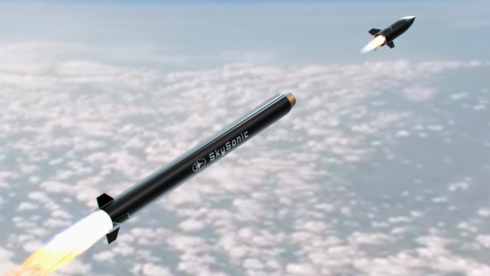
After years under wraps, Rafael’s secretive hypersonic interceptor steps into the spotlight
A full-scale model of Sky Sonic is on display at AUSA in Washington, where Israeli defense companies are seeking to deepen their presence in the U.S. market.
Around 25 Israeli defense companies are seeking to capitalize on the U.S. military’s expanding budget at the AUSA land warfare exhibition, which opened in Washington on Monday. The U.S. defense budget currently stands at approximately $1 trillion and is projected to grow by 50% to $1.5 trillion by 2027.
Armed with weapon systems whose operational effectiveness has been demonstrated over three years of war, and against the backdrop of joint Israeli and U.S. military efforts to counter Iran and an accelerating global arms race, the companies are hoping to turn the momentum into business. Some are seeking to establish a foothold in the expanding American market, while others aim to strengthen their existing presence.
The warm reception given to Israeli company representatives at the Washington exhibition stands in contrast to the boycotts and exclusion they have faced at other international arms fairs in recent years, particularly in France. The more welcoming atmosphere could help advance deals, forge new partnerships and strengthen existing ties.
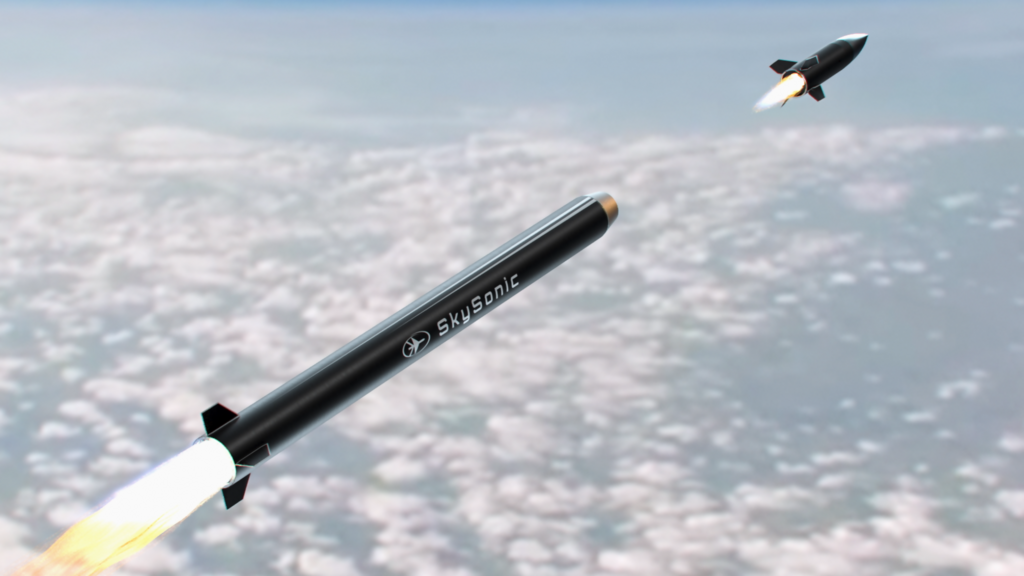
Rafael’s extensive lineup at the exhibition reflects the importance the company places on the U.S. market and the opportunities it offers for collaboration. Alongside its Iron Dome and David’s Sling air defense systems, as well as a high-power laser system designed to intercept drones and rockets, Rafael is displaying a full-scale model of Sky Sonic, an interceptor missile under development to counter maneuvering hypersonic missiles.
Hypersonic missiles travel at speeds exceeding Mach 5. Some can maneuver in flight and change trajectory, making them difficult for existing air defense systems to detect, track and intercept.
Rafael announced the development of Sky Sonic in June 2023, as the threat posed by hypersonic missiles moved to the forefront of the global defense agenda. Russia had begun using such missiles against Ukraine, while Iran was touting what it described as breakthroughs in its own capabilities in the field. Rafael Chairman Yuval Steinitz said at the time that development had begun early in the decade and was based on innovative technology developed by the company. He added that the system was in advanced stages of development and that initial flight tests would take place soon.
Rafael has declined to discuss the program in the intervening years. Its display of a full-scale model now offers a glimpse of the project’s progress, although it does not establish the system’s current development or testing status. “With the U.S., everything is open, and companies showcase their next-generation product developments and innovations,” Yair Kulas, head of the Defense Ministry's SIBAT directorate (The International Defense Cooperation Directorate), told Calcalist.
Rafael is also showcasing new capabilities for its Spike family of anti-tank missiles, including the ability to launch them from TOW missile launchers already used by the U.S. Army and mounted on Bradley armored vehicles. Upgraded versions of the Bradley have only recently begun arriving in the U.S. Army’s fleet and feature Elbit Systems’ Iron Fist active protection system, designed to defend armored vehicles against anti-tank missiles.
Israel Aerospace Industries (IAI) is presenting its POINT@AIR defense system, which uses a tactical radar mounted on a balloon to detect and track aerial, maritime and ground targets. The system shares some characteristics with IAI’s Sky Dew, known in Hebrew as Tal Shamayim, which also uses a radar mounted on a large observation balloon. The two systems differ in their intended roles: Sky Dew was designed for strategic detection and early warning from a fixed location, while POINT@AIR is intended to provide tactical detection and tracking using a smaller, mobile platform that can be deployed rapidly as operational needs change.
IAI is also showcasing HawkGuard, a system designed to defend against attack drones. It uses interceptor drones that neutralize incoming threats through physical collision, eliminating the need for warheads or explosive charges that could endanger friendly forces nearby. IAI is targeting the system at maneuvering ground forces as well as operators of critical infrastructure and strategic facilities, including power plants, airports and offshore rigs.
Israel’s defense exports reached a record $19.2 billion in 2025, with 13% of the total coming from deals in the U.S. and North America. Expanding those exports is a key objective for the Defense Ministry in 2026.
The importance Israel attaches to the American market was also reflected in the presence of IDF Ground Forces Commander Maj. Gen. Nadav Lotan. Among other things, he was there to offer guidance and help open doors for procurement representatives from militaries around the world.
“This is home to the world’s largest defense budget, and now is the time for our industries to strengthen partnerships with American companies that export to NATO standards,” Kulas said. “This will also help facilitate our entry into additional markets.”



