





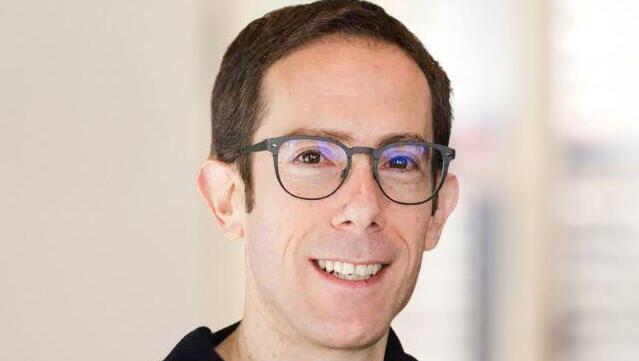
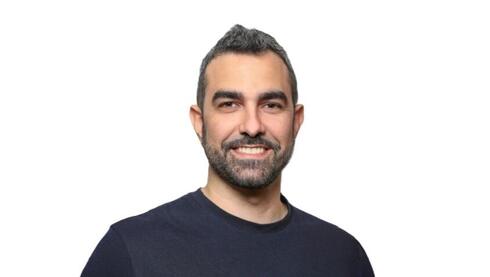
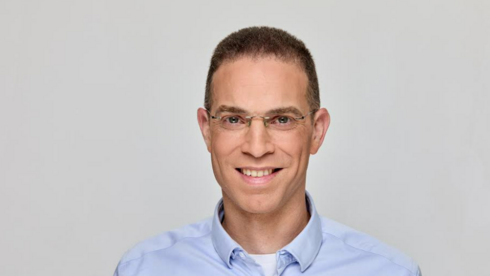

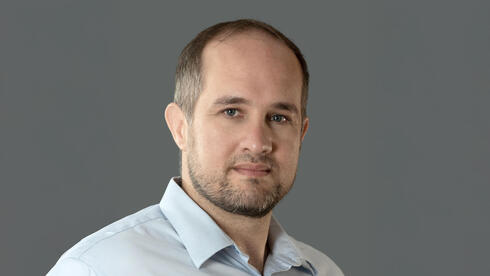
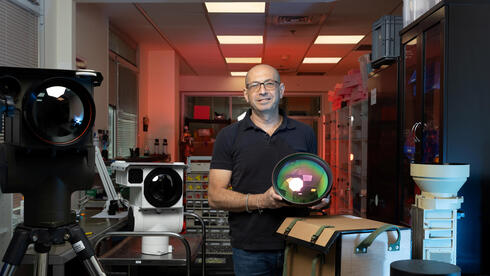
In focus: Since RP Optical Lab set it sights on defense, business is booming
The mechanical eyes developed by Ran Carmeli and Pavel Rashidko are located along borders, on drones and at the heart of some of the most advanced security systems in the world. First established as a medical lens company, their company pivoted as the defense market gave them a 400% jump in shares and a value of NIS 3 billion.
In another world, less violent but also much less profitable, RP Optical Lab would probably be the kind of company you'd never hear of. The sophisticated lenses its employees know how to make would be embedded in medical devices or cameras that scan borders, the advanced software it developed would identify physical anomalies or uninvited guests, and RP would operate — perhaps even grow — quietly, behind the scenes.
But that's not the case, and RP, which began its journey in the business of saving lives and guarding borders, has undergone a metamorphosis over the years, and in the last five years it has been thriving thanks to the booming war business. So much so that the value of the company - which produces advanced cameras, sensors and radars for the defense market and was floated exactly a year ago at a value of 575 million shekels - is currently traded on the Tel Aviv Stock Exchange at a value of about 3 billion shekels - a 400% year-on-year jump. Last week it even entered the Tel Aviv 90 index.
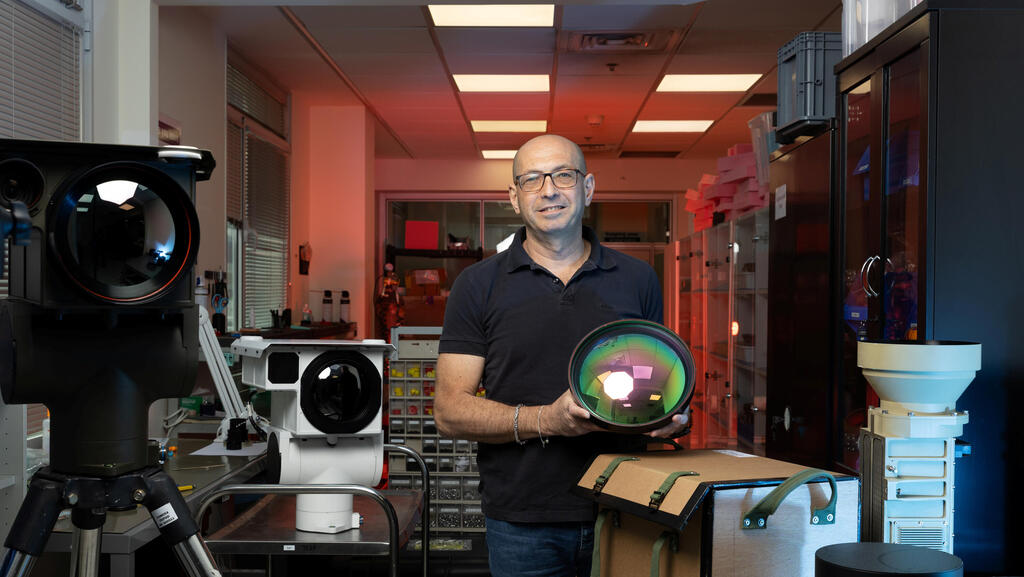
Ran Carmeli (60), who founded RP with Dr. Pavel Rashidko (61), is the first to admit that the boom the company enjoys was not planned. "Being a defense company was not in our portfolio," says Carmeli. "It turned out that way, but that was not our original intention."
So what happened?
"When we founded the company, our goal was to develop thermal lens technology. We had customers in Germany who were doing research on cancerous tumors and they needed thermal systems that would photograph moles and suspicious lesions on the skin in a way that would allow us to compare their sizes. In addition, we also sold systems to customers in the border protection sector. We weren't targeting security customers, but then it turned out that our technology was in great demand in the security sector, and that's how we got into the field. We would work on a project-by-project basis until customers asked us if we could build the entire camera for them."
And when you asked where this camera would be located and what it would be used for, what did they tell you?
"We asked, 'What will it sit on?' and they told us, 'On a drone.' We said to ourselves, 'Okay, it'll sit on a drone. What do we care?' That's how it happened, and today the electro-optical systems that operate in giant drones from IAI and Elbit are our electro-optical systems. Since it's a system that feeds itself, most of our sales and most of our customers today are from the security sector, but at the same time, many of our lenses continue to reach the border security sector."
Did installing your cameras on, among other things, offensive weapons raise ethical dilemmas for you?
"Do I have an ethical problem helping us or our allies? No. And the regulation in Israel is pretty clear, and the countries Israel works with are probably fine. Beyond that, I'm not that romantic. We know what human nature is and I never thought we would achieve world peace. Take Ukraine for example. Putin invaded it because Israel did something? No."
In one of the memorable videos from the morning of October 7, we saw a Hamas drone easily disabling an observation system and firing on the border. What is all this optical sophistication worth?
"The Sight-and-Shoot is not our system, but many of our systems were damaged that day. We were in Italy at the time with friends and they called me from Controp (a Rafael subsidiary whose RP products were integrated into the systems it builds), and asked me how many lenses I could bring when I returned to Israel, and that's how we realized that many of our systems had been blown up. But the problem wasn't that they didn't see them, but that they didn't interpret what they saw. The problem was the concept — the IDF lookouts saw, shouted, and the higher up didn't believe them. These systems work when they are used, if that doesn't happen — it's a shame to hang them. It's a shame to spend the money."
The most urgent project of the defense establishment today is providing a response to the threat of fiber-optic drones. Are you involved in it too?
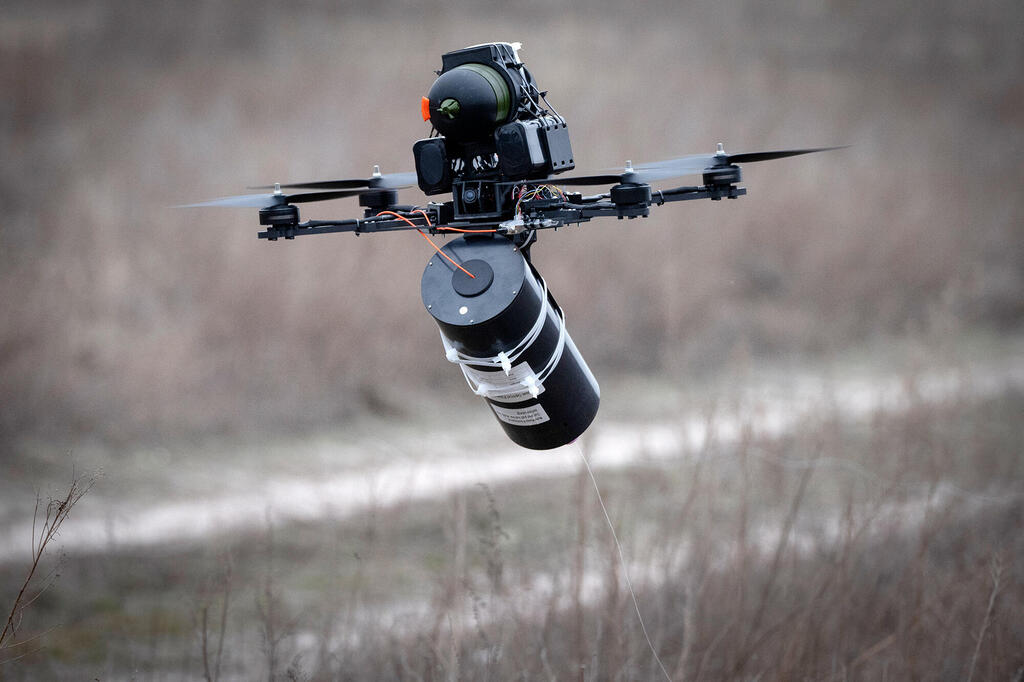
"The entire industry is working in this field on many channels at the same time, and so are we. To deal with this threat, it is impossible to use electronic warfare means because these drones are connected to a thin wire, a quarter of a millimeter thick, which also transmits information from the camera on the drone to the operator and the instructions that the operator gives to the drone, and therefore to deal with them you need to do two things: detect them and then intercept them. The goal is to detect the drone at a reasonable distance that gives enough time to hide from it or intercept it. Technically, even if our solution works, it has to be economical so that they will purchase it and I don't know if we will succeed from a business perspective, but I think that within a year there will be a solution to this problem."
"Pavel didn't get along with his boss and called me"
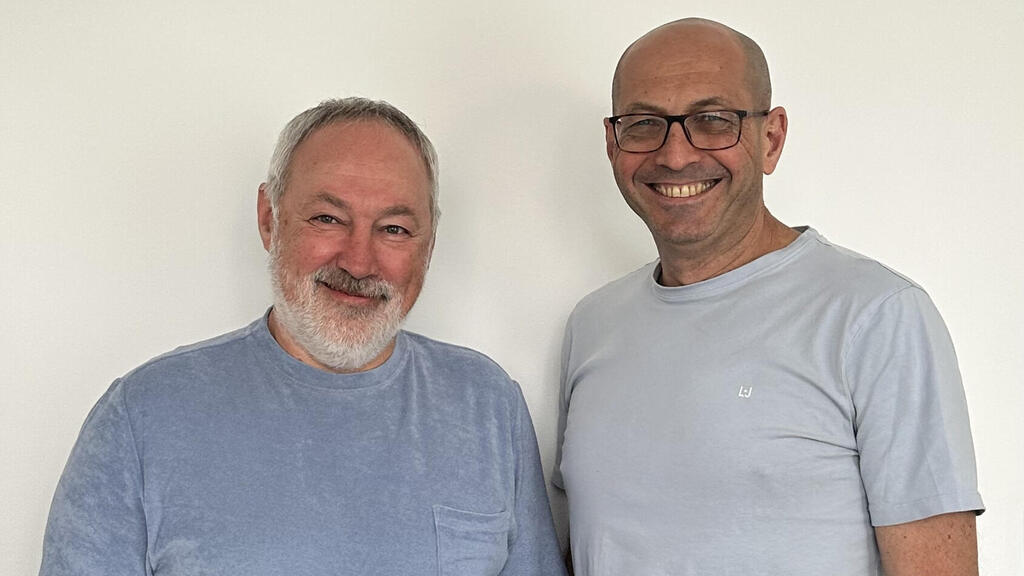
RP Optical Lab, named after its founders — Ran and Pavel— is largely based on their extensive experience and the personal connection that has developed between them since they met about 20 years ago. Ran Carmeli studied physics and mathematics at the Hebrew University as part of the Talpiot program, and after taking a course on optical fibers, he decided that he wanted to serve in the 81st, the IDF's technological unit that dealt with the field. When he reached the military phase of his service, Carmeli learned how and where to develop the various parts of a complex system, which included a combination of optics, electronics, mechanics, and software, and won the Israel Defense Forces Prize for his development. After being discharged from the army, he worked for a company that was trying to develop a model for opening blockages in arteries in order to implant stents in them, and in 2005 he made a minor exit when he sold Vectop, an electro-optics company in which one of the partners was former Sayeret Matkal elite commando unit commander Omer Bar-Lev, who later became Minister of Public Security. At the same time, Rashidko also carved out a unique path for himself. He immigrated to Israel from Moscow in the early 2000s with a doctorate in techno-optical physics and established himself in Israel as an expert in the production of advanced lenses. The two crossed paths about 20 years ago when Rashidko, then working as an employee, was asked to build a system that Carmeli had designed for the Intelligence Corps. “He created the first optics that I designed, and since he didn’t really get along with his boss, after the joint project ended he called me and suggested that we work together on developing thermal optics,” Carmeli says.
And you agreed.
"Yes. We developed one lens for three years in the garage of my house in Rinatiya and we traveled with it to an exhibition in the United States. At that time, the medical market was thinking of examining moles that grow on the skin using this technology, but we knew that there was a market for such a product in the field of border security."
What was the division of labor between you?
"Pavel is a technological genius. All the complicated designs of the optics are his. He is the best in Israel, if not in the top 10 in the world. When we founded the company in 2010 after three years in the garage, he worked in development and operations, and I did everything else. In addition to technology, you also need money and sales, and to make sales in Israel you had to be very Israeli, with acquaintances from the army — which Pavel does not have. Over time, we reached a situation where we trust each other blindly."
Explain a little about the work process.
"We design optics to see what the eye cannot see. We define what we want to get from the lens, what zoom, what focus. It is a complex design, because in the lens alone there are 5 to 15 different elements that matter how they are designed, arranged and moved relative to each other. In the thermal field, you don't need light to see, but detectors, and all of this also has to work at different temperatures, and under constant vibrations."
What is the thrill of making a lens?
"Every lens is different. A lens is a beautiful piece like a piece of jewelry and has beautiful, shiny, clean elements that are very well put together, and have to move in harmony and with precision of hundredths of a millimeter to give a good image."
When asked to give an example of all this beauty, Carmeli points to a lens called Amaryllis, many of which are deployed along Israel's borders. "It's a giant optomechanical eye that allows you to see an enemy tank or vehicle across the border at a distance of 30 kilometers — that is, far beyond the sensitivity of the eye. It copes well with haze, looks deep, and its weight is relatively light — 8–10 kg — so that it can be installed on tall poles," he says. "There are not many groups in the world that can achieve this performance, and the trick is to build it so that it is economical — so that the customer can buy it and we can sell it at a profit. The same lens is also installed on drones, where it is adapted to a flying system. In fact, we use several technologies that only when you stitch them together do you create a complete electro-optical system. What makes our company unique is the knowledge that ties all the technologies together. We didn't invent the theory of image design and optics, but we know how to design and integrate all the technologies together to develop products."
Have you considered making the lenses yourself?
"We don't — at least not yet — have our own in-house lens manufacturing facility. A lens design is a set of drawings of optical elements that subcontractors make for us to order. We receive bags of optical, mechanical, and electronic parts, and our technicians assemble everything here."
How is quality measured in this field?
"The lens is measured by the quality and sharpness of the image produced under conditions of different temperatures and vibrations; the quality of the electronics is measured by the speed of image processing, and stabilization is measured by successfully reaching a state where the image does not shake. A complete system should include a combination of image stabilization, image processing speed, and that the system will identify all threats."
When did you feel professional satisfaction following your developments?
"What is closest to our hearts is a product that we have developed in recent years. We provided several dozen units of an observation system that saved the lives of our soldiers in the tunnels in Gaza. I cannot say what exactly we did because it is a classified system, but it helped our soldiers enter and exit the tunnels safely."
How did you deal with the global shortage of germanium, which is the main ra material in the lens industry?
"Germanium is a critical raw material for thermal vision because of its transparency. If you disassemble a lens that consists of 15 elements, five of them will be made of germanium. Due to the geopolitical situation between China and the United States and the fact that this material is also used in the semiconductor industry, the Chinese imposed an embargo on the sale of germanium, which created a shortage. We made efforts to develop a complete production line of products that do not contain germanium, but rather a certain metal alloy, the use of which allows us to circumvent the problem."
"The world has gone crazy, demand has grown exponentially"
Like the shares of drone camera company NextVision, whose market value has soared to about NIS 30 billion, and the fuse company Aryt Industries, which has also experienced rapid growth – RP Optical Lab is also benefiting from the growing military tension in the world. In 2019, AP Partners acquired 50% of it at a value of NIS 58 million, and in January 2024, Manor Evergreen paid NIS 70 million for 40% of the company, whose value had already climbed to NIS 175 million at that time. Its first products were electro-optical observation devices of various sizes, and the radar company Radomatics, which it acquired about a year ago for NIS 12.8 million, is adding another range of capabilities: homing heads for proximity fuses of various types of ammunition, sensors for Elbit's Iron Fist system that protects armored vehicles, and thermal sighting for the Iron Beam laser weapon that Rafael and Elbit Systems manufacture to intercept rockets.
While RP Optical Lab’s revenue in 2025 was quite modest — $45 million, which yielded a net profit of $10 million — a look at its customer list reveals quite a bit about its centrality to the defense establishment and therefore its growth potential: 64% of sales were made in Israel, and about 40% of them were to Elbit Systems. After the acquisition of Radomatics, it employs about 75 people, and Carmeli and Rashidko each own 11% of the company. In other words, their holdings in the company are now worth more than NIS 600 million.
"Before Evergreen entered in 2024, AP Partners held 50% of the company and I and my partner each held 25%," says Carmeli. "After AP Partners sold Evergreen 30% of their shares, Pavel and I each sold 5%. After the IPO, we bought Radomatics in a stock and cash deal, so we were all diluted. Pavel and I also did a small secondary and sold some."
Looking back, do you regret selling 50% of the shares to AP Partners for less than $60 million seven years ago and missing out on the big jump in the company's value?
"We both did pretty well for ourselves. If we had continued on the path we were on, we would have owned a lot more shares but a smaller pie. So it's all good and I don't regret it."
You actually rode the wave of the arms industry before you knew there would be one.
"Yes. We were in defense tech in 2010, and the wave came when Russia invaded Ukraine. When Trump was re-elected president in 2024, the wave got even stronger because he told NATO countries, 'Invest 5% in the arms industry because I'm not paying you for defense anymore.' The result was that demand for the industry's products increased exponentially, and then came the Iran story and geopolitical extremism. The whole world went crazy."
It seems that the company is very dependent on both of you.
"One of the reasons why we brought in funds to own the company and later also issued shares is that we wanted the company to develop independently of me and my partner. Now we are active and proactive, but the company should not depend on us, and as it grows it will be less and less dependent on a specific person. If we were to get up tomorrow and leave, the company would survive just fine — which was not possible 10 years ago. We brought in a salaried manager two years ago, and our operations manager, who used to be Pavel, is also a salaried manager. We both accompany and support, but none of the company's major projects are managed by me or by Pavel."
Have you thought about taking your foot off the gas and celebrating the millions you've made?
"I don't want this conversation to give the impression that I or my partner are ascetics, otherwise whoever reads it will burst out laughing. We have some assets in the world, and we travel the world. We are the antithesis of ascetics, and we really don’t suffer. But waking up in the morning without a goal seems stressful to me. It hasn't happened to me, and I don't think I'll start today. And when I see a box of goods coming out the door, I'm happy."
In this context, it is impossible not to ask if your dream is to become the next NextVision.
"I have a wish that is more realistic than a dream: that RP will become a regular event. If the path has to go through the stock exchange — fine. I want us to be a well-known and stable name in the next decades, like Elbit has become, and I hope we are on our way to doing that. This will be done through organic and inorganic growth — that is, through acquisitions — and we are investing in developing additional projects that may substantially expand our customer base."
In fact, a world without wars is your worst nightmare.
"With or without us, the wars will continue. The question is whether we and 80 other families will make a living from them. If not, they will make a living for someone else."



