










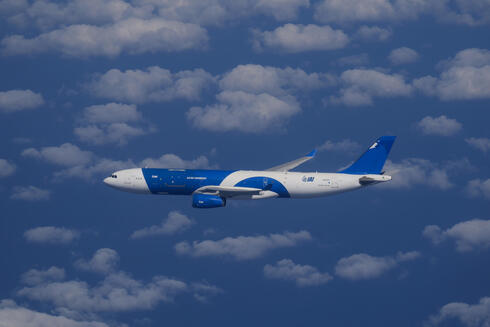
IAI completes maiden flight of A330 freighter in push into Airbus market
The conversion involved removing 350 passenger seats, installing a large cargo door and assembling about 30,000 parts. IAI says the program could eventually support 15 to 20 conversions annually.
Israel Aerospace Industries completed the maiden flight of an Airbus A330-300 on Friday following its conversion from a passenger aircraft into a freighter, marking a new step in the company’s effort to expand its aircraft-conversion business to Airbus wide-body jets.\
The aircraft took off from Ben Gurion Airport and flew for about an hour and 15 minutes, during which test pilots from IAI’s Aviation Group tested its systems. The company, chaired by Boaz Levy and led by CEO Guy Barlev, said the successful test flight was a significant milestone toward obtaining a Supplemental Type Certificate (STC), the certification required for major changes to an aircraft’s configuration before it can enter service in its new form.
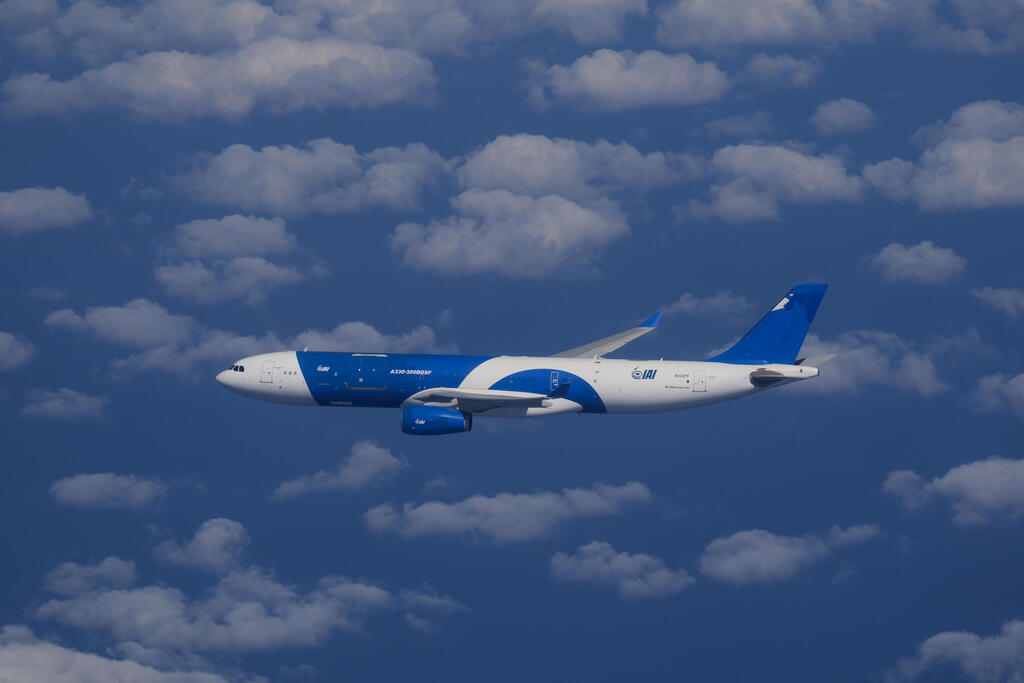
The flight followed complex structural work on the aircraft, centered on the installation of a main cargo door. The process required cutting a 3.6-meter-wide by 2.6-meter-high opening into the side of the fuselage, allowing the aircraft to carry about 30 containers with a total payload of more than 60 tons.
“Converting such an aircraft is like open-heart surgery. In the end, you have a completely new and different aircraft,” a senior IAI official told Calcalist.
IAI’s Aviation Group has been converting passenger aircraft into freighters for decades, but until now its work has focused on Boeing aircraft, including the 737, 767 and 777. According to the company, it has converted approximately 300 Boeing aircraft to date. In 2022, IAI began planning its expansion into the Airbus A330 conversion market.
IAI believes its growing ability to convert the A330 could open an additional market for the company as global demand for air cargo transportation continues to grow, partly driven by the expansion of e-commerce.
Converting passenger aircraft into freighters allows airlines to extend the commercial life of existing jets rather than purchase new cargo aircraft. Aviation officials estimate that a converted freighter costs about 30%-40% of the price of a new cargo aircraft.
Yaakov Berkovich, general manager of IAI’s Aviation Group, told Calcalist that the company expects to reach an optimal conversion rate of 15 to 20 A330 aircraft per year within about a decade. After completing the development and certification process, the conversion of a single aircraft is expected to take about five months, he said.
To support that potential production rate, IAI has invested in recent years in establishing and expanding aircraft-conversion capabilities at additional facilities around the world.
IAI declined to identify the airline that owns the A330, saying only that it is a “long-time customer” of the company. According to IAI, about 100 employees worked on the aircraft each day, assembling approximately 30,000 parts as part of the conversion.
The work included removing about 350 passenger seats, along with the cabin’s interior and equipment, which together weighed approximately 20 tons.
Aircraft conversion is one of the main pillars of the Aviation Group’s civilian business and accounts for approximately 40%-50% of its activity, according to Berkovich. IAI reported that the Aviation Group’s sales reached approximately $1.61 billion in 2025, up from about $1.48 billion in 2024.
The successful A330 flight caps a significant business week for IAI, which began with the signing of the “Achilles Shield” agreement in Greece. Under the approximately €3 billion deal, IAI and Rafael will supply Greece with a multilayered air defense system.
Earlier in the week, IAI also completed a successful demonstration for the German Navy of launching its Lora missile from a ship in the North Atlantic. The demonstration included two launches and precise strikes on targets, bringing IAI closer to another potentially significant deal in Germany, which has become one of the most important markets for Israeli defense companies in recent years.
Last month, IAI reported that its second-quarter sales rose 35% year over year to $2.18 billion. Its order backlog reached approximately $35 billion.



