










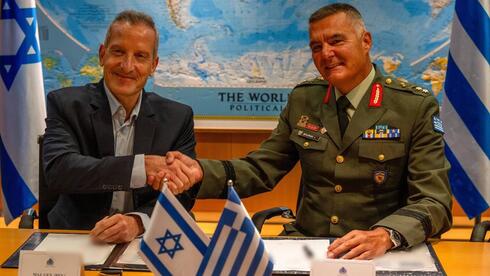
Israel and Greece sign €3 Billion air defense deal, largest in bilateral defense trade
“Achilles Shield” deal, under which Rafael and Israel Aerospace Industries (IAI) will establish a multi-layered air defense network for Greece is the largest defense export agreement ever signed between Israel and Greece, and one of the largest arms deals in the country’s history
After roughly three years of negotiations and lengthy approval procedures, Israel and Greece have signed the “Achilles Shield” deal, worth approximately €3 billion (more than NIS 10 billion), under which Rafael and Israel Aerospace Industries (IAI) will establish a multi-layered air defense network for Greece. The deal is the largest defense export agreement ever signed between Israel and Greece, and one of the largest arms deals in the country’s history.
The deal was signed at the Israeli Ministry of Defense complex in the Kirya in Tel Aviv, between Director General of the Ministry of Defense Amir Baram and the head of Greece’s General Directorate for Defense Investments and Armaments, Yannis Bouras. The deal is unusual not only in its scale but also in its structure: Israel will not sell Greece a single weapons system, but will instead establish a complete national air defense architecture designed to counter a wide range of threats, including ballistic missiles, fighter jets, drones and unmanned aerial vehicles.
At the heart of the network are Rafael’s David’s Sling and SPYDER systems, as well as IAI’s BARAK MX system. These will be joined by MMR radars manufactured by IAI’s ELTA Systems division, and a new command-and-control system to be developed under Rafael’s leadership, which is expected to connect all the systems into a single integrated network.
Greece will become the second European country to acquire David’s Sling. The first to procure the air defense system was Finland, which signed a NIS 1.3 billion deal with Rafael for its acquisition in 2023, as part of an effort to upgrade its defense capabilities following Russia’s invasion of Ukraine.
The “Achilles Shield” program includes agreements on cooperation between the Israeli companies and Greece’s defense industry, including the transfer of knowledge and technology that will enable some of the project’s components to be manufactured in Greece. This is in line with a trend that has characterized the European arms market in recent years, in which countries purchasing weapons increasingly demand that part of their production take place domestically, in an effort to strengthen their industrial capabilities.
The deal is a G2G agreement (government-to-government deal between the Israeli and Greek governments), signed at a time when both state-owned Israeli defense companies are enjoying record-high order backlogs. Defense officials told Calcalist that the deal is expected to lead to follow-on agreements with Greece, ahead of additional procurement of IAI’s BARAK MX system. Such deals could also benefit state-owned Tomer, which manufactures the engines for BARAK MX missiles.
The Israeli defense establishment linked the deal to the deepening of strategic ties between Jerusalem and Athens, which share common interests and strategic challenges, foremost among them Turkey’s moves in the region. According to a senior defense official, “The two countries will continue to deepen their defense cooperation against the backdrop of attempts by actors with ‘hegemonic ambitions’ to expand their influence in the region.”
Beyond the export revenues, the Ministry of Defense also sees the deal as important for expanding Israel’s production capacity. Baram said that government-to-government deals of this scale are “a direct engine for expanding local production lines in Israel, increasing inventories and strengthening Israel’s munitions independence.”
His remarks come against the backdrop of the extraordinary workload facing Israel’s defense industries since the outbreak of the October 7 war. Increasing production for the IDF, while simultaneously meeting growing export contracts, requires Rafael and IAI to expand production lines, recruit workers and increase investment in infrastructure. From the Ministry of Defense’s perspective, long-term export deals enable the industries to justify expanding their production capacity, which in times of emergency can also serve the IDF’s needs.



