









Twenty companies, six ways to build a quantum computer: Israel’s quantum map
A new map shows a sector that has more than doubled in a little over a year, and that has not settled on how a qubit should be built.
In 2019, Israel had five quantum companies and about 50 people working in the field. Today it has more than 20 companies, roughly 1,000 employees, and a map that includes everything from startups founded this year to the defense giants Rafael and Israel Aerospace Industries.
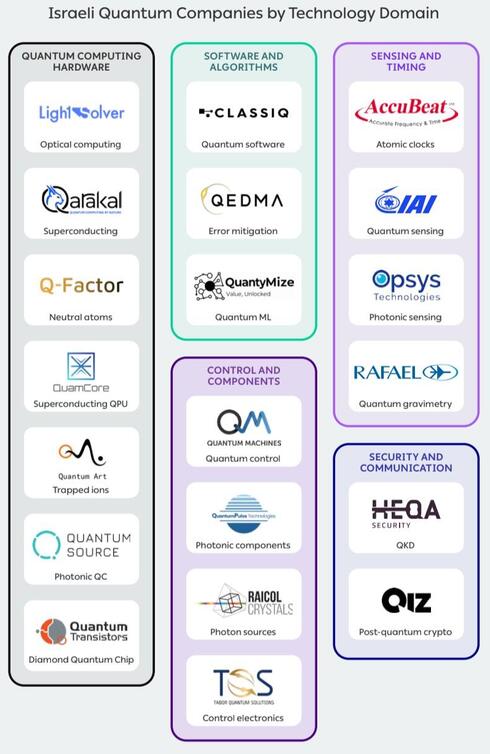
The map, published in a report by the Israel Innovation Authority and the World Economic Forum, divides 20 companies into five technology domains. Last July, a private-sector map of the field counted nine core quantum computing startups, along with about 15 working on related technologies.
1 View gallery
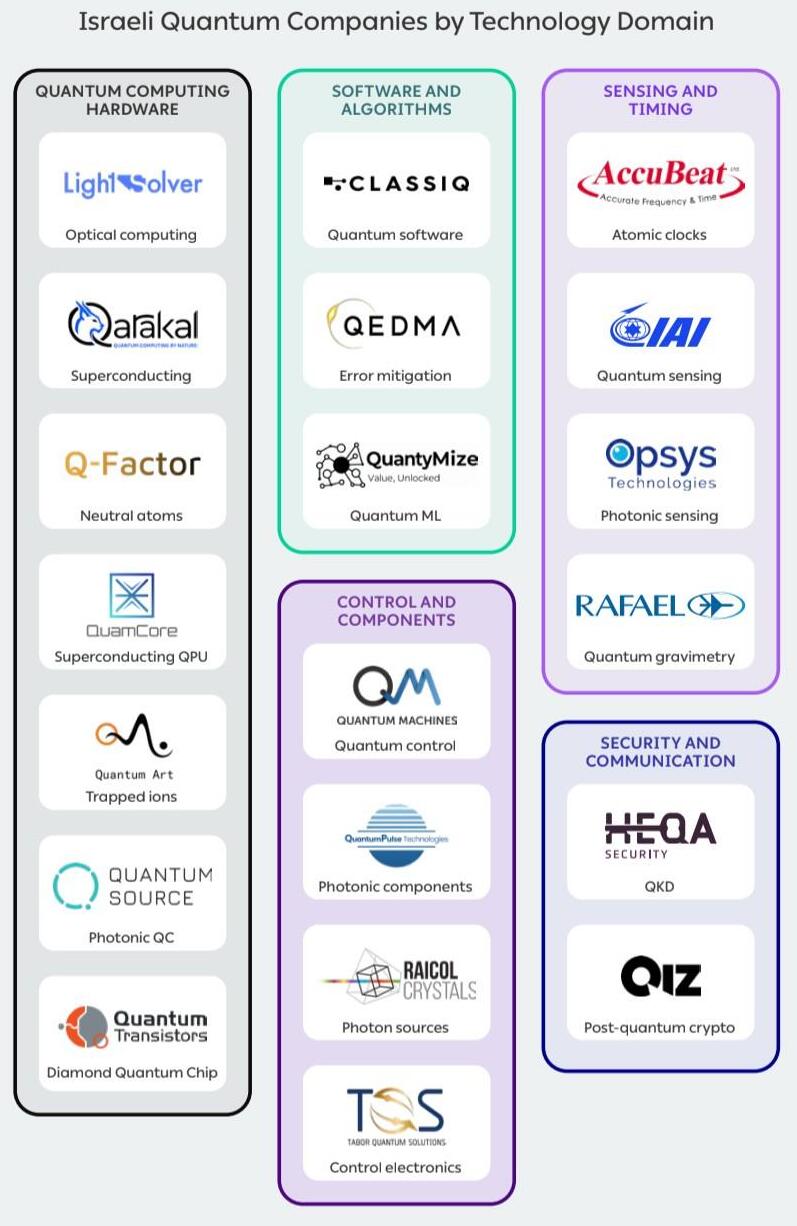
Israeli quantum companies by technology domain.
(The Israeli Quantum Ecosystem, Israel Innovation Authority and the World Economic Forum)
Hardware, the machines themselves, is the largest domain, with seven companies. But there is no consensus on how to build a quantum bit, or qubit, the basic unit of quantum information. Israeli companies are pursuing six different approaches. Quantum Art is developing trapped-ion technology, while Qarakal and QuamCore are working on superconducting circuits. Q-Factor is pursuing neutral atoms, Quantum Source is focused on photonic quantum computing, LightSolver works on optical computing, and Quantum Transistors is developing a diamond-based quantum chip.
No one knows which approach will ultimately prevail. The government’s own strategy reflects that uncertainty. The Israel Innovation Authority’s call for a national quantum computing platform, reported by CTech in July, requires the operator to integrate at least three different quantum processing technologies. The aim is to compare competing systems rather than commit the country to a single approach before a clear winner has emerged.
One of the newest companies on the map is also among the most ambitious. Q-Factor, founded by physicists from the Weizmann Institute and the Technion, emerged from stealth in April with $24 million in Seed funding, led by NFX and TPY Capital, and an ambition to scale beyond one million qubits.
It is not alone. QuamCore says it has designed an architecture for a million qubits in a single cryostat, according to a December report, though the claim has not yet been validated. Quantum Art's roadmap targets quantum advantage by 2027 and a million-qubit system by 2033. Such targets are common across the industry, and they remain claims, not results.
Two other domains cover what sits around the machines. Control and components, with four companies, includes Quantum Machines, whose control systems are used across most types of quantum hardware, and which raised $170 million at an estimated $700 million valuation in February 2025. It also operates the Israeli Quantum Computing Center at Tel Aviv University.
In software and algorithms, three companies work at a different layer. Classiq, which builds software that turns a developer's goals into quantum circuits, has raised more than $200 million, with AMD, Qualcomm and IonQ among its investors. Qedma, which makes error-mitigation software, said in July that together with IBM it had demonstrated quantum advantage on a 74-qubit problem, a claim based on the companies' and researchers' own results. QuantyMize rounds out the group with quantum machine learning.
Defense on the map
The sensing and timing domain lists Rafael, working on quantum gravimetry, a way of detecting tiny changes in gravity, and Israel Aerospace Industries, on quantum sensing, alongside AccuBeat, which makes atomic clocks, and Opsys Technologies, which works on photonic sensing.
Defense is hardly mentioned in the funding announcements that dominate quantum news, but the report treats it as a potential source of demand, in which operational requirements can give early feedback on emerging technologies. The country's established defense companies are in the race alongside the venture-backed startups.
The smallest domain, security and communication, holds two companies: Heqa, which works on quantum key distribution, and QIZ, on post-quantum cryptography. The area is moving fast. In August the Innovation Authority backed a consortium of nine companies and six universities, including Heqa, Classiq, Nvidia and Allot, to protect communications networks from future quantum computers that could weaken many current encryption methods.
Israeli quantum companies raised nearly $500 million in 2025, according to the report, about 9% of global private investment in the field, which it says ranks Israel fourth, behind only the US, the UK and Canada. The report puts the total raised between 2019 and 2025 at $1 billion. Public funding, by contrast, remains limited by international standards: $413 million has been invested in the National Quantum Initiative since 2019.



