











What made Q.ai worth $1.5 billion to Apple
How a secretive deep-tech company fit precisely into Apple’s hardware and AI strategy.
There’s a good reason Apple acquired Israeli-based Q.ai. The deal, valued at between $1.5 billion and $2 billion, a substantial sum, though not in the same league as some past Israeli tech exits, marks Apple’s second-largest acquisition ever. More importantly, it speaks directly to Apple’s long-term strategy and what it intends to do with Q.ai.
There’s also a reason that while other tech giants spend tens of billions of dollars on high-profile acquisitions, Apple’s deals typically amount to hundreds of millions of dollars, and only twice before Thursday had they entered the “three-comma club.” While rivals buy well-known brands, established services, or fully developed technologies, Apple tends to take a different path.
Apple, which prefers to do most of its development in-house, almost always acquires deep technologies: highly specific, advanced capabilities that help it close gaps or leap ahead in its products and services. It paid $1 billion in 2019 for Intel’s modem business after struggling to develop 5G modems internally. Israel’s Anobit was worth about $500 million in 2011, strengthening Apple’s memory chip development.
In the rare cases where Apple has bought a brand, such as Shazam in 2017, the acquisition was driven primarily by underlying technology. Other landmark deals, like NeXT in 1996 or Beats in 2014 (still the largest acquisition in Apple’s history at $3 billion), were less about products than about people. NeXT brought Steve Jobs back to Apple; Beats brought music executive Jimmy Iovine, who helped launch Apple Music and revive Apple’s headphone business.
This strategy has clear advantages. It is cheaper than mega-acquisitions and makes integration far simpler. In most cases, the acquired company, its technology, and its employees are folded directly into a relevant Apple division. In more extreme cases, such as Anobit, the company ceased to operate independently and instead became the foundation of Apple’s R&D center in Israel.
Against this backdrop, when Apple pays $1.5 billion or more for Q.ai, it is not buying a finished product it can immediately market, nor even a fully mature technology. Rather, it is acquiring a capability with the potential to enhance future generations of Apple products. There is also a clear human premium: Apple is effectively bringing back Aviad Maizels, who previously exited Apple via PrimeSense in 2013, before leaving to co-found Q.ai.
So what exactly does Apple hope to gain from Q.ai? To answer that, one must understand at least part of its technology. Q.ai operated in deep stealth prior to the acquisition and did not publicly detail its work. However, patents filed by the company provide important clues. According to these filings, Q.ai has developed technology capable of interpreting minute facial skin movements via wearable computing to understand speech; decoding “silent speech” based solely on muscle activity; and detecting subtle muscle signals using head-mounted systems. In some cases, the technology is described as identifying an intention to speak even before speech occurs.
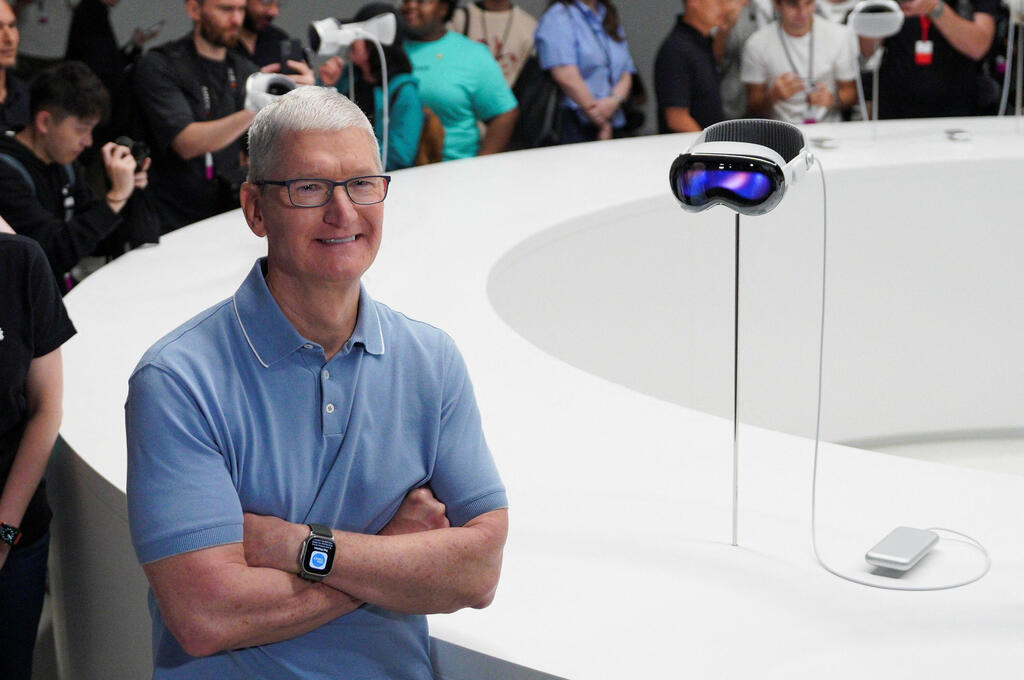
In short, Q.ai has developed technology that enables speech recognition without sound, a form of ultra-precise lip or muscle reading that may surpass conventional approaches. This capability could be integrated across a wide range of Apple products. The Vision Pro headset is an obvious candidate, but others could benefit as well. Future generations of AirPods, for example, could potentially receive voice commands in extremely noisy environments, or without the user speaking aloud at all.
In face-to-face conversations, the technology could also be used to improve communication quality when background noise interferes with speech recognition. And more advanced applications are possible: subtle muscle detection could enable sophisticated gesture-based input on devices like the Apple Watch, which already supports relatively coarse gestures such as a two-finger pinch.
None of this will happen overnight. Apple’s hardware development cycles are long, and even if Q.ai’s technology is integrated, Apple is unlikely to publicly acknowledge it. Still, Apple’s acquisition sends a clear signal: the company conducted deep technical validation, identified no viable alternative to acquiring Q.ai, developed a concrete integration roadmap, and concluded that the technology, and the people behind it, would ultimately be worth far more than the price it paid.



