










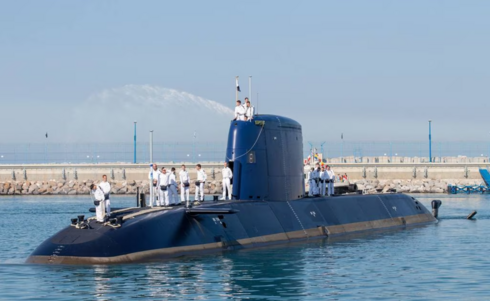
What is hidden inside Israel’s new submarine?
The INS Drakon’s unusual design has prompted speculation about advanced launch systems and strategic capabilities.
Israel has quietly taken delivery of one of the most advanced submarines in its fleet, adding a vessel whose capabilities remain partly undisclosed but whose arrival signals a major evolution in the country’s naval strategy.
Germany’s ThyssenKrupp Marine Systems (TKMS) formally transferred the INS Drakon, the sixth and final Dolphin-II class submarine, to the Israeli Navy at the company’s shipyard in Kiel. Unlike previous Israeli submarine handovers, the event took place without a public ceremony or announcement. Only after the transfer did the vessel leave the shipyard under the Israeli flag for the first time, conducting sea trials in Kiel Bay.
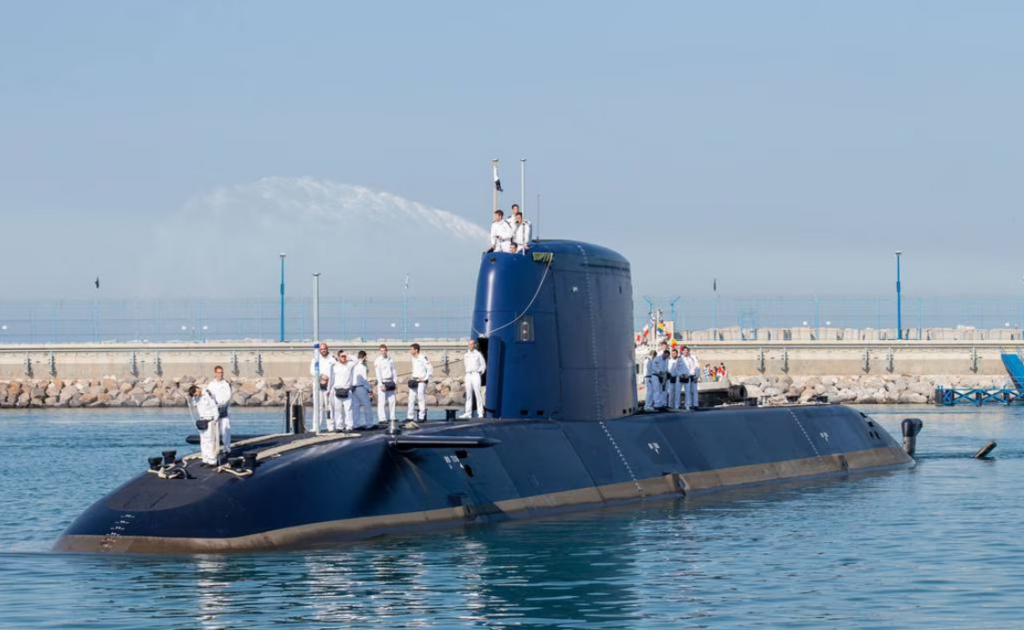
The delivery marks the completion of a submarine program that has served as one of the foundations of Israel’s long-range strategic capabilities. But the Drakon is also different from its predecessors, and those differences have fueled speculation among defense analysts about new capabilities hidden beneath its enlarged hull.
According to foreign reports, the submarine is approximately 73 meters long, compared with 68.6 meters for the earlier Dolphin-II submarines, the INS Tanin and INS Rahav, which entered service in 2014 and 2016. It also features a significantly larger sail, the structure on top of the submarine that houses sensors and other systems.
Neither Israel nor TKMS has disclosed the reason for the expanded design or confirmed what systems are installed inside. However, analysts have suggested that the additional volume could be linked to new mission capabilities, including possible vertical launch systems (VLS).
Such systems, if present, could significantly expand the submarine’s role by enabling the deployment of additional weapons, cruise missiles, unmanned underwater systems, intelligence equipment, or special operations capabilities. Some analysts have suggested the enlarged structure could contain several launch cells, although the exact configuration remains unknown.
Israel’s Ministry of Defense has only described the submarine as containing “unique systems” and “groundbreaking technologies” that expand the IDF’s operational capabilities.
The confirmed weapons configuration of the INS Drakon includes 10 torpedo tubes located in the bow, six standard 533 mm tubes and four larger 650 mm tubes. The larger tubes can accommodate heavier weapons, specialized equipment, or underwater vehicles.
For decades, Israel’s Dolphin-class submarines have been viewed internationally as an important component of the country’s strategic deterrence posture. Foreign analysts have long speculated that the fleet provides Israel with a potential sea-based second-strike capability, although Israel maintains a policy of neither confirming nor denying its nuclear capabilities.
The arrival of the Drakon does not immediately change that strategic equation. The submarine will first need to complete operational integration with the Israeli Navy before becoming fully relevant from a military perspective.
But Israeli officials have emphasized that the submarine represents a broader transformation underway within the naval fleet.
At the submarine’s naming ceremony in November 2024, Israeli Navy Commander Vice Admiral David Saar Salama described the vessel as a “force multiplier” that would strengthen Israel’s ability to operate “in distant and hidden realms for extended periods.”
“Seen and unseen, it will dwell in distant and hidden realms for extended periods,” Salama said at the ceremony. “With the addition of INS Drakon to the depths of our operations, our extended arm grows significantly in length and strength.”
The Drakon also serves as a bridge between Israel’s current submarine fleet and its next generation of vessels.
During the November 2024 ceremony, Israel marked not only the naming of the Drakon but also the beginning of the construction process for the future Dakar-class submarines, which are scheduled to be delivered at the beginning of the next decade.
The name “Drakon”, meaning dragon, was chosen because the Hebrew letters in the word correspond to those in “Dakar,” while also symbolizing strength and uniqueness. The name also commemorates the legacy of the INS Dakar, the Israeli submarine that disappeared in 1968 with its entire crew while sailing from Britain to Israel.



