










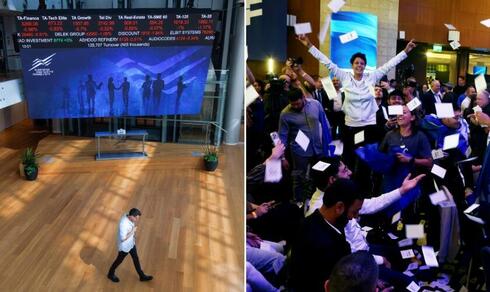
Israeli stocks plunge as election results cloud path to new government
The TA-90 fell 4.5% and construction shares dropped 8.8% as investors reassessed the political outlook. The shekel weakened and 10-year government bond yields rose, reversing gains made ahead of the vote.
The Tel Aviv Stock Exchange fell sharply on Wednesday following interim Knesset election results that offered no clear path to a stable political outcome. Stocks exposed to the domestic economy suffered the steepest losses, while the shekel weakened and long-term government bond yields rose.
During trading, the TA-125 index fell 2.5% and the TA-90 dropped 4.5%. The construction index plunged 8.8%, the insurance index lost 5.2%, and the banking index declined 4.9%. In the foreign exchange market, the dollar climbed to NIS 3.127, up from around NIS 3.02 on Tuesday, while the euro rose to NIS 3.48.
The pressure extended beyond equities. The yield on 10-year Israeli government bonds rose by eight basis points to 4.12%. Because bond prices move inversely to yields, the increase indicated that investors were also demanding higher returns to hold long-term Israeli government debt.
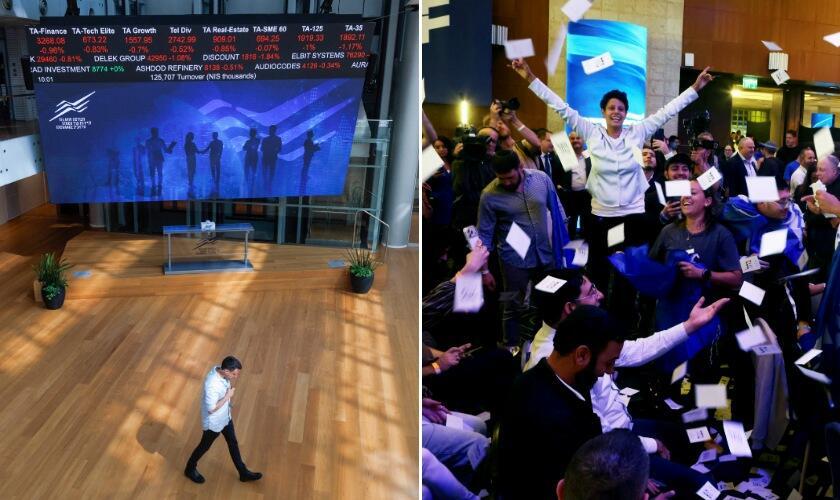
The market reaction was almost the reverse of the trend seen ahead of the election. On Monday, the final trading day before voting began, major stock indices gained approximately 2% and the shekel strengthened, amid expectations among some investors that the election could bring political change.
The interim results have since dampened some of that optimism. The prospect of forming a narrow “government of change” appears less likely, while a broad-based government, a different coalition arrangement or another election remain possible.
Even before the vote, an investment manager at a major institutional investment firm told Calcalist that the outcome he feared most was the formation of a narrow right-wing government. In his assessment, such a scenario could trigger a 10% decline in the stock market and prompt him to shift investments from Israel to overseas markets.
That assessment reflects the individual investor’s view, rather than a broader market consensus. “A shift in the market toward the right would lead institutional investors to sell off their holdings,” he added.
There is, however, no consensus among capital market professionals on what the sell-off signals or how investors should respond. Some see the declines as a natural reaction to disappointment over the election results. Others point to the economic risks of a prolonged period without a functioning government or an approved state budget.
Views also differ on how investors should position their portfolios amid the uncertainty. Those interviewed caution against drawing definitive conclusions from a single day of trading, particularly while the political outcome remains unresolved.
Yaron Friedman, head of research in Bank Leumi’s Investment Division, believes market jitters will persist as long as the political situation remains unclear. “The market is facing a high degree of uncertainty, and this situation is expected to continue in the near term,” he says. According to Friedman, the foreign exchange market was the first to react, wiping out within hours the significant gains the shekel had made on election day.
Friedman also points to Israel’s “fear index,” the stock market volatility index, which has climbed to around 23%, up from approximately 14% just a few weeks ago. This represents an increase of about 64%, reflecting expectations of greater volatility in the stock market.
Despite the sharp declines, however, Friedman cautions investors against making hasty decisions. “During periods of uncertainty, the recommendation is to avoid taking significant action within investment portfolios. In the vast majority of cases, emotional reactions turn out to be a mistake. Therefore, it is best to remain calm and patient,” he advises. He estimates that stability will return to the capital markets once the political outlook becomes clearer.
Amir Kahanovich, chief economist at the Profit financial group, attributes the market reaction to an increase in Israel’s risk premium, although he says it is too early to determine the precise reasons behind the sell-off.
“What we are seeing today is an increase in Israel’s risk premium. There are several possible explanations for the market’s behavior, and only in the coming days will we know what actually happened,” he says.
The first possibility, according to Kahanovich, is that investors are disappointed with the emerging election results. “It is clear to everyone that these results could lead to a narrow right-wing government or to fresh elections. It is possible that investors simply do not like the political outcome that has materialized.”
The second possibility is that investors are reacting to the prospect of continued uncertainty.
“The market does not want to be dragged into a prolonged period in which the situation remains unclear. The market dislikes uncertainty, regardless of who ultimately takes power. It may not even matter to the market which political bloc gains the upper hand; it simply craves certainty,” he says.
A third explanation is the unwinding of positions built up ahead of the election in anticipation of post-election gains.
“This is a phenomenon known as ‘buy the rumor, sell the news.’ Many investors build positions ahead of a specific event, and once that event arrives, they sell, even if the outcome is the best possible scenario. It is possible that some investors were compelled to close out their positions, regardless of the price,” Kahanovich says.
He suggests that foreign investors may be driving much of the activity, pointing to the sharp rise in the dollar against the shekel.
“Typically, Israeli institutional investors do not cause such extreme fluctuations in the currency,” he says. For Israeli institutions, foreign currency exposure is generally managed separately from investment decisions. Foreign investors, by contrast, buy shekels when entering the Israeli market and sell them when exiting. The sharp currency reaction may therefore indicate that foreign investors are playing a significant role in the sell-off.
According to Kahanovich, trading over the coming days may help clarify the reasons behind the declines.
“If we see the market begin to recover even before the political uncertainty dissipates, we can infer that the activity likely stems from investors who had built up positions ahead of the elections and were subsequently forced to close them,” he says.
Sivan Aizescu, head of investments at One Zero Bank, believes the declines primarily reflect disappointment with the election results. He says the stock market gains and the strengthening of the shekel ahead of the vote reflected expectations of a political outcome that would reduce uncertainty, expectations that the interim results have failed to support.
“We are seeing declines in stocks exposed to the domestic market, particularly in the insurance, real estate and financial sectors,” Aizescu says.
He attributes some of the pressure on these sectors to the potential impact of political uncertainty on economic activity.
“Companies that require financing may postpone investments, while households might defer major decisions, such as purchasing a home, until it becomes clear who will manage the economy and what policies they will pursue. Conversely, some dual-listed stocks are showing relative resilience, partly because they are also traded abroad and benefit from the strengthening of the dollar.”
Aizescu also warns that the political crisis could complicate the management of the state budget. Even before the election, the Bank of Israel had anticipated that 2027 would begin under a “continuing budget,” an interim framework that allows government spending to continue in the absence of an approved annual budget. The latest developments raise the possibility that this arrangement could remain in place for an extended period.
Such a scenario could delay critical decisions about defense spending and the allocation of resources among government ministries, Aizescu says.
Nevertheless, he cautions against interpreting a single day of market declines as evidence of a lasting trend.
“In the period following elections, the market tends to be more volatile, swinging both upward and downward,” he says.



