










Analysis
Israel’s economic strength comes with a growing Nvidia-shaped risk
The chipmaker is increasingly important to both GDP growth and government revenues. But overseas production, underspending by civilian ministries and rising defense costs make the headline economic picture less reassuring.
In less than 24 hours, the Central Bureau of Statistics published two figures that look like a gift to whoever forms Israel’s next government. GDP grew at an annualized rate of 8% in the third quarter, well above forecasts, while inflation fell to 1.1% in October, its lowest level since April 2021. One more figure helps complete the picture: a week earlier, the Finance Ministry’s Accountant General reported that the budget deficit over the preceding 12 months had fallen to 3.3% of GDP, far below the 4.9% ceiling set for the full year.
It is a dream scenario for any incoming finance minister: rapid growth, stable prices and apparently healthy public finances. Such a combination is rare in real economies, and it is often a sign that the headline figures do not tell the whole story. That is also the case here. Taken together, the three figures create a mirage: an economy that appears to be racing ahead but is actually growing at a healthy, more moderate pace; a low deficit that rests partly on the underperformance of civilian spending, which is among the lowest in the Western world and needs to accelerate; and tax revenues whose current strength may prove difficult to sustain. All of this is unfolding amid considerable uncertainty and unusual political and geopolitical instability. There is also a fourth figure that deserves attention: the trade deficit.
1 View gallery
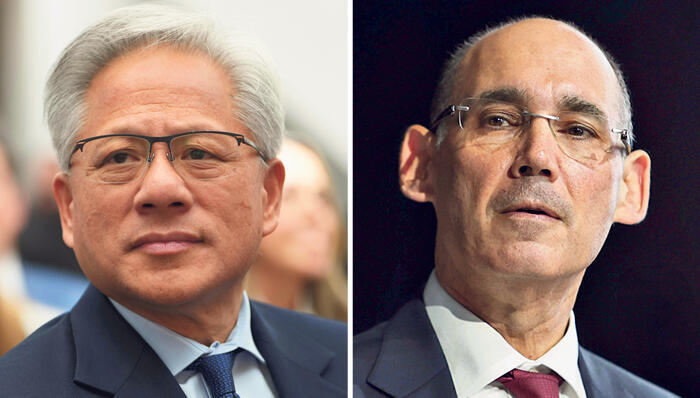
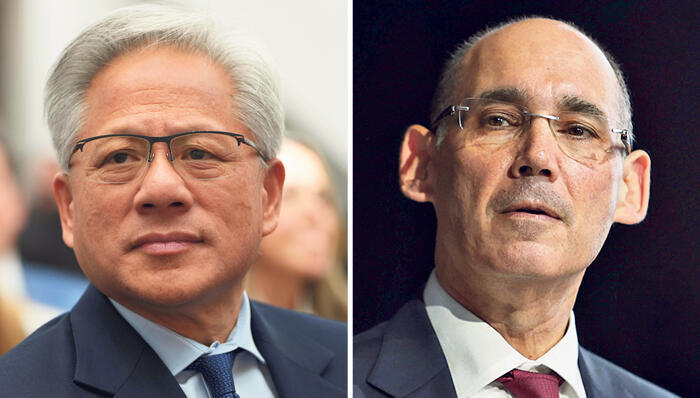
BOIl Governor Prof. Amir Yaron (right) and outgoing Nvidia CEO Jensen Huang
(Orel Cohen, AP/ Julia Demaree Nikhinson)
1. Growth, with an Nvidia-sized caveat
Let’s start with growth. When overseas production is excluded, a calculation that removes activity associated with Nvidia (formerly Mellanox), GDP grew at an annualized rate of just 4% in the third quarter, half the official figure. The gap is even wider when comparing the third quarter with the same period last year: 6.7% according to the official measure, versus just 2.8% when overseas production is excluded.
This is the fourth consecutive quarter in which the official growth figure has exceeded the rate adjusted for overseas production, at times by a considerable margin. In the second quarter, for example, the respective figures were 17.2% and 10.7%. A simple calculation shows that even if output remains unchanged in the fourth quarter, growth in 2026 will reach approximately 5.5% to 5.6%. That would be in line with forecasts from the Bank of Israel and rating agency S&P, which published a comprehensive review of Israel just last week. Excluding overseas production, however, the same scenario would produce annual growth of approximately 2.8%.
The gap is particularly striking in exports: an annualized growth rate of 39.5% according to the official figures, compared with 18.4% when overseas production is excluded. Even the lower figure represents an impressive pace, supported by a healthy composition of growth. Exports of business services, the core of Israel’s high-tech sector, surged by more than 15%.
Investment also expanded at an annualized rate of more than 11% in the third quarter, driven primarily by a 45.5% jump in investment in information technology equipment. It is impossible to determine exactly how much of this is linked to Nvidia, but a significant portion appears to reflect foreign investment. S&P projects net foreign direct investment to reach 2.5% of GDP this year, up from 2.1% in 2025. This is precisely the kind of growth the Israeli economy needs. The problem is that such investment is particularly sensitive to political and geopolitical developments. S&P warns that a regional escalation could undermine foreign investor confidence and trigger capital flight.
There is therefore good reason to be cautious about describing the economy as "soaring." It is growing at a healthy pace, but the headline figure overstates the strength of activity taking place within Israel.
Overseas production is not fictitious economic activity. It involves goods developed in Israel but manufactured and sold abroad. However, as S&P economists point out, this activity does not rely on Israeli capital or workers, and much of the resulting income flows to foreign shareholders. In other words, it boosts the GDP figure more than it improves the day-to-day economic circumstances of Israel’s residents.
Rating agencies differ in how they treat this activity. S&P bases its forecasts on the full GDP figure, while Moody’s economists have noted in a review of Israel that the rapid expansion of this component distorts the underlying picture. The Bank of Israel, meanwhile, has identified the smaller figure as a better reflection of domestic economic activity.
2. Low inflation tells a different story
There are already several warning signs in the underlying data. Private consumption rose at an annualized rate of 6.4% in the third quarter, following a 17% increase in the second quarter, when the economy was recovering from the war with Iran. At the same time, spending on vehicles plunged by 23.8%. Consumption of semi-durable goods, including clothing and footwear, home textiles, tools and small household appliances, entertainment and leisure products, and personal items, actually declined in the third quarter compared with the previous quarter.
Goods manufactured and sold abroad are not consumed in Israel. They do not employ workers on Israeli production lines or create the same domestic demand and price pressures. Yet they contribute to the headline GDP figure.
Perhaps the clearest indication that the economy is not overheating at an 8% pace is inflation. An economy genuinely expanding that quickly would normally be expected to show signs of surging demand, intensifying competition for workers and rising prices. Instead, the opposite has happened. The Consumer Price Index fell by 0.1% in October, following a 0.5% decline in September, while annual inflation dropped from 1.6% to 1.1%, approaching the lower end of the government's price stability target.
The decline was partly driven by cheaper airfares, but broader trends also point to a moderation in price increases. The housing market is sending a similar signal. Housing prices fell by 1.5% in August and September compared with the same period last year. It is difficult to reconcile a sustained decline in housing prices with an economy supposedly surging at an annual rate of 8%.
This discrepancy has direct implications for monetary policy. Inflation of 1.1%, near the lower end of the target range, strengthens expectations that the Bank of Israel will cut interest rates at its upcoming decision. The headline growth figure, by contrast, points toward caution. The Monetary Committee will have to decide which indicators offer the more accurate picture of the economy. Consumption, housing and the effect of overseas production all point toward the lower growth figure.
This brings us to the Nvidia effect. What appeared until recently to be a methodological footnote has become a more tangible economic risk. The developments surrounding Jensen Huang, Nvidia’s founder and chief executive for the past 33 years, illustrate how sensitive and volatile the current situation has become. In recent weeks, Nvidia’s stock has lost approximately 30% of its value.
That does not necessarily mean the company will scale back its operations in Israel or that tax revenues will collapse. But roughly half of Israel’s economic growth, along with a significant portion of state revenue, is now linked to a single company. Nvidia is also at the center of the technological confrontation between the United States and China. That concentration creates a vulnerability that the headline growth figure does not adequately convey.
3. The deficit is lower, but the underlying picture is less reassuring
The budget deficit of 3.3% of GDP might appear to demonstrate fiscal discipline, particularly when compared with the 4.9% ceiling set for the year. But that interpretation misses what is happening on the spending side.
Defense spending has increased by approximately 10% since the beginning of the year, compared with the 2.7% increase originally planned in the budget. Spending by civilian ministries, which fund education, health and welfare, has grown much more slowly, by only about 1.4%. By the end of October, just 79% of the annual expenditure framework had been used.
In other words, the relatively low deficit is largely the result of underspending by civilian ministries, while defense spending is running above budget and the full cost has yet to be accounted for.
The other side of the equation is tax revenue. State tax receipts have risen by approximately 13% in nominal terms since the beginning of the year, or about 8% after adjusting for inflation. Current collections are running roughly 16% above their long-term trend line. According to S&P, much of this increase is being driven by tax payments from Nvidia.
The money is real, but the source of the additional revenue may not be stable. Tax collections that rise significantly above their long-term trend tend to move back toward it over time. When that happens, the deficit will widen, even if the government does not introduce a single shekel of additional spending.
Looking ahead, the deficit could therefore increase significantly for two reasons. The first is a normalization of tax revenues toward their long-term trend. The second, and more consequential, is the defense budget, which represents the main source of fiscal uncertainty.
On November 3, President Donald Trump announced that the United States would end its annual military aid to Israel, worth approximately $4 billion, by the end of 2026. Since then, the Prime Minister’s Office has spoken of a gradual phaseout, while reports have emerged of discussions over an agreement that could extend the payments. Whatever the eventual arrangement, the direction of travel is clear: Israel is expected to gradually assume responsibility for funding assistance currently provided by Washington. The amount is equivalent to roughly 0.4% to 0.5% of GDP annually.
4. A budget without a government, and a trade deficit growing
Compounding these challenges is the prospect of entering 2027 without an approved state budget, and potentially without a functioning government. A continuing budget would temporarily limit spending and might even help contain the deficit. But Fitch has already made clear that such an arrangement amounts to paralysis, not policy. The political situation would also make it difficult to implement the priorities and reforms needed to strengthen growth. In effect, the economy risks being paralyzed on two fronts.
The debt-to-GDP ratio is subject to the same distortion caused by overseas production. According to the Bank of Israel, the ratio is projected to fall to 66.5% by the end of 2027. Excluding overseas production, however, it would rise to 70.5%.
Another emerging concern has received less attention: the trade account. Imports of machinery and equipment have surged in recent months, coinciding with the increase in investment in equipment. Imports of civilian goods also rose at an annualized rate of more than 25% in the third quarter.
The cumulative trade deficit between January and October has widened by more than 34%, following an 11% increase last year. This has become an important factor in the weakening of the shekel. For now, other forces are offsetting the pressure, but that balance could change. The shekel's appreciation has been one of the main forces holding down inflation. If the trade deficit continues to widen, the current low inflation rate could prove to be another part of the same mirage.
None of this suggests that Israel’s economy is in crisis. Far from it. Excluding overseas production, the economy is growing at an annual rate of approximately 3%, close to its potential, while inflation remains low, the labor market is tight and investment is robust. The economy is stable, but it is not the "economic miracle" that the headline figures, and some politicians, might suggest.
The danger, therefore, lies not in the data itself but in how it is interpreted. A government that builds its budget on the assumption of 5.5% growth, record tax revenues and a deficit of 3.3% of GDP may soon discover that the water it thought it saw in the desert was only a reflection.
Economic forecasts, and above all the next state budget, should be built around an Israel without Nvidia. Anything else amounts to a bet on a single company, one whose recent stock performance is a reminder of just how exposed that bet may be.