









Can Nice survive the SaaS apocalypse? Its CEO says investors are betting on the wrong future
Wall Street fears AI agents will replace enterprise software. Scott Russell argues that building AI is easy, but making it work at scale is where companies like Nice still dominate.
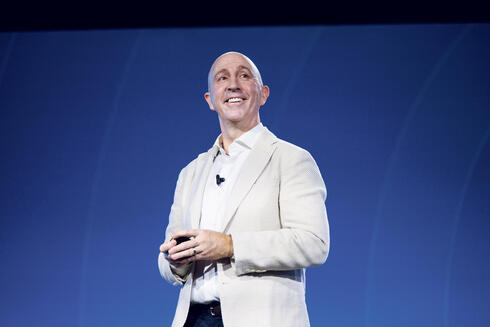
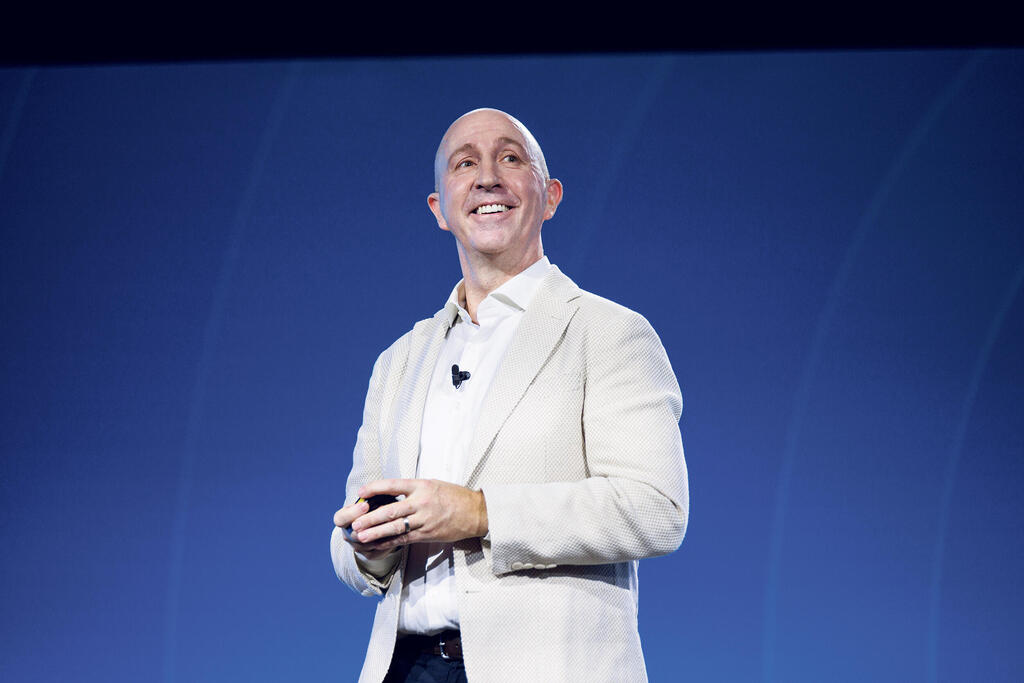
Scott Russell is an excellent salesman. Polished, well-prepared, smiling, and even cordial in his approach. But there is one thing the CEO of Nice has been unable to sell, despite his best efforts: reassurance for investors.
Since taking over as CEO of the software company a year and a half ago, Russell has had little peace, and neither has the company's stock. In 2025, Nice was the only company in the Tel Aviv 35 Index to end the year with a negative return. It fared little better on Wall Street, where its shares fell 33% even as the major U.S. indices reached new highs. Incidentally, Russell received compensation worth $12 million that year, making him one of the highest-paid executives among Tel Aviv-listed companies.
Since the beginning of 2026, Nice shares have fallen "only" another 12%. As a result, what was once one of Israel's largest technology companies, with a market capitalization of $20 billion at its peak, is now worth less than $6 billion, placing it near the bottom of the Tel Aviv 35 Index by market value.
Interview with Soctt Russell


The irony, or even the absurdity, from Russell's perspective, is that Nice remains one of Israel's largest companies in terms of both revenue and profitability, and one of the world's leading providers of customer service software. The company is expected to generate more than $3 billion in annual revenue for the first time in its history should it continue to grow by 10%, but operating profit is set to drop by a dollar to $11 per share, despite an aggressive repurchasing of shares. Nice serves 25,000 customers worldwide with its customer experience and contact center software, and 85% of the Fortune 500 use its products. Its customer base spans industries and geographies and includes companies such as Marriott, Lidl, Lufthansa, and Disney.
Scott Russell, why aren't investors buying into your vision? Customers continue to buy your products, yet the capital market, which is supposed to represent the ultimate wisdom of crowds, remains unconvinced.
"I can't comment on what investors see or don't see, but for me the narrative in the markets is background noise. My job is to deliver results, and we are accelerating growth, raising our guidance, and meeting our targets. Over the last three quarters, our bookings have reached record levels, and our order backlog has continued to grow. I believe that's what will ultimately matter.
"What I know is what our customers see, and what we see, which is an exceptional market opportunity. To investors in Tel Aviv, I can assure them that we will deliver. The results will be strong and consistent, and they can expect exciting times ahead. Over time, sentiment will catch up with reality," Russell says in his first interview since taking office. The interview was conducted at Nice's annual customer event in London.
A similar event was held a few weeks earlier in Orlando, Florida, for the company's U.S. customers. Thousands of representatives from many of the world's largest companies filled the exhibition halls and conference rooms, where Russell and other Nice executives demonstrated how customers can maximize the value of the company's products while introducing new AI capabilities.
The narrative Russell refers to is what some investors have dubbed the "SaaS apocalypse", the fear that traditional enterprise software will be replaced by internally developed AI agents, particularly among smaller customers, while AI giants move into the broader CRM and customer service software market.
Nice has become one of the clearest victims of this sentiment. Customers continue to buy its products, but investors worry that, in the future, enterprises will no longer be willing to pay millions of dollars annually for enterprise software subscriptions. These concerns extend well beyond Nice and affect much larger software companies, including Salesforce. Investors fear that the traditional SaaS model, charging subscriptions based on the number of employees using the software, is under threat, as organizations increasingly build AI-powered solutions internally.
"What customers understand, but investors, in my opinion, still don't, is that building an AI agent is easy. Getting it to work reliably at enterprise scale is the real challenge," Russell says, dismissing those concerns.
"What happens in a customer service center when thousands of customers suddenly contact the company at once? Will the AI agent hold up? These technologies are impressive, but in many cases they're still best suited for pilot projects. Large, established software companies like Nice can leverage four decades of accumulated expertise to make AI truly enterprise-ready."
What further weighed on Nice's shares, which had already begun declining before AI disrupted the software sector, was the departure of former CEO Barak Eilam.
Eilam, who joined Nice as an engineer and rose through the ranks to become CEO, transformed what had once been viewed as a mature software company by successfully leading its transition to the cloud. His decision to step down at the end of 2024 was widely interpreted as leaving at the peak, after completing one major transformation rather than embarking on another battle to reinvent the company in the AI era.
Eilam, with his Israeli accent and understated style, was highly respected by institutional investors in Israel, where more than half of Nice's trading volume is concentrated. Over time, investors in New York also came to appreciate what many viewed as a rare combination of technological depth and managerial ability.
Russell, 53, originally from Australia, studied information systems but spent most of his career in operations and sales. He began at PwC before spending a decade at IBM and roughly 15 years at SAP, where he rose to become Chief Revenue Officer. Although his Australian accent remains noticeable, he has lived in the United States for years. Since becoming CEO of Nice, he has relocated to Dallas, Texas, which he says allows him to work more effectively with customers across global time zones. Nice's corporate headquarters, meanwhile, are located in Hoboken, New Jersey, while a large development center remains in Ra'anana.
Many viewed Barak Eilam's departure as reflecting an unwillingness to navigate another industry transformation after leading the company through the cloud revolution and the pandemic. Others argued that Nice was too slow in responding to AI compared with some competitors. What do you think was your predecessor's biggest mistake?
"I don't look at the past through the lens of mistakes. You can only learn from it. My predecessor built a platform for growth, and my role is to build on the assets, history, and culture that Nice has accumulated. The company has data from more than 25 billion transactions, and that knowledge can now be applied to the AI era."
It is, naturally, a diplomatically phrased answer. But comparing Nice's leadership team at the end of 2024 with today's reveals that it has changed dramatically.
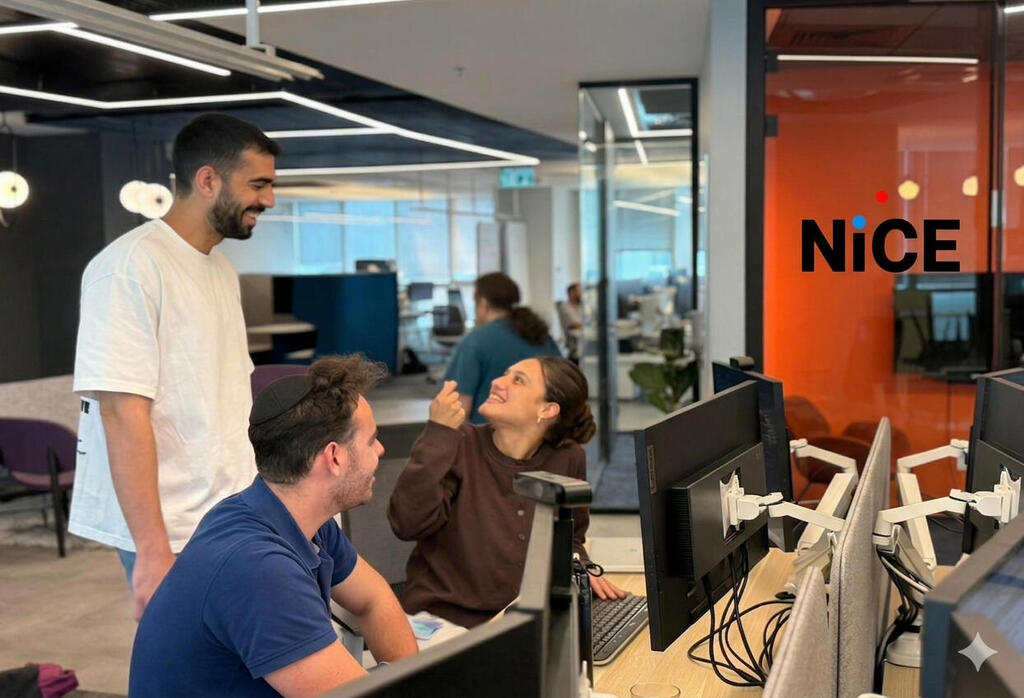
The only senior executive who has remained since Eilam's tenure is CFO Shiri Neder. The company is increasingly managed as a global organization, with Israel accounting for only about 10% of its workforce despite still housing a significant R&D center and remaining listed on the Tel Aviv Stock Exchange.
In recent years, Nice appears to have increasingly downplayed, or perhaps deliberately distanced itself from, its Israeli roots.
Walking through the exhibition floor in London, where employees demonstrated the company's products to customers, very few of the presenters were from Israel.
Even during Russell's on-stage conversation with actress Kristin Bell, Nice's newest brand ambassador, there was no acknowledgment of the company's Israeli origins. Bell, best known recently for the Netflix series Nobody Wants This, in which her secular Christian character dates a Reform rabbi, creating numerous cultural and family tensions, discussed the show as well as her role as the voice of Anna in Frozen. Yet Russell carefully avoided any mention of Judaism or the Jewish themes that play such a central role in the series. The conversation remained firmly focused on entertainment rather than identity.
What was the most difficult thing about moving from a senior position at a huge international conglomerate like SAP to managing Nice, a company that is smaller in global terms and has Israeli roots and culture?
"As someone who has lived outside Australia, where I was born, for 25 years, I consider myself a true global citizen. Part of that means working across different cultures and business dynamics. That's what I've done throughout my career. What is impressive and different about Nice is the speed at which things move. When I decided to bet on AI, the entire company mobilized at record speed. In today's environment, where technological change is happening faster than ever and uncertainty is high, speed and agility are critical."
But since you took office, you have replaced almost all of Nice's senior management. Why?
"I brought in people who can add tremendous value to the company and who come with deep expertise in AI and CRM. Arun Chandra, who joined as Chief Operating Officer, spent many years at Disney and Meta and has a deep understanding of the customer perspective. He knows how to help customers get the most out of Nice's products. Jeff Comstock came from Microsoft, where he led its CRM business, one of Nice's competitors that has significantly stepped up competition over the past year with AI-powered offerings. The third addition is Phil Heltewig, one of the three founders and former CEO of Cognigy, which we acquired last year for $1 billion. He now serves as our Chief AI Officer. This wasn't about replacing people, it was about bringing in the capabilities we need for the future."
Heltewig has become one of Nice's most strategic hires. He appears on stage at company conferences even more frequently than Russell, underscoring Nice's determination to demonstrate that its AI strategy is substantive rather than merely following industry trends. The acquisition of Cognigy was a lightning-fast move that Russell completed just six months after becoming CEO, possibly helped by the fact that he already knew Heltewig, an Australian-German executive who had also previously worked at SAP.
The goal is to integrate AI-powered voice capabilities into customer service operations and bring traditional customer relationship management systems into the era of AI agents. Instead of exhausted customer service representatives handling endless complaints about blocked credit cards or canceled flights, AI agents can manage routine interactions while sounding increasingly human and never becoming tired or frustrated. Nice's customers can now operate with far fewer human representatives by adopting a hybrid model: AI agents resolve the majority of customer issues, while more complex interactions, such as those involving high-value transactions or emotionally charged situations, are escalated to human representatives. Those representatives can approve AI-generated recommendations, refine responses to make them more empathetic, or step in directly when needed.
"Our customers no longer have to build call scripts. There are no longer long waits before reaching a representative, even if a thousand customers call the contact center simultaneously. We're seeing consumers return to voice interactions because they want quick solutions and don't have the patience for endless menus or messaging back and forth.
"We saw this during a Lufthansa strike, when thousands of flights were canceled. Our AI proactively contacted affected passengers, sometimes before they even knew their flight had been canceled, rebooked them on alternative flights, updated hotel reservations when necessary, and arranged refunds for those who couldn't be accommodated. That prevented the usual scenario in which every passenger calls at once and overwhelms the contact center," Russell says, describing a situation familiar to Israeli travelers who have experienced similar disruptions with El Al.
This vision of combining AI agents with human representatives gained further validation just weeks ago when Salesforce, one of Nice's biggest competitors, announced its $3.6 billion acquisition of FIN, a company with a similar focus but larger than Cognigy in terms of revenue. Another Cognigy competitor attracting significant investor attention is Israeli startup Wonderful, which has been raising capital rapidly and was valued at $2 billion just a few months ago.
There is, however, an important caveat. While the technology is increasingly available, successfully deploying AI agents and extracting maximum value from them requires customers to adopt the technology and rethink their workflows, not just spend money. For example, companies such as Wonderful employ AI specialists who work directly with customers in a model known as Forward Deployed Engineering (FDE). If this becomes the industry's dominant approach, Nice could face pressure on its profitability, something investors have already begun to notice in recent quarters.
Cognigy itself, despite operating for more than a decade and serving many companies similar to Nice as an AI layer, had reached an annual recurring revenue run rate of only about $85 million before the acquisition. Interestingly, Heltewig revealed at the conference that Cognigy's products continue to be sold to Nice's competitors as well as directly to Nice customers seeking additional AI capabilities.
Since completing the Cognigy acquisition, we've seen some erosion in Nice's profitability. Is this a trend that will deepen as AI becomes a larger part of the business?
"We invested heavily in Cognigy during the first half of 2026, integrating it into the core platform and expanding its sales and marketing operations. However, we're already ahead of schedule and are seeing an improvement in our profitability outlook for 2026. I'm confident that operating margins will improve over time, perhaps even faster than we originally expected."
Another concern among investors is the shift in software pricing from per-user subscriptions to consumption-based AI pricing. How significant is this trend for Nice?
"Since launching our AI capabilities, much of our pricing has already been consumption-based, accounting for 14% of cloud revenue in the first quarter. Most new contracts combine both models. When a case is handled by a human representative, billing remains per user. We also have agreements based on the output generated by our AI solutions for customers. The market is still figuring out the optimal pricing model, one that provides predictability for both customers and vendors."
Following the Cognigy acquisition, Nice's cash balance fell to about $300 million. How do you plan to strengthen the balance sheet? And where does the planned sale of the Actimize financial crime division, reportedly valued at around $2 billion, stand?
"Nice generates tremendous amounts of cash. Our cash flow is very strong and more than sufficient for our operational needs. We don't need cash, and that's not why we're considering selling Actimize. I want to be transparent: we're still evaluating our options, and no decision has been made. We always look at acquisition opportunities as well, but after Cognigy, the core platform is largely complete. If we pursue additional acquisitions, they will likely be smaller, complementary ones."
If Nice succeeds in selling Actimize, which it acquired roughly 20 years ago for $280 million, for around $2 billion, it would further underscore how low the company's current valuation has become. Even assigning Cognigy only the $1 billion that Nice paid for it, rather than the higher valuations private investors have given comparable companies, implies that the market is attributing surprisingly little value to Nice's core business.
Will Nice carry out layoffs, either to improve profitability, to follow the broader AI-driven trend across the software industry, or simply to reassure investors?
"Of course we're using AI extensively, but our plan is to grow, not shrink. We have no plans to reduce headcount. AI takes over repetitive, routine work, allowing employees to focus on higher-value tasks. Interestingly, we're not seeing customers reduce the number of human representatives as much as many expected. Instead, those employees are handling significantly larger workloads, enabling our customers to generate more revenue."
And what about Nice's Israeli operations, which currently employ about 1,000 people, roughly 10% of the company's global workforce? To what extent does the strong shekel influence your decisions about expanding or reducing operations there?
"Our Israeli center is one of our competitive advantages. Israel has tremendous expertise in CRM and software development more broadly. If anything, you'll see us continue expanding our R&D operations there. The strength of the shekel is a short-term issue and does not influence our long-term investment decisions. We have no plans to reduce our workforce in Israel."
First published: 19:30, 08.07.26



