










While some tech giants cut jobs, Palo Alto Networks and Nvidia are hiring hundreds in Israel
AI isn't eliminating engineering jobs at two of the industry's biggest winners, but it is fundamentally changing the skills they expect from candidates.
While much of the global technology industry continues to announce layoffs, two of the world's biggest winners from the artificial intelligence boom are still hiring aggressively in Israel.
Palo Alto Networks and Nvidia Israel continue to recruit hundreds of engineers and researchers even as thousands of technology workers lose their jobs elsewhere. But executives at both companies say the AI revolution is fundamentally changing the type of talent they seek, the skills engineers need, and even the definition of traditional technology roles.
Rather than reducing demand for engineers, they argue, AI is shifting where that demand lies. The companies are looking for developers who can work alongside AI systems, critically evaluate AI-generated output, and adapt continuously as new tools emerge.
4 View gallery
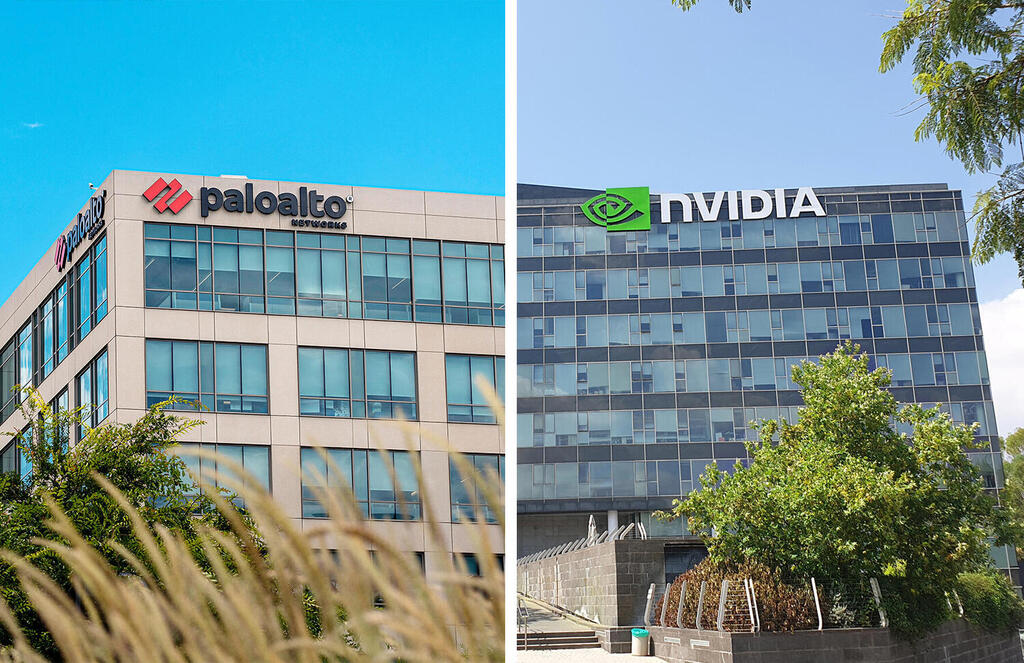
NVIDIA offices in Yokneam (right), Palo Alto offices in Santa Clara, California
(David Paul Morris/Bloomberg)
"The problems we need to solve haven't disappeared, in fact, AI has created entirely new ones," says Galia Eckstein, Head of People at Palo Alto Networks in Israel.
"AI can replace certain standalone software capabilities, forcing companies to rethink their business models and become more efficient. But it is also creating entirely new cyber threats that require new approaches to security, monitoring, threat detection and real-time response."
Israel has become one of Palo Alto Networks' largest development hubs, a position strengthened further by its acquisition of CyberArk.
"We're in a period of significant growth," Eckstein says. "We're continuing to expand our engineering organization, and today we have more than 200 open positions across multiple disciplines."
Around 75% of those roles are in software development, with additional hiring across cyber research, product management and DevOps.
"The AI revolution is naturally changing our products," she says. "Like every technology company, we're going through this transformation ourselves. But we still have a tremendous amount to build, and we need outstanding people who can help us develop the next generation of security technologies while making intelligent use of AI."
The biggest change, Eckstein says, is not necessarily technical knowledge but adaptability.
"There are always early adopters, people who immediately embrace new technologies, and there are others who take longer," she says. "Today, that has become part of our hiring process. We want to understand not only what candidates know today, but how quickly they learn."
Employees are expected to use both commercial AI tools and internal systems developed by Palo Alto Networks.
"We're interested in people who are naturally curious and willing to experiment."
Are you looking for qualities that weren't required before the AI revolution?
"It's still too early to say there's a single playbook," Eckstein says. "We're all learning as the technology evolves.
"What hasn't changed is the need for deep engineering knowledge. Candidates still need to understand architecture, infrastructure and how products are built. But they also need to know how to work effectively with AI systems, how to write good prompts, evaluate AI-generated results and integrate these tools into their workflow.
"The emphasis has shifted. Technical depth is still essential, but now we also value people's ability to adapt to a rapidly changing technological environment."

Ori Kotler, Senior Vice President of Engineering at Palo Alto Networks, says AI literacy has quickly become a competitive advantage.
"Developers who treat AI as a natural part of the way they work already have an advantage," he says.
"Understanding AI isn't enough. You need the judgment to review what AI produces, identify mistakes and improve the output. Those critical thinking skills are becoming increasingly important."
Beyond hiring engineers, Palo Alto is also looking for what Kotler calls "technology influencers."
"We're looking for people who can drive change inside the organization, people with genuine passion for AI, deep technical understanding and the ability to spread knowledge and motivate others."
Are there roles you're no longer recruiting for?
"There are certainly tasks that AI can now perform almost entirely on its own," Eckstein says.
"That allows employees to focus on more strategic and complex work."
Quality assurance is one example.
"In the past, developers typically handed code over to dedicated QA teams. Today they're increasingly expected to take responsibility for testing their own software using AI-assisted tools and automated testing platforms.
"That doesn't necessarily eliminate QA, but it changes the role dramatically. QA professionals need broader technical skills, including software development and the ability to work with AI."
The transformation, she says, extends far beyond engineering.
"Everyone has to keep learning now."
"I've worked in human resources for 22 years, and I also have to learn how to build AI agents and rethink how I do my own job.
"If you're not learning continuously today, that's a problem."

"We're all under pressure"
The pace of change, however, is creating anxiety alongside excitement.
"It's our responsibility as employers to provide the tools and the environment that allow people to learn," Eckstein says.
"But that's not always easy. Everyone is busy delivering products while simultaneously trying to master an entirely new set of technologies.
"That naturally creates stress."
Do you actually see that stress among employees?
"We don't see elevated stress levels in our employee surveys," she says. "But we certainly hear very different reactions.
"Some people are anxious. Others are incredibly excited."
She recalls speaking with a software developer returning from maternity leave after six months away.
"I asked her what it was like to come back after everything had changed so quickly.
"She told me she was actually excited because writing code had never been her favorite part of the job. What she really enjoys is understanding the product, designing solutions and thinking strategically.
"For people like her, AI is fantastic because it automates some of the work they enjoyed least."
For others, the transition is more difficult.
"If someone's professional identity was built around being exceptionally good at writing code, and AI suddenly changes that equation, it's understandable that they'll experience uncertainty.
"Everyone now has to ask themselves a new question: What unique value do I bring?
"That's true not just for engineers, but for all professions."
AI is also creating entirely new positions inside Palo Alto Networks.
Among them are AI-focused data scientists, engineers specializing in AI systems, and employees working in the company's AI Transformation initiative, which develops internal AI tools and trains staff to use them effectively.
Despite the industry's focus on experienced AI talent, Palo Alto continues to invest heavily in university graduates.
"We've had a graduate hiring program for five years," Eckstein says.
"It's important to us to recruit talented people directly from academia, including those who didn't serve in elite military technology units."
The company hires between 30 and 60 graduates annually.
"This year alone we've recruited more than 40 junior engineers in Tel Aviv."
CyberArk's former Idaptive division, now part of Palo Alto Networks, hired another 35 junior developers for its Petah Tikva and Be'er Sheva sites, where recruits begin with an intensive boot camp before joining engineering teams.
"In Tel Aviv, graduates join teams immediately as full-time employees," Eckstein says.
"We provide training, mentoring and a strong community around them."
The approach appears to be paying off.
"Most are promoted within their first year, and our retention rate is around 90%. Some of those graduates are already leading engineering teams."
Nvidia: "AI isn't reducing hiring, it's changing what we hire for"
Few companies have benefited more from the artificial intelligence boom than Nvidia. Its Israeli development center, built around the 2020 acquisition of Mellanox, has become one of the company's most important engineering hubs, employing more than 6,000 people across five sites.
Despite widespread layoffs across the technology sector, Nvidia Israel is continuing to expand aggressively.
"We currently have more than 430 open positions in Israel," says Yael Aviram Rosenfeld, Recruitment Director at Nvidia Israel.
"Our development center is based on the acquisition of Mellanox, whose high-speed networking technology became a critical component of modern AI infrastructure. Nvidia didn't just build the GPU that powers AI, it also built the networking technology that allows AI systems to communicate across entire data centers. That's one of the reasons we've reached where we are today."
Most of Nvidia's open roles are in engineering.
"The majority of our hiring is in hardware and software engineering," she says. "We're recruiting chip designers, architects, networking engineers, cybersecurity specialists, AI researchers and software developers."
The company is hiring across all levels, from students and recent graduates to senior engineers and managers.
Has the AI revolution changed the types of people you're looking for?
"Without question," Aviram Rosenfeld says.
"We're seeing entirely new specializations emerge around artificial intelligence."
These include AI researchers, engineers integrating AI into development processes, and cybersecurity researchers specializing in AI-related threats.
At the same time, AI's rapid growth is increasing demand for engineers who can bridge research and manufacturing.
"We're also seeing growing demand for Product Engineering roles, engineers who connect product development with the large-scale manufacturing of advanced chips and systems while ensuring quality and reliability."
The expectation, she says, extends beyond AI specialists.
"Anyone pursuing a career in engineering today should become deeply familiar with AI technologies.
"This field evolves at an extraordinary pace. New capabilities appear constantly, so continuous learning has become essential."
Are there roles that are no longer relevant?
"There hasn't been a fundamental change in the types of roles we recruit for," Aviram Rosenfeld says.
"We continue to expand our activities across many areas.
"What has changed is the nature of those roles. The skills required are evolving continuously, particularly as AI becomes integrated into more aspects of engineering work."
Rather than replacing employees, AI is becoming another engineering tool.
"We provide employees with access to the world's most advanced AI technologies and expect them to use them intelligently, responsibly and effectively.
"Ultimately, every engineer remains responsible for the products they build."
Training has therefore become a core part of the company's strategy.
"We invest heavily in helping employees learn how to use AI effectively through dedicated training programs and learning resources."
Like Palo Alto Networks, Nvidia continues to recruit heavily from universities.
"Every year, hundreds of employees join us at the beginning of their careers," Aviram Rosenfeld says.
"They immediately become part of teams designing the technologies driving today's AI revolution."
Many remain at Nvidia after graduation.
"A large number of our managers actually began their careers here as students or junior engineers."
Three pieces of advice for anyone looking for a tech job
After years of recruiting engineers, Aviram Rosenfeld believes the rules for succeeding in today's market are changing rapidly.
Her first recommendation is straightforward.
"Become familiar with the AI technologies available today and understand how they affect your profession."
That applies to both technical and non-technical roles.
"In every job, employers increasingly expect candidates to know these tools and demonstrate how they use them to improve productivity."
Her second recommendation is to prepare more carefully for interviews.
"Practice with friends or family members, or even record yourself.
"You should be able to explain your experience, achievements and technical skills clearly, concisely and in a way that's relevant to the position."
Finally, she emphasizes the importance of professional networks.
"It starts with maintaining an up-to-date LinkedIn profile, but it also includes participating in professional communities, WhatsApp groups, conferences and industry events."
Equally important, she says, is staying connected with former colleagues and classmates.
"A strong professional network is one of the most valuable assets you can build over the course of your career."



